Belleric Myrobalan Fruit
- Chinese
- 毛诃子
- Pinyin
- Mao He Zi
- Latin
- Fructus Terminaliae Billericae
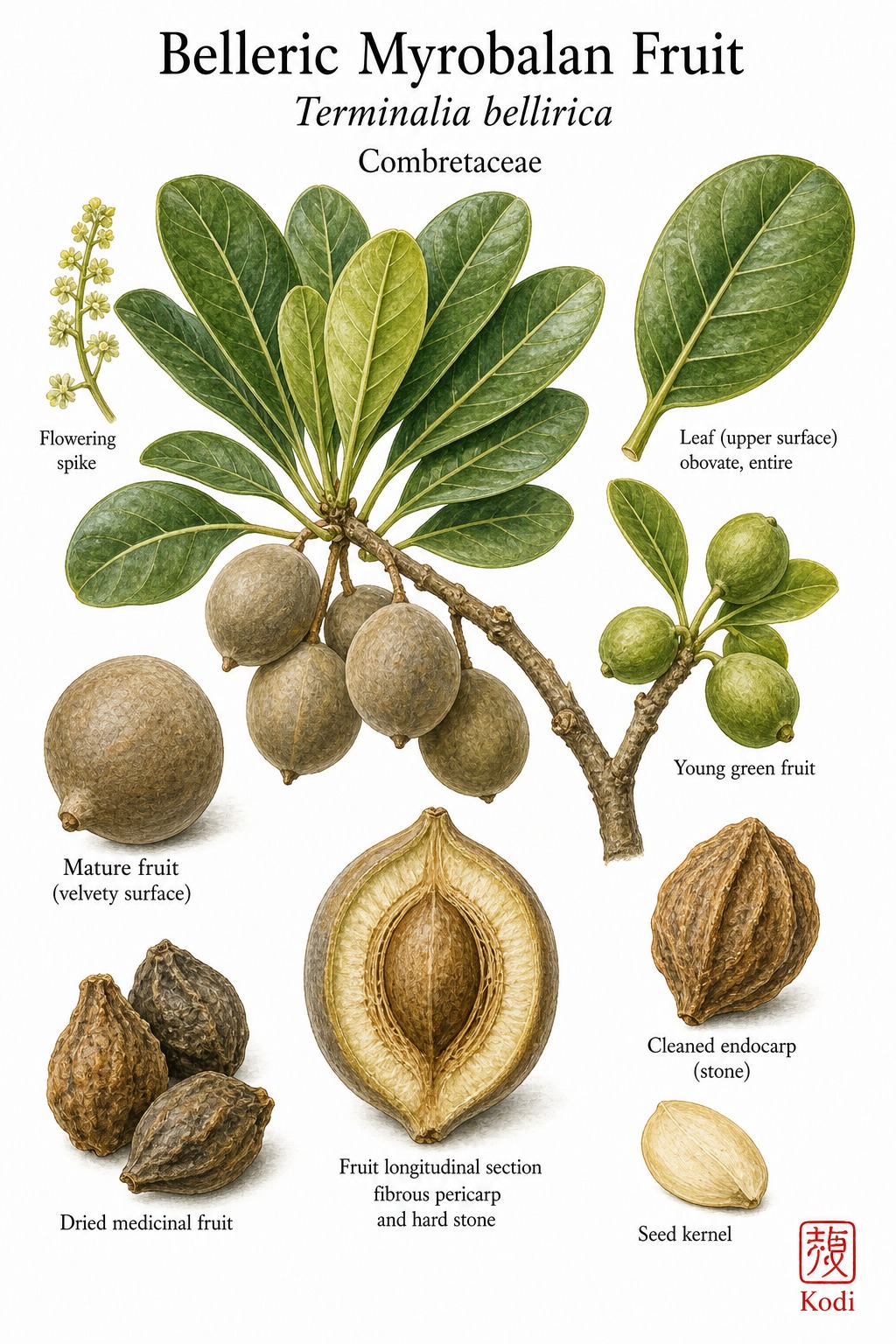
Known in TCM as Mao He Zi (毛诃子). Traditionally, it clears heat and removes toxicity - regional materia medica uses Mao He Zi for lingering heat syndromes and toxic disorders, most often applied for diarrhea, hepatitis, and fatigue. Modern research has identified Gallic among its active constituents.
Part used: Fruit
Also Known As
Latin: Fructus Terminaliae Billericae | Pinyin: Mao He Zi | Chinese: 毛诃子
TCM Properties
- Taste
- sweet, astringent
- Temperature
- neutral
Traditional Use
Primary Actions
- Clears heat and removes toxicity - regional materia medica uses Mao He Zi for lingering heat syndromes and toxic disorders.
- Astrings and supports recovery after leakage or weakness - the fruit is used when chronic diarrhea or depletion after illness calls for a gentle binding action.
- Harmonizes the properties of companion herbs - traditional descriptions treat it as a moderating ingredient in compound prescriptions rather than only as a strong stand-alone drug.
Secondary Actions
- Mao He Zi is a regional medicinal distinct from the better-known He Zi of Terminalia chebula, even though both belong to the Terminalia group.
- Its usage is more prominent in Tibetan, Mongolian, and border-region practice than in the best-known Han formula canons.
Classic Formulas
- Regional Tibetan and Mongolian formula lineages use Mao He Zi for chronic diarrhea, hepatobiliary discomfort, weakness after illness, and heat-toxin presentations.
Classical References
- TCM Wiki describes Mao He Zi as sweet, astringent, and neutral, used to clear heat, remove toxicity, astringe, and harmonize the properties of medicine.
- Traditional use notes place Mao He Zi more in regional materia medica traditions than in the mainstream single-herb repertoires familiar to most modern TCM students.
Modern Research
Active Compounds
- Gallic acid - a major phenolic constituent associated with antioxidant activity
- Ellagic acid - polyphenolic compound widely discussed in Terminalia bellirica research
- Chebulagic and related tannins - astringent polyphenols central to the fruit's chemistry
- Broad tannin-rich polyphenol fractions - often treated as the main active matrix in modern studies
Studied Effects
- Terminalia bellirica fruit extract protected rodents from carbon-tetrachloride-induced liver injury, supporting ongoing interest in hepatoprotective effects (PMID 31092988).
- Fruit extracts showed antibacterial and radical-scavenging activity against multidrug-resistant organisms in vitro, consistent with the plant's polyphenol-rich chemistry (PMID 30526562).
- Terminalia bellirica tannins reduced injury markers in a rat model of high-altitude pulmonary hypertension via Nrf2/HO-1 signaling, illustrating broader anti-inflammatory and vascular research interest (PMID 37149589).
PubMed References
- Protective Role of Terminalia bellirica (Gaertn.) Roxb Fruits Against CCl4 Induced Oxidative Stress and Liver Injury in Rodent Model. (2019)
- Terminalia bellirica fruit extracts: in-vitro antibacterial activity against selected multidrug-resistant bacteria, radical scavenging activity and cytotoxicity study on BHK-21 cells. (2018)
- Protective effects of the Terminalia bellirica tannin-induced Nrf2/HO-1 signaling pathway in rats with high-altitude pulmonary hypertension. (2023)
Safety & Interactions
Contraindications
- Patterns that still require venting or purging rather than astringing
- Marked constipation or severe dryness without a true leakage component
Cautions
- Modern research usually concerns Terminalia bellirica as a polyphenol-rich fruit and does not always map neatly onto Mao He Zi as a specific TCM record.
- Astringent fruits can trap pathogens if used too early in unresolved infectious or heat-excess presentations.
- MSK page not found - drug interaction data not available from Memorial Sloan Kettering integrative medicine database
Conditions
Frequently Asked Questions
What is Belleric Myrobalan Fruit used for?
Belleric Myrobalan Fruit is traditionally used to Clears heat and removes toxicity - regional materia medica uses Mao He Zi for lingering heat syndromes and toxic disorders., Astrings and supports recovery after leakage or weakness - the fruit is used when chronic diarrhea or depletion after illness calls for a gentle binding action., Harmonizes the properties of companion herbs - traditional descriptions treat it as a moderating ingredient in compound prescriptions rather than only as a strong stand-alone drug.. Research has investigated its effects on: Terminalia bellirica fruit extract protected rodents from carbon-tetrachloride-induced liver injury, supporting ongoing interest in hepatoprotective effects (PMID 31092988).; Fruit extracts showed antibacterial and radical-scavenging activity against multidrug-resistant organisms in vitro, consistent with the plant's polyphenol-rich chemistry (PMID 30526562)..
What are other names for Belleric Myrobalan Fruit?
Belleric Myrobalan Fruit is also known as Terminalia. In TCM: 毛诃子 (Mao He Zi); Fructus Terminaliae Billericae.
Is Belleric Myrobalan Fruit safe during pregnancy?
The safety of Belleric Myrobalan Fruit during pregnancy has not been established. Consult a qualified healthcare provider before use.
What are the contraindications for Belleric Myrobalan Fruit?
Belleric Myrobalan Fruit should not be used in: Patterns that still require venting or purging rather than astringing; Marked constipation or severe dryness without a true leakage component. Consult a qualified healthcare provider before use.