Fried Pangolin Scales
- Chinese
- 炒山甲
- Pinyin
- Chao Shan Jia
- Latin
- Squama Manitis
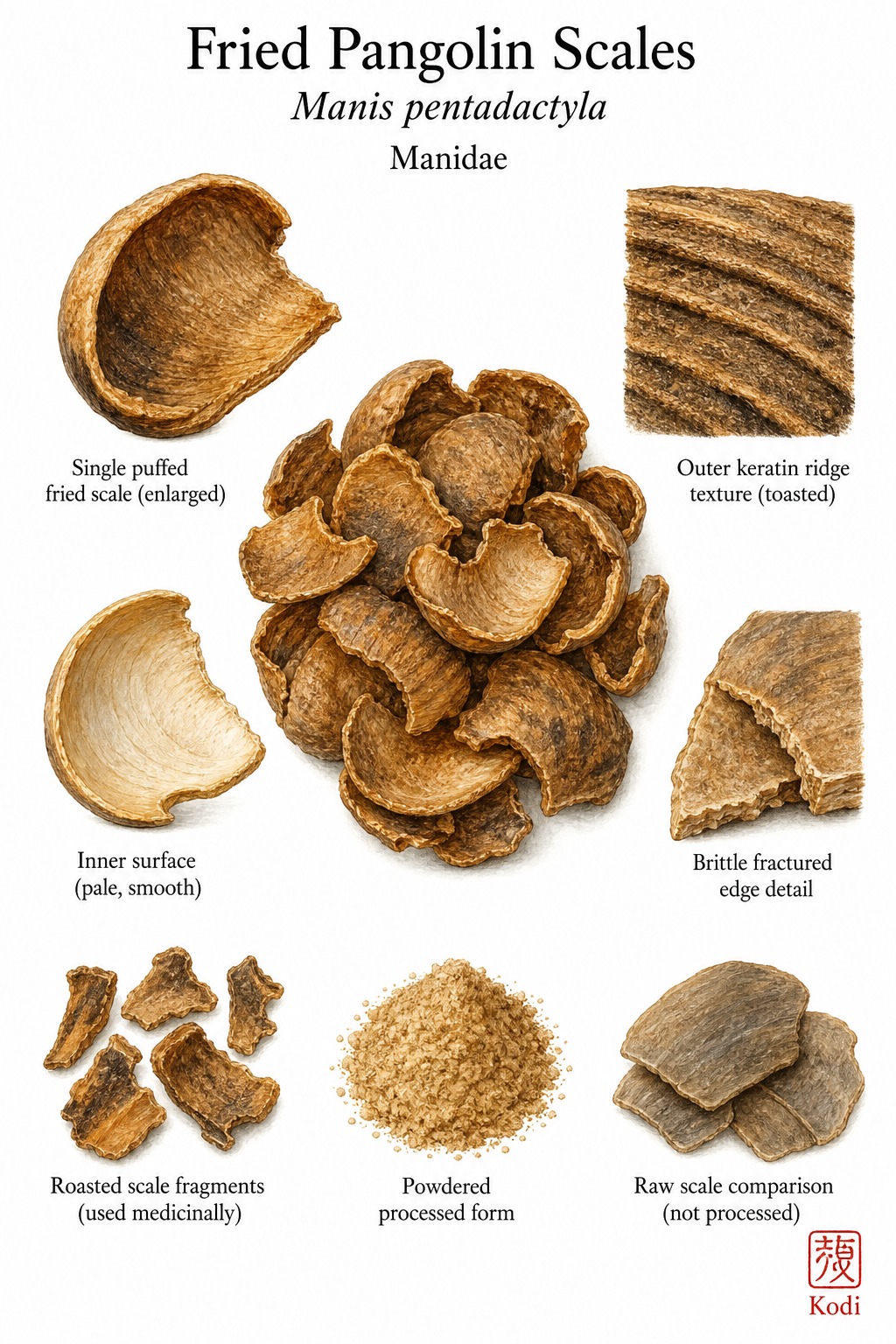
Known in TCM as Chao Shan Jia (炒山甲), this salty, slightly cold herb enters the Liver and Stomach. Traditionally, it activates blood and unblocks the channels - Chao Shan Jia is the stir-fried form historically used for amenorrhea, masses, traumatic blood stasis, and fixed obstruction in the collaterals, most often applied for insufficient lactation, mastitis, and amenorrhea. Modern research has identified Keratin among its active constituents.
Part used: Scale
Also Known As
Latin: Squama Manitis | Pinyin: Chao Shan Jia | Chinese: 炒山甲
TCM Properties
- Taste
- salty
- Temperature
- slightly cold
- Channels
- Liver, Stomach
Traditional Use
Primary Actions
- Activates blood and unblocks the channels - Chao Shan Jia is the stir-fried form historically used for amenorrhea, masses, traumatic blood stasis, and fixed obstruction in the collaterals.
- Promotes lactation and opens the breasts - it was classically prescribed for post-partum milk insufficiency caused by obstruction rather than by simple deficiency alone.
- Reduces swelling and expels pus - traditional use includes unruptured abscesses, carbuncles, mastitis, and other hard swellings that need suppuration.
Secondary Actions
- Stir-frying made the scales more brittle and easier to powder, but the medicinal intent remained fundamentally similar to Chuan Shan Jia.
- Modern handling is governed by conservation law and ethics rather than materia medica theory alone because pangolin-derived medicinals are banned and critically endangered.
Classic Formulas
- Tong Ru Dan - lactation-opening formula that historically paired pangolin scales with Wang Bu Liu Xing and other breast-channel medicinals.
- Tou Nong San - abscess formula lineage using pangolin scales to promote suppuration and drainage.
- Xian Fang Huo Ming Yin - classical swelling and abscess formula family in which pangolin scales historically served as a strong channel-opening ingredient.
Classical References
- TCM Wiki and related materia medica sources describe Chuan Shan Jia and its processed forms as salty and slightly cold, entering the Liver and Stomach to move blood, unblock the channels, promote lactation, and expel pus.
- Modern educational materia medica sources note that pangolin scales were removed from the Chinese Pharmacopoeia in 2020 and are prohibited under wildlife-protection law and CITES controls.
Modern Research
Active Compounds
- Keratin - the dominant structural protein of pangolin scales
- Cyclic dipeptides - small constituents discussed in limited anti-inflammatory screening work
- Fatty acids such as stearic and palmitic acid - minor non-keratin fractions identified in older analyses
- Trace minerals - source-dependent constituents more relevant to composition analysis than to validated therapeutic use
Studied Effects
- Modern evidence remains low quality and ethically constrained; a systematic review concluded that historical clinical literature on Squama Manitis is limited and methodologically weak.
- Experimental reports describe anti-inflammatory and prolactin-related effects in laboratory settings, but conservation concerns now make substitute research more appropriate than renewed use of animal-derived material.
- Because authentic pangolin scales cannot be legally sourced, current scientific relevance centers on conservation, fraud detection, and substitution rather than on clinical development.
Safety & Interactions
Contraindications
- Pregnancy - strong blood-moving action and miscarriage risk
- Active bleeding or severe deficiency without blood stasis
- Any attempted clinical use of genuine pangolin material because it is a banned wildlife medicinal
Cautions
- Pangolin-derived medicinals are illegal or ethically unacceptable in modern practice; any commercial product claiming to contain genuine material should be treated as fraudulent or unlawful.
- Traditional substitutes are used instead, including Wang Bu Liu Xing for lactation and Zao Jiao Ci or other plant medicinals for swelling and suppuration.
- Historical oral use involved very small processed doses; this is not a safe self-care material.
Drug Interactions
- Anticoagulants or antiplatelet drugs - additive bleeding risk with a strong blood-moving medicinal
- NSAIDs - possible additive bleeding or irritant effects in historical internal-use contexts
Conditions
- Insufficient Lactation Traditional ★★★★☆ JSON
- Mastitis Traditional ★★★★☆ JSON
- Amenorrhea Traditional ★★★☆☆ JSON
- Carbuncle Traditional ★★★☆☆ JSON
Frequently Asked Questions
What is Fried Pangolin Scales used for?
Fried Pangolin Scales is traditionally used to Activates blood and unblocks the channels - Chao Shan Jia is the stir-fried form historically used for amenorrhea, masses, traumatic blood stasis, and fixed obstruction in the collaterals., Promotes lactation and opens the breasts - it was classically prescribed for post-partum milk insufficiency caused by obstruction rather than by simple deficiency alone., Reduces swelling and expels pus - traditional use includes unruptured abscesses, carbuncles, mastitis, and other hard swellings that need suppuration.. Research has investigated its effects on: Modern evidence remains low quality and ethically constrained; a systematic review concluded that historical clinical literature on Squama Manitis is limited and methodologically weak.; Experimental reports describe anti-inflammatory and prolactin-related effects in laboratory settings, but conservation concerns now make substitute research more appropriate than renewed use of animal-derived material..
What are other names for Fried Pangolin Scales?
Fried Pangolin Scales is also known as Manitis. In TCM: 炒山甲 (Chao Shan Jia); Squama Manitis.
Is Fried Pangolin Scales safe during pregnancy?
Fried Pangolin Scales is not recommended during pregnancy.
What are the contraindications for Fried Pangolin Scales?
Fried Pangolin Scales should not be used in: Pregnancy - strong blood-moving action and miscarriage risk; Active bleeding or severe deficiency without blood stasis; Any attempted clinical use of genuine pangolin material because it is a banned wildlife medicinal. Consult a qualified healthcare provider before use.
Does Fried Pangolin Scales interact with any medications?
Fried Pangolin Scales may interact with: Anticoagulants or antiplatelet drugs - additive bleeding risk with a strong blood-moving medicinal; NSAIDs - possible additive bleeding or irritant effects in historical internal-use contexts. Always inform your healthcare provider of any herbal supplements you are taking.