Fresh Soybean
- Chinese
- 新豉
- Pinyin
- Xin Chi
- Latin
- Semen Sojae
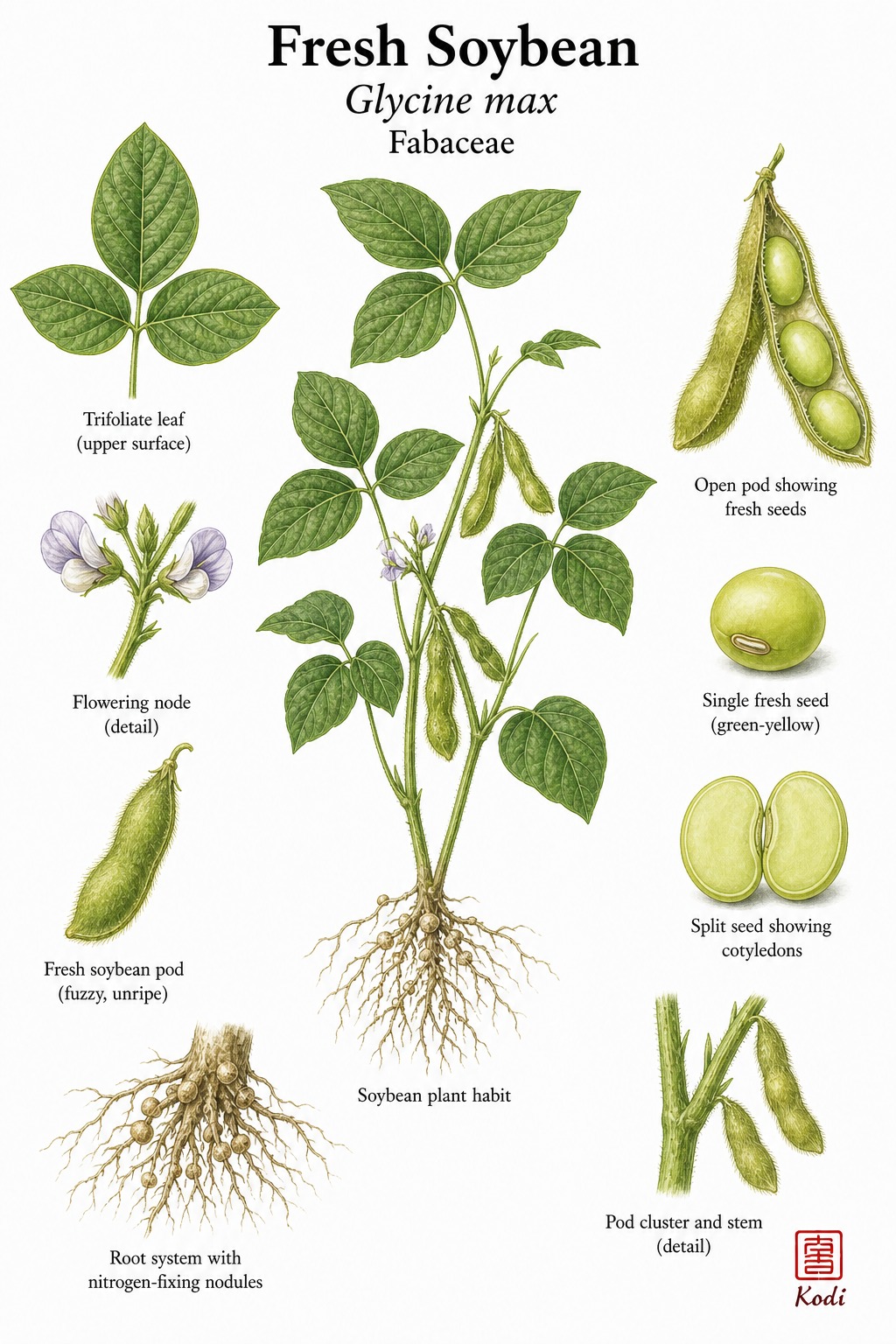
Known in TCM as Xin Chi (新豉), this sweet and pungent and slightly bitter, cold herb enters the Lung and Stomach. Traditionally, it releases the exterior and induces a light sweat - Xin Chi is a mild, food-like soybean medicinal used for superficial fever, mild chills, and headache when stronger diaphoresis is unnecessary, most often applied for common cold, fever, and insomnia. Modern research has identified Genistein among its active constituents.
Part used: Seed
Also Known As
Latin: Semen Sojae | Pinyin: Xin Chi | Chinese: 新豉
TCM Properties
- Taste
- sweet, pungent, slightly bitter
- Temperature
- cold
- Channels
- Lung, Stomach
Traditional Use
Primary Actions
- Releases the exterior and induces a light sweat - Xin Chi is a mild, food-like soybean medicinal used for superficial fever, mild chills, and headache when stronger diaphoresis is unnecessary.
- Relieves febrile irritability - traditional descriptions use it for restlessness, chest oppression, and residual vexation during or after externally contracted disease.
- Harmonizes the middle while clearing mild heat - it can be chosen when exterior symptoms coexist with slight nausea, poor appetite, or weakness after illness.
Secondary Actions
- Xin Chi is the fresh soybean record in older materia medica, whereas Dan Dou Chi is the fermented soybean better known in later formula practice.
- Modern biomedical literature focuses far more on soy foods and isoflavone extracts than on Xin Chi as a distinct TCM medicinal identity.
Classic Formulas
- Cong Bai Qi Wei Yin - recovery-stage exterior formula using Xin Chi with Cong Bai, Ge Gen, Sheng Jiang, Mai Men Dong, and Di Huang for fever without sweating after depletion.
- Light Cong Bai-Xin Chi pairings - traditional lineages use fresh soybean when fever and restlessness are present but the patient is too depleted for harsh sweating methods.
Classical References
- TCM-ID records Xin Chi as cold, pungent, sweet, and slightly bitter, entering the Lung and Stomach to induce diaphoresis, ease the mind, and relieve fever.
- Formula literature around Cong Bai Qi Wei Yin places Xin Chi in post-illness or blood-deficient surface patterns where fluids must be protected while residual exterior heat is lightly vented.
Modern Research
Active Compounds
- Genistein - one of the best-known soybean isoflavones with estrogen-receptor and antioxidant activity
- Daidzein - a major soy isoflavone relevant to menopause and cardiometabolic research
- Glycitein - a lesser-abundant soybean isoflavone contributing to the soy phytoestrogen profile
- Soy proteins, saponins, and phospholipids - broader food-medicine constituents discussed alongside isoflavones
Studied Effects
- A 2021 review summarized antioxidant, estrogen-receptor, and metabolic effects of soybean isoflavones in humans while emphasizing that supplement effects are not identical to whole-food use (PMID 34209224).
- A clinical trial of a Glycine max phytoestrogen preparation reported improvement in menopausal hot flushes and related symptoms, illustrating one major modern use-context for soy actives (PMID 11995954).
- An in vivo study found a standardized soybean extract altered cytochrome P450 gene expression, underscoring that concentrated extracts may have interaction potential beyond traditional food-like dosing (PMID 20825053).
PubMed References
- Current Perspectives on the Beneficial Effects of Soybean Isoflavones and Their Metabolites for Humans. (2021)
- Efficacy and safety of a phytoestrogen preparation derived from Glycine max (L.) Merr in climacteric symptomatology: a multicentric, open, prospective and non-randomized trial. (2002)
- The influence of a standardized soybean extract (Glycine max) on the expression level of cytochrome P450 genes in vivo. (2010)
Safety & Interactions
Contraindications
- Known soy allergy
- Unsupervised use of concentrated soy-isoflavone supplements in hormone-sensitive clinical contexts
- Loose stool or marked middle-burner weakness when a cold, food-like soybean medicinal would aggravate dampness
Cautions
- Whole-food soy, medicinal Xin Chi, and concentrated soy-isoflavone supplements are not interchangeable from a safety or potency standpoint.
- MSK notes that soy isoflavones can exert selective estrogen-receptor effects and are best reviewed in the context of current medications and diagnosis.
- Modern interaction concerns come mainly from concentrated extracts rather than from small traditional decoction-level use.
Conditions
Frequently Asked Questions
What is Fresh Soybean used for?
Fresh Soybean is traditionally used to Releases the exterior and induces a light sweat - Xin Chi is a mild, food-like soybean medicinal used for superficial fever, mild chills, and headache when stronger diaphoresis is unnecessary., Relieves febrile irritability - traditional descriptions use it for restlessness, chest oppression, and residual vexation during or after externally contracted disease., Harmonizes the middle while clearing mild heat - it can be chosen when exterior symptoms coexist with slight nausea, poor appetite, or weakness after illness.. Research has investigated its effects on: A 2021 review summarized antioxidant, estrogen-receptor, and metabolic effects of soybean isoflavones in humans while emphasizing that supplement effects are not identical to whole-food use (PMID 34209224).; A clinical trial of a Glycine max phytoestrogen preparation reported improvement in menopausal hot flushes and related symptoms, illustrating one major modern use-context for soy actives (PMID 11995954)..
What are other names for Fresh Soybean?
Fresh Soybean is also known as Soja. In TCM: 新豉 (Xin Chi); Semen Sojae.
Is Fresh Soybean safe during pregnancy?
The safety of Fresh Soybean during pregnancy has not been established. Consult a qualified healthcare provider before use.
What are the contraindications for Fresh Soybean?
Fresh Soybean should not be used in: Known soy allergy; Unsupervised use of concentrated soy-isoflavone supplements in hormone-sensitive clinical contexts; Loose stool or marked middle-burner weakness when a cold, food-like soybean medicinal would aggravate dampness. Consult a qualified healthcare provider before use.