Frankincense
- Chinese
- 乳香
- Pinyin
- Ru Xiang
- Latin
- Resina Olibani
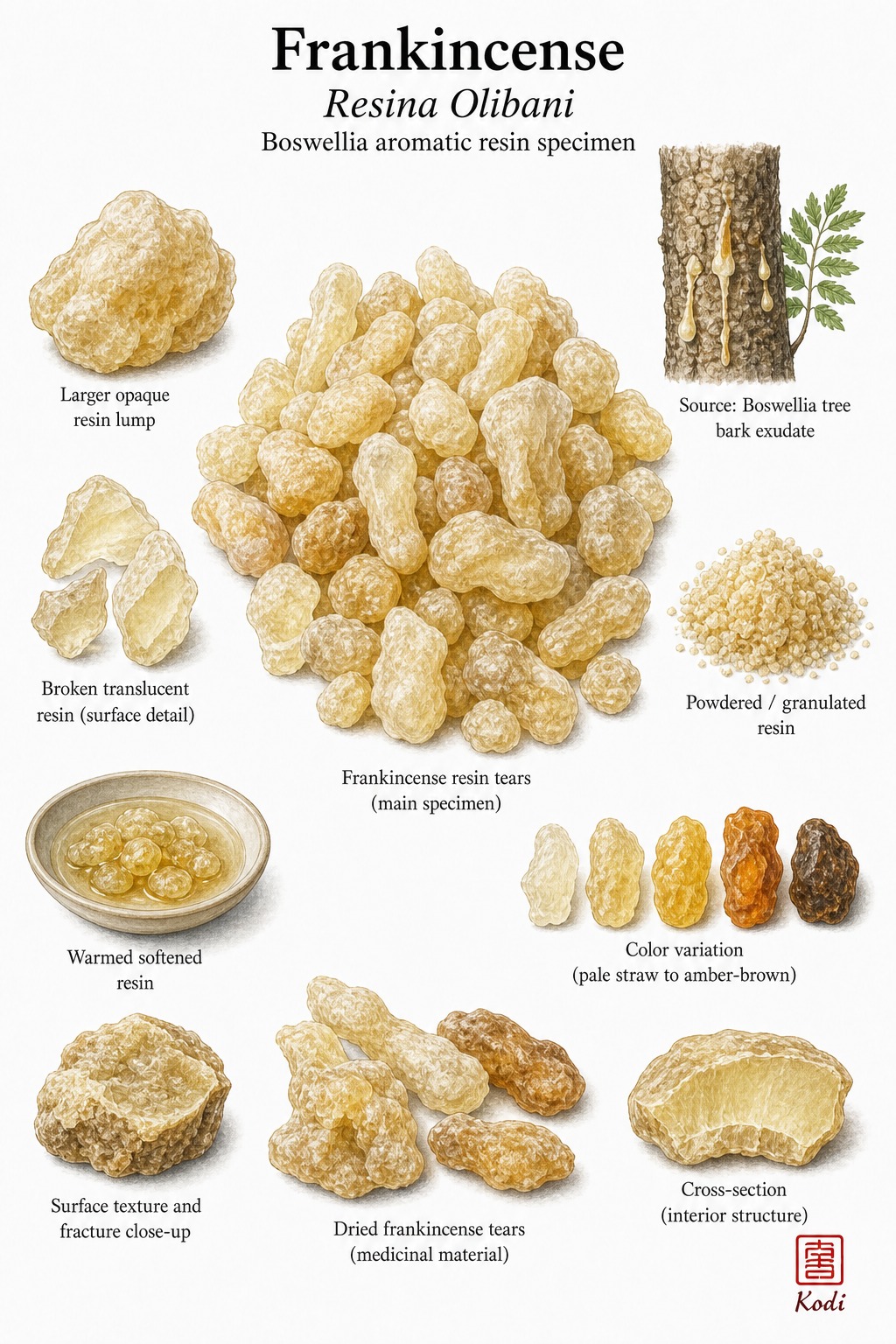
Known in TCM as Ru Xiang (乳香), this pungent and bitter, warm herb enters the Liver, Heart, and Spleen. Traditionally, it invigorates blood and moves qi to relieve pain - Ru Xiang is a major resin for fixed pain from trauma, qi stagnation, or blood stasis in the chest, abdomen, sinews, and joints, most often applied for traumatic injury, joint pain, and abscess. Modern research has identified Boswellic among its active constituents.
Part used: Resin
Also Known As
Latin: Resina Olibani | Pinyin: Ru Xiang | Chinese: 乳香
TCM Properties
- Taste
- pungent, bitter
- Temperature
- warm
- Channels
- Liver, Heart, Spleen
Traditional Use
Primary Actions
- Invigorates blood and moves qi to relieve pain - Ru Xiang is a major resin for fixed pain from trauma, qi stagnation, or blood stasis in the chest, abdomen, sinews, and joints.
- Reduces swelling and promotes healing of sores - it is used for abscesses, ulceration, painful swelling, and wounds that are slow to close.
- Opens the collaterals and eases menstrual or musculoskeletal pain - traditional pairings use it for dysmenorrhea, sprains, bruising, and chronic obstruction.
Secondary Actions
- Ru Xiang is commonly paired with Mo Yao; frankincense contributes more qi movement and opening while myrrh contributes stronger blood-breaking and analgesic support.
- Source species, purification, and extract concentration vary widely between crude traditional resin and modern supplement products.
Classic Formulas
- Huo Luo Xiao Ling Dan - classic blood-stasis pain formula pairing Ru Xiang with Dan Shen, Dang Gui, and Mo Yao.
- Xian Fang Huo Ming Yin - classical abscess and carbuncle formula using Ru Xiang to move blood, reduce swelling, and relieve pain.
- Zhan Jin Dan - trauma formula lineage using Ru Xiang to activate blood, move qi, relieve pain, reduce swelling, and support tissue recovery.
Classical References
- TCM Wiki describes Ru Xiang as pungent, bitter, and warm, entering the Liver, Heart, and Spleen to activate blood, move qi, relieve pain, reduce swelling, and promote tissue regeneration.
- Ming Yi Bie Lu is cited as an early classical source for Ru Xiang.
- Traditional literature repeatedly emphasizes the Ru Xiang-Mo Yao pairing for trauma, sores, and fixed stasis pain.
Modern Research
Active Compounds
- Boswellic acids including AKBA - the best-known anti-inflammatory triterpenes of Boswellia resin
- Volatile oils and monoterpenes - aromatic resin constituents contributing to fragrance and topical use
- Resin acids and pentacyclic triterpenes - the broader bioactive matrix in frankincense extracts
- Incensole-related diterpenes - supportive constituents discussed in some Boswellia species research
Studied Effects
- A major review summarized anti-inflammatory, anti-arthritic, cytotoxic, pharmacokinetic, and clinical data on Boswellia serrata, reinforcing modern interest in boswellic acids for pain and inflammation (PMID 21553931).
- A 2023 study in osteoarthritic rats reported improved cartilage architecture with inhibition of matrix metalloproteinase activation and apoptosis after Boswellia extract treatment (PMID 37842260).
- MSK notes clinically relevant but mixed data for osteoarthritis, musculoskeletal pain, tendinopathy, asthma, and radiation-related edema or skin effects.
PubMed References
- Boswellia serrata: an overall assessment of in vitro, preclinical, pharmacokinetic and clinical data. (2011)
- Boswellia serrata Extracts Ameliorates Symptom of Irregularities in Articular Cartilage through Inhibition of Matrix Metalloproteinases Activation and Apoptosis in Monosodium-Iodoacetate-Induced Osteoarthritic Rat Models. (2023)
Safety & Interactions
Contraindications
- Pregnancy unless specifically prescribed by an experienced practitioner
- Heavy menstrual bleeding or active bleeding without a clear blood-stasis rationale
- Known resin allergy or contact-dermatitis tendency
Cautions
- MSK notes boswellia may increase bleeding risk when used with blood thinners.
- Supplement extracts can be much more concentrated than crude medicinal resin and may not behave like traditional decoction or powder use.
- Species sourcing varies across frankincense products marketed outside classical TCM channels.
Drug Interactions
- Anticoagulants or antiplatelet drugs such as warfarin - boswellia may increase bleeding risk.
- Drugs affected by OATP1B3 transport - boswellic acids modulated this transporter in vitro, but clinical relevance remains unclear.
Conditions
- Traumatic Injury Traditional ★★★★☆ JSON
- Joint Pain Traditional ★★★★☆ JSON
- Abscess Traditional ★★★☆☆ JSON
- Dysmenorrhea Traditional ★★★☆☆ JSON
Frequently Asked Questions
What is Frankincense used for?
Frankincense is traditionally used to Invigorates blood and moves qi to relieve pain - Ru Xiang is a major resin for fixed pain from trauma, qi stagnation, or blood stasis in the chest, abdomen, sinews, and joints., Reduces swelling and promotes healing of sores - it is used for abscesses, ulceration, painful swelling, and wounds that are slow to close., Opens the collaterals and eases menstrual or musculoskeletal pain - traditional pairings use it for dysmenorrhea, sprains, bruising, and chronic obstruction.. Research has investigated its effects on: A major review summarized anti-inflammatory, anti-arthritic, cytotoxic, pharmacokinetic, and clinical data on Boswellia serrata, reinforcing modern interest in boswellic acids for pain and inflammation (PMID 21553931).; A 2023 study in osteoarthritic rats reported improved cartilage architecture with inhibition of matrix metalloproteinase activation and apoptosis after Boswellia extract treatment (PMID 37842260)..
What are other names for Frankincense?
Frankincense is also known as Olibani. In TCM: 乳香 (Ru Xiang); Resina Olibani.
Is Frankincense safe during pregnancy?
Frankincense is not recommended during pregnancy.
What are the contraindications for Frankincense?
Frankincense should not be used in: Pregnancy unless specifically prescribed by an experienced practitioner; Heavy menstrual bleeding or active bleeding without a clear blood-stasis rationale; Known resin allergy or contact-dermatitis tendency. Consult a qualified healthcare provider before use.
Does Frankincense interact with any medications?
Frankincense may interact with: Anticoagulants or antiplatelet drugs such as warfarin - boswellia may increase bleeding risk.; Drugs affected by OATP1B3 transport - boswellic acids modulated this transporter in vitro, but clinical relevance remains unclear.. Always inform your healthcare provider of any herbal supplements you are taking.