Fragrant Solomonseal Rhizome
- Chinese
- 玉竹
- Pinyin
- Yu Zhu
- Latin
- Rhizoma Polygonati Odorati
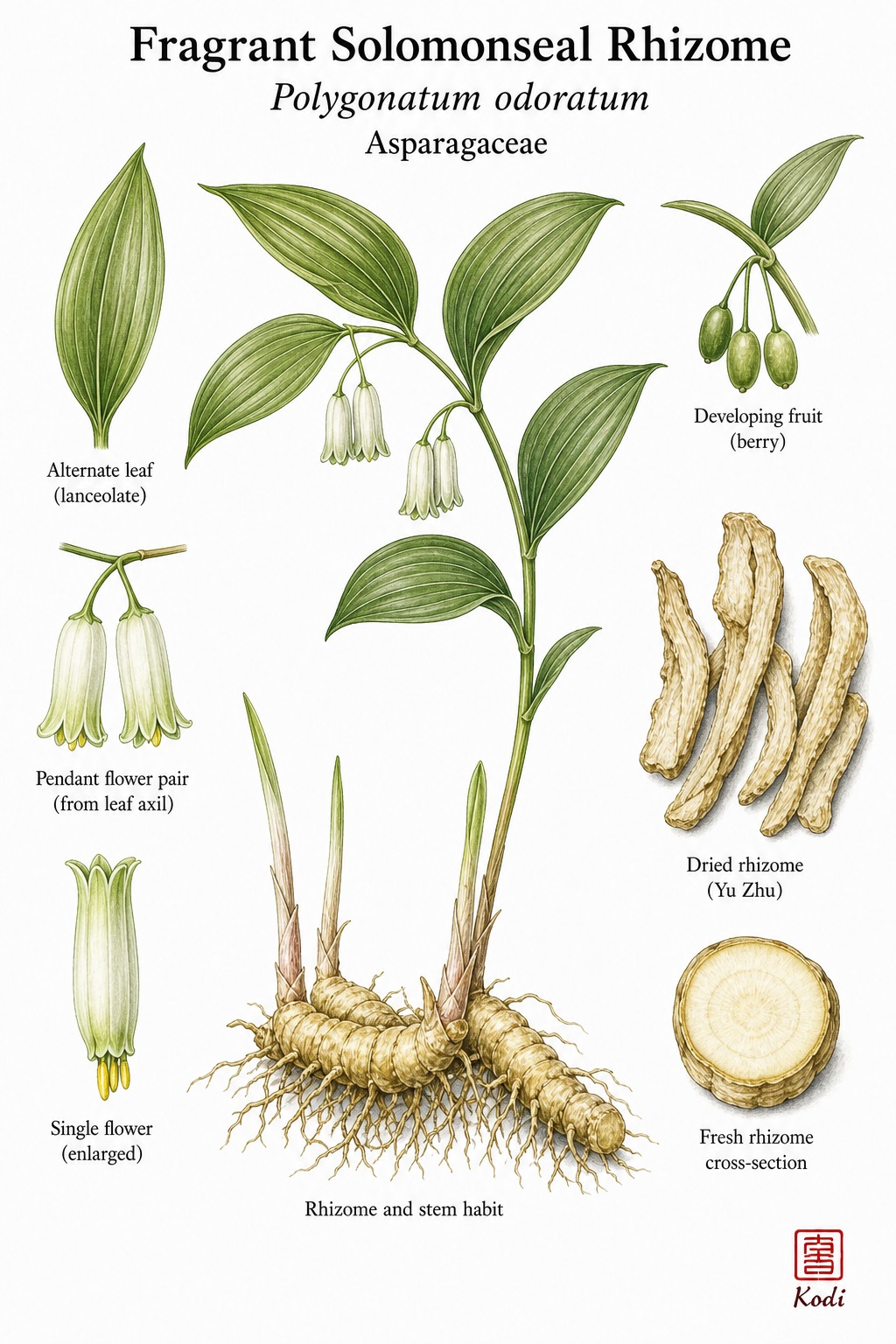
Known in TCM as Yu Zhu (玉竹), this sweet, slightly cold herb enters the Lung, Stomach, and Heart. Traditionally, it nourishes Lung Yin and moistens dryness - Yu Zhu is used for dry cough, hoarseness, throat dryness, and scant sputum when dryness or post-febrile injury has depleted fluids, most often applied for dry cough, yin deficiency, and poor appetite. Modern research has identified Polygonatum among its active constituents.
Part used: Rhizome
Also Known As
Latin: Rhizoma Polygonati Odorati | Pinyin: Yu Zhu | Chinese: 玉竹
TCM Properties
- Taste
- sweet
- Temperature
- slightly cold
- Channels
- Lung, Stomach, Heart
Traditional Use
Primary Actions
- Nourishes Lung Yin and moistens dryness - Yu Zhu is used for dry cough, hoarseness, throat dryness, and scant sputum when dryness or post-febrile injury has depleted fluids.
- Nourishes Stomach Yin and generates fluids - it treats thirst, dry mouth, hunger without appetite, and dry stool from Stomach fluid deficiency.
- Gently clears residual heat without being cloying - this makes it useful in warm-dryness and post-illness patterns where some exterior or residual heat remains.
Secondary Actions
- Yu Zhu is gentler and less greasy than many Yin tonics, so it is often used when there is residual pathogen or fragile digestion.
- It is commonly paired with Sha Shen and Mai Dong when Lung and Stomach dryness occur together.
Classic Formulas
- Sha Shen Mai Dong Tang - classic dryness-injured Lung formula pairing Yu Zhu with Sha Shen and Mai Men Dong.
- Yi Wei Tang - Stomach-Yin formula in which Yu Zhu helps restore fluid and appetite after heat has damaged the middle burner.
- Qianjin Weirui Tang - wind-warm and Yin-deficiency exterior formula where Yu Zhu acts as the principal moistening herb.
Classical References
- TCM Wiki describes Yu Zhu as sweet and slightly cold, entering the Lung, Stomach, and Heart to nourish Yin and clear slight heat.
- Formula commentary from Qianjin Weirui Tang and Sha Shen Mai Dong Tang emphasizes Yu Zhu's ability to moisten without trapping residual pathogen.
Modern Research
Active Compounds
- Polygonatum odoratum polysaccharides - the best-studied macromolecular constituents of Yu Zhu
- Homoisoflavonoids and flavonoids - antioxidant and signaling-related constituents reported in modern reviews
- Steroidal saponins - characteristic secondary metabolites of the Polygonatum lineage
- Phenolic constituents - supportive compounds in antioxidant and functional-food literature
Studied Effects
- A 2025 comprehensive review summarized the botany, chemistry, bioactivity, and applications of Polygonatum odoratum, reinforcing its importance as both a medicinal and food-medicine plant (PMID 40335673).
- A 2025 review focused on Polygonatum odoratum polysaccharides and summarized antioxidant, immunomodulatory, hypoglycemic, and gut-related interests in this fraction (PMID 40907918).
- Most modern evidence is preclinical or functional-food oriented rather than based on herb-specific clinical trials that mirror classical decoction practice.
PubMed References
Safety & Interactions
Contraindications
- Damp-phlegm patterns with greasy tongue and marked stagnation
- Loose stool from Spleen deficiency when rich moistening tonics worsen fullness
Cautions
- Yu Zhu is gentle, but in people with marked dampness or cloying-food intolerance it can worsen abdominal fullness or loose stool.
- Modern literature often focuses on polysaccharide or functional-food fractions rather than classical decoction use.
- MSK page not found - drug interaction data not available from Memorial Sloan Kettering integrative medicine database
Conditions
- Dry Cough Traditional ★★★★☆ JSON
- Yin Deficiency Traditional ★★★★☆ JSON
- Poor Appetite Traditional ★★☆☆☆ JSON
- Diabetes Traditional ★★☆☆☆ JSON
Frequently Asked Questions
What is Fragrant Solomonseal Rhizome used for?
Fragrant Solomonseal Rhizome is traditionally used to Nourishes Lung Yin and moistens dryness - Yu Zhu is used for dry cough, hoarseness, throat dryness, and scant sputum when dryness or post-febrile injury has depleted fluids., Nourishes Stomach Yin and generates fluids - it treats thirst, dry mouth, hunger without appetite, and dry stool from Stomach fluid deficiency., Gently clears residual heat without being cloying - this makes it useful in warm-dryness and post-illness patterns where some exterior or residual heat remains.. Research has investigated its effects on: A 2025 comprehensive review summarized the botany, chemistry, bioactivity, and applications of Polygonatum odoratum, reinforcing its importance as both a medicinal and food-medicine plant (PMID 40335673).; A 2025 review focused on Polygonatum odoratum polysaccharides and summarized antioxidant, immunomodulatory, hypoglycemic, and gut-related interests in this fraction (PMID 40907918)..
What are other names for Fragrant Solomonseal Rhizome?
Fragrant Solomonseal Rhizome is also known as Polygonati. In TCM: 玉竹 (Yu Zhu); Rhizoma Polygonati Odorati.
Is Fragrant Solomonseal Rhizome safe during pregnancy?
The safety of Fragrant Solomonseal Rhizome during pregnancy has not been established. Consult a qualified healthcare provider before use.
What are the contraindications for Fragrant Solomonseal Rhizome?
Fragrant Solomonseal Rhizome should not be used in: Damp-phlegm patterns with greasy tongue and marked stagnation; Loose stool from Spleen deficiency when rich moistening tonics worsen fullness. Consult a qualified healthcare provider before use.