Forest Frog's Oviduct
- Chinese
- 蛤蟆油
- Pinyin
- Ha Ma You
- Latin
- Oviductus Ranae
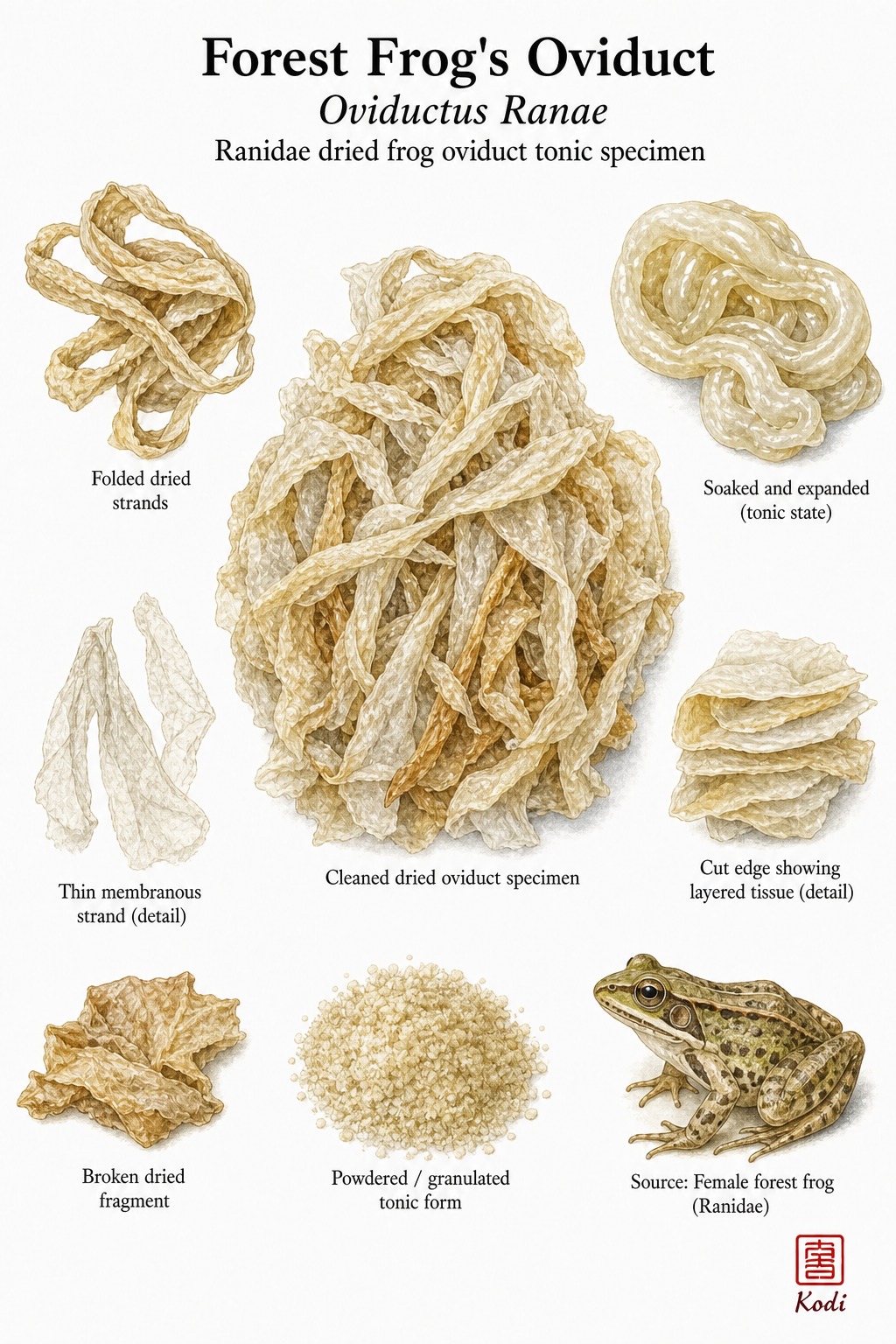
Known in TCM as Ha Ma You (蛤蟆油), this sweet and salty, neutral herb enters the Lung and Kidney. Traditionally, it tonifies the Kidney and supplements essence - Ha Ma You is used for chronic depletion, weakness after illness, and deficiency patterns marked by reduced reserve and poor recovery, most often applied for fatigue, dry cough, and night sweats. Modern research has identified Proteins among its active constituents.
Part used: Oviduct
Also Known As
Latin: Oviductus Ranae | Pinyin: Ha Ma You | Chinese: 蛤蟆油
TCM Properties
- Taste
- sweet, salty
- Temperature
- neutral
- Channels
- Lung, Kidney
Traditional Use
Primary Actions
- Tonifies the Kidney and supplements essence - Ha Ma You is used for chronic depletion, weakness after illness, and deficiency patterns marked by reduced reserve and poor recovery.
- Moistens the Lung and nourishes Yin - traditional indications include dry consumptive cough, throat dryness, blood-streaked sputum, and deficiency-heat with night sweating.
- Rebuilds depleted fluids and strength after prolonged illness or childbirth - it is valued as both a medicinal tonic and food-like restorative in Northeast Chinese practice.
Secondary Actions
- Oviductus Ranae functions as both a classical animal medicine and a modern tonic food, so species authentication and hygienic sourcing matter more than with ordinary dried botanicals.
- Its rich nourishing character makes it unsuitable in early exterior invasion or in damp-stagnation patterns with poor appetite and loose stool.
Classical References
- TCM Wiki describes Ha Ma You as sweet, salty, and neutral, entering the Lung and Kidney to supplement Kidney essence while moistening the Lung and nourishing Yin.
- Modern quality-control literature on Oviductus Ranae still repeats the traditional indication set of physical weakness, night sweats, dry cough, and Yin deficiency after illness.
Modern Research
Active Compounds
- Proteins and bioactive peptides - the major nutrient and pharmacology-bearing fraction of Oviductus Ranae
- Phospholipids and unsaturated fatty acids - relevant to tonic-food and endocrine-interest literature
- Steroids and sterol-like constituents - part of the estrogen-like and ovarian-support discussion in modern studies
- Amino acids, nucleosides, vitamins, and trace minerals - supportive nutritional constituents discussed in review literature
Studied Effects
- A 2019 review summarized immunomodulatory, antioxidant, antifatigue, antiaging, antiosteoporotic, estrogen-like, and antitussive interests in Oviductus Ranae, while emphasizing its role as a tonic food more than as a routine prescription medicine (PMID 31281578).
- A 2024 rat study reported that Oviductus Ranae promoted follicle growth, increased estradiol and progesterone levels, and upregulated PI3K/Akt-pathway signaling in ovarian tissue (PMID 39723099).
- A toxicology study found no major acute, subacute, or genotoxic signal at tested experimental doses, but this remains preclinical and does not remove the need for careful sourcing and practitioner oversight (PMID 28341247).
PubMed References
- Traditional Uses, Bioactive Constituents, Biological Functions, and Safety Properties of Oviductus ranae as Functional Foods in China. (2019)
- Oviductus Ranae Promotes Follicle Growth Through the PI3K/AKT Signaling Pathway In Vivo and In Vitro in Rat. (2024)
- Toxicological evaluation of Oviductus ranae: Acute, sub-acute and genotoxicity studies in mice and rats. (2017)
Safety & Interactions
Contraindications
- Early external pathogenic invasion
- Poor appetite, food stagnation, or loose stool from dampness
- Hormone-sensitive conditions without clinician oversight, given modern estrogen-like findings
Cautions
- Authenticate species and source carefully; Oviductus Ranae is an animal-derived medicinal and adulteration or contamination risk is meaningful.
- Modern work often describes estrogen-like, ovarian, or immune effects in preclinical settings rather than in large human trials.
- Because it is a rich tonic, it can worsen damp accumulation or digestive stagnation in people without true deficiency.
- MSK page not found - drug interaction data not available from Memorial Sloan Kettering integrative medicine database
Conditions
- Fatigue Traditional ★★★★☆ JSON
- Dry Cough Traditional ★★★★☆ JSON
- Night Sweats Traditional ★★★☆☆ JSON
- Kidney Deficiency Traditional ★★★☆☆ JSON
Frequently Asked Questions
What is Forest Frog's Oviduct used for?
Forest Frog's Oviduct is traditionally used to Tonifies the Kidney and supplements essence - Ha Ma You is used for chronic depletion, weakness after illness, and deficiency patterns marked by reduced reserve and poor recovery., Moistens the Lung and nourishes Yin - traditional indications include dry consumptive cough, throat dryness, blood-streaked sputum, and deficiency-heat with night sweating., Rebuilds depleted fluids and strength after prolonged illness or childbirth - it is valued as both a medicinal tonic and food-like restorative in Northeast Chinese practice.. Research has investigated its effects on: A 2019 review summarized immunomodulatory, antioxidant, antifatigue, antiaging, antiosteoporotic, estrogen-like, and antitussive interests in Oviductus Ranae, while emphasizing its role as a tonic food more than as a routine prescription medicine (PMID 31281578).; A 2024 rat study reported that Oviductus Ranae promoted follicle growth, increased estradiol and progesterone levels, and upregulated PI3K/Akt-pathway signaling in ovarian tissue (PMID 39723099)..
What are other names for Forest Frog's Oviduct?
Forest Frog's Oviduct is also known as Rana. In TCM: 蛤蟆油 (Ha Ma You); Oviductus Ranae.
Is Forest Frog's Oviduct safe during pregnancy?
The safety of Forest Frog's Oviduct during pregnancy has not been established. Consult a qualified healthcare provider before use.
What are the contraindications for Forest Frog's Oviduct?
Forest Frog's Oviduct should not be used in: Early external pathogenic invasion; Poor appetite, food stagnation, or loose stool from dampness; Hormone-sensitive conditions without clinician oversight, given modern estrogen-like findings. Consult a qualified healthcare provider before use.