Bombax Flower
- Chinese
- 木棉花
- Pinyin
- Mu Mian Hua
- Latin
- Flos Gossampini
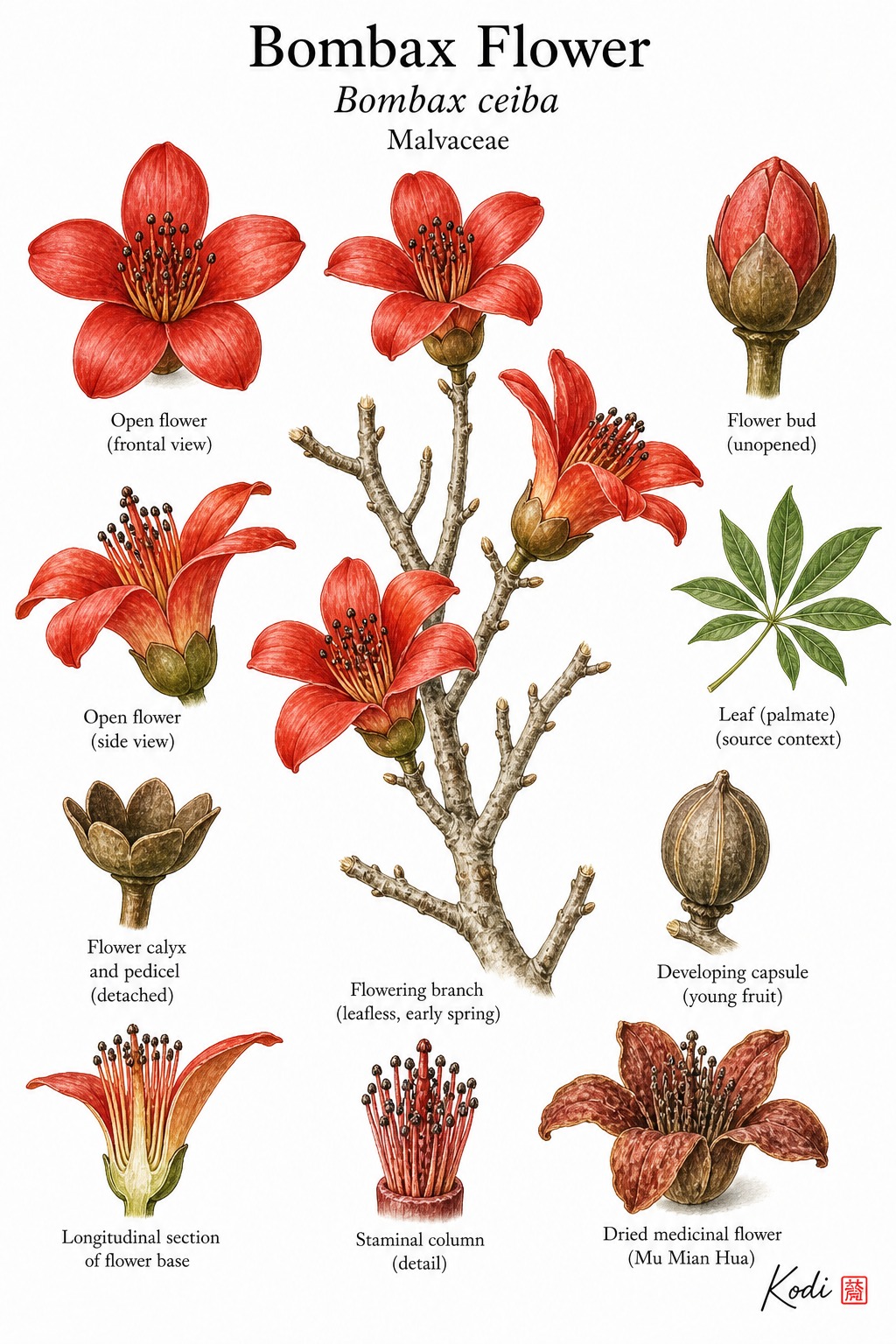
Known in TCM as Mu Mian Hua (木棉花), this sweet and bland, cool herb enters the Large Intestine. Traditionally, it clears heat and drains dampness from the intestines - Mu Mian Hua is traditionally used for diarrhea, damp-heat dysentery, and lingering intestinal irritation with heat signs, most often applied for diarrhea, dysentery, and hemorrhoids. Modern research has identified Polyphenols among its active constituents.
Part used: Flower
Also Known As
Latin: Flos Gossampini | Pinyin: Mu Mian Hua | Chinese: 木棉花
TCM Properties
- Taste
- sweet, bland
- Temperature
- cool
- Channels
- Large Intestine
Traditional Use
Primary Actions
- Clears heat and drains dampness from the intestines - Mu Mian Hua is traditionally used for diarrhea, damp-heat dysentery, and lingering intestinal irritation with heat signs.
- Reduces toxic swelling - older herb texts and folk practice extend its use to hot swollen lesions, hemorrhoidal irritation, and suppurative conditions.
- Stops bleeding when specially prepared - charred or ash-processed forms are sometimes used for hemorrhoidal bleeding, uterine bleeding, or blood in the stool.
Secondary Actions
- Traditional notes sometimes distinguish red and white flower forms for different kinds of dysenteric discharge, but the larger principle is still damp-heat in the intestines.
- Mu Mian Hua is a relatively focused bowel-and-bleeding flower herb rather than a broad anti-infective flower like Jin Yin Hua or Ju Hua.
Classic Formulas
- Mu Mian Hua with Bai Tou Weng or Huang Lian - damp-heat bowel pattern pairing for dysentery with burning, mucus, or blood.
- Mu Mian Hua with Di Yu and Huai Hua - heat-bleeding approach for hemorrhoids or blood in the stool.
- Charred Mu Mian Hua with other hemostatic herbs - traditional strategy for uterine bleeding or persistent lower-burner heat bleeding.
Classical References
- TCM references describe Mu Mian Hua as sweet, bland, and cool, entering the Large Intestine to clear heat, promote urination or damp drainage, remove toxicity, and stop bleeding.
- Its most repeated classical indications are diarrhea, dysentery, hemorrhoidal bleeding, and lower-burner heat with swelling.
- The herb is remembered more in southern and folk practice than in the most famous textbook formulas, but its clinical theme is consistent.
Modern Research
Active Compounds
- Polyphenols and flavonoids - major contributors to Bombax ceiba flower antioxidant activity
- Polysaccharide and carbohydrate-rich fractions - part of the flower's functional-food research profile
- Organic acids and mixed phenolic constituents - relevant to anti-inflammatory and metabolic studies
- Broader Bombax flower phytochemical fraction - increasingly investigated for nutraceutical use
Studied Effects
- A 2025 review summarized Bombax ceiba flower chemistry and pharmacology, highlighting antioxidant, anti-inflammatory, metabolic, and wound-related research while emphasizing that the evidence remains largely preclinical (PMID 40825150).
- Bombax ceiba ethanolic extract reduced inflammatory and structural markers in a murine rheumatoid-arthritis model, supporting the species' broader anti-inflammatory reputation (PMID 37908617).
- Chemical-profiling work paired with network pharmacology suggested Bombax ceiba flower may influence glucose and inflammatory pathways, but these findings are exploratory rather than direct clinical proof (PMID 36313078).
PubMed References
- Exploring the Therapeutic Potential of Bombax ceiba L. Flowers as Source of Functional Food Development: A Review. (2025)
- Anti-arthritic efficacy of Bombax ceiba ethanolic extract in a murine model for rheumatoid arthritis using in vivo, in vitro and radiological analysis. (2023)
- A preliminary study of the chemical composition and bioactivity of Bombax ceiba L. flower and its potential mechanism in treating type 2 diabetes mellitus using ultra-performance liquid chromatography quadrupole-time-flight mass spectrometry and network pharmacology analysis. (2022)
Safety & Interactions
Contraindications
- Chronic diarrhea from pure Spleen deficiency cold without damp-heat
- Bleeding disorders without signs of heat or irritation
Cautions
- Mu Mian Hua is best matched to damp-heat bowel or bleeding patterns rather than weak, cold, deficiency-type loose stool.
- Modern Bombax research is mostly preclinical and should not be overstated as proof of benefit for arthritis, diabetes, or cancer.
- MSK page not found - drug interaction data not available from Memorial Sloan Kettering integrative medicine database
Conditions
- Diarrhea Traditional ★★★★☆ JSON
- Dysentery Traditional ★★★☆☆ JSON
- Hemorrhoids Traditional ★★★☆☆ JSON
- Uterine Bleeding Traditional ★★☆☆☆ JSON
Frequently Asked Questions
What is Bombax Flower used for?
Bombax Flower is traditionally used to Clears heat and drains dampness from the intestines - Mu Mian Hua is traditionally used for diarrhea, damp-heat dysentery, and lingering intestinal irritation with heat signs., Reduces toxic swelling - older herb texts and folk practice extend its use to hot swollen lesions, hemorrhoidal irritation, and suppurative conditions., Stops bleeding when specially prepared - charred or ash-processed forms are sometimes used for hemorrhoidal bleeding, uterine bleeding, or blood in the stool.. Research has investigated its effects on: A 2025 review summarized Bombax ceiba flower chemistry and pharmacology, highlighting antioxidant, anti-inflammatory, metabolic, and wound-related research while emphasizing that the evidence remains largely preclinical (PMID 40825150).; Bombax ceiba ethanolic extract reduced inflammatory and structural markers in a murine rheumatoid-arthritis model, supporting the species' broader anti-inflammatory reputation (PMID 37908617)..
What are other names for Bombax Flower?
Bombax Flower is also known as Gossampini. In TCM: 木棉花 (Mu Mian Hua); Flos Gossampini.
Is Bombax Flower safe during pregnancy?
The safety of Bombax Flower during pregnancy has not been established. Consult a qualified healthcare provider before use.
What are the contraindications for Bombax Flower?
Bombax Flower should not be used in: Chronic diarrhea from pure Spleen deficiency cold without damp-heat; Bleeding disorders without signs of heat or irritation. Consult a qualified healthcare provider before use.