Feather Cockscomb Seed
- Chinese
- 青葙子
- Pinyin
- Qing Xiang Zi
- Latin
- Semen Celosiae
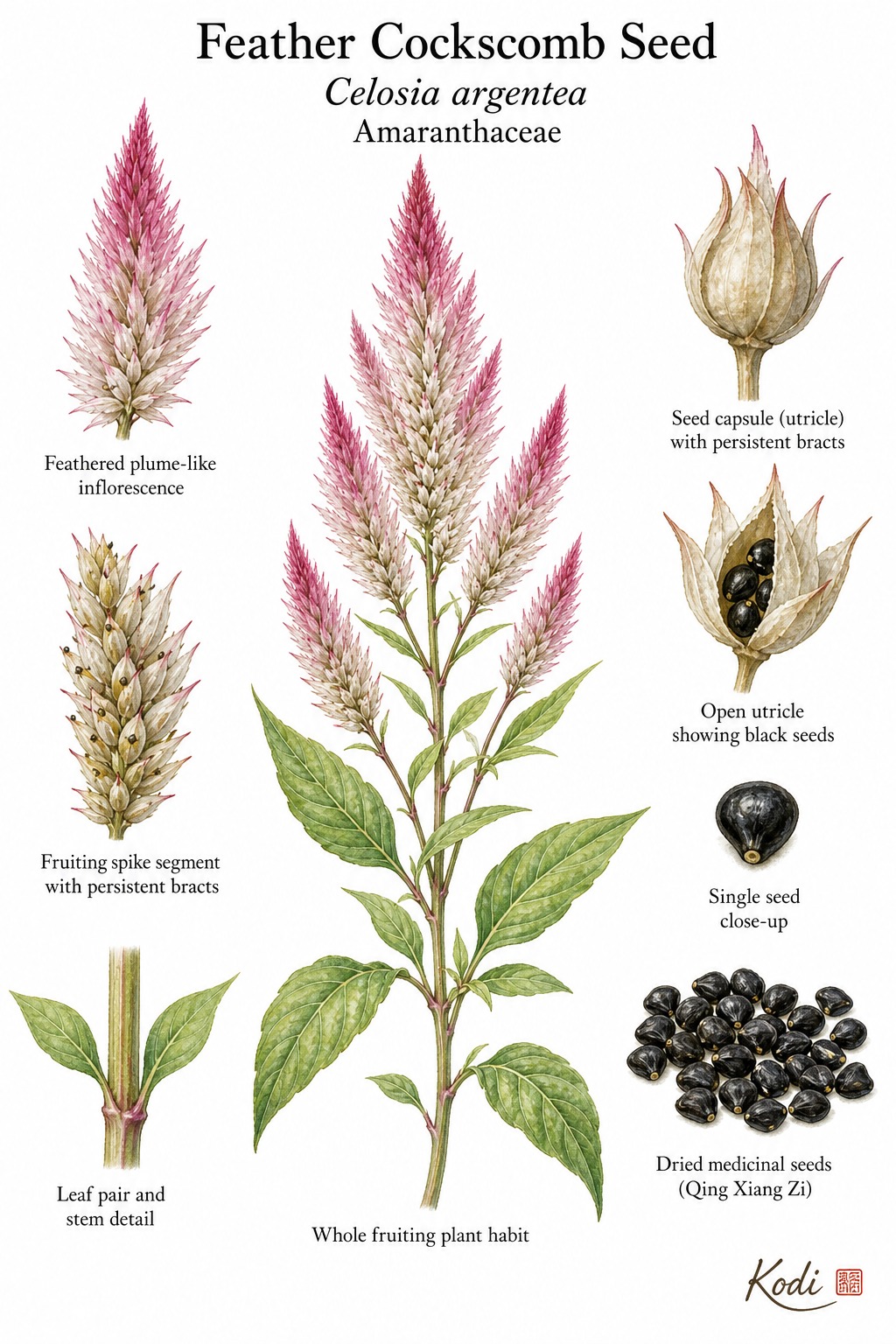
Known in TCM as Qing Xiang Zi (青葙子), this sweet and bitter, slightly cold herb enters the Liver. Traditionally, it clears Liver fire and improves vision - Qing Xiang Zi is classically used for red, swollen, painful eyes and visual disturbance caused by excess heat in the Liver channel, most often applied for conjunctivitis, blurred vision, and hypertension. Modern research has identified Celosian among its active constituents.
Part used: Seed
Also Known As
Latin: Semen Celosiae | Pinyin: Qing Xiang Zi | Chinese: 青葙子
TCM Properties
- Taste
- sweet, bitter
- Temperature
- slightly cold
- Channels
- Liver
Traditional Use
Primary Actions
- Clears Liver fire and improves vision - Qing Xiang Zi is classically used for red, swollen, painful eyes and visual disturbance caused by excess heat in the Liver channel.
- Dispels wind-heat from the eyes - it is especially valued when superficial ocular inflammation, headache, and photophobia accompany wind-heat or Liver fire patterns.
- Directs hyperactive Liver yang downward - traditional use extends to headache and hypertension patterns associated with rising Liver fire.
Secondary Actions
- Qing Xiang Zi is strongest for excess heat eye disorders and is less appropriate than Jue Ming Zi when constipation, yin deficiency, or deficiency-type visual problems are central.
- Traditional sources note that it can dilate the pupils, which is part of why it is used cautiously in certain eye-pressure conditions.
Classic Formulas
- Eye-fire combinations often pair Qing Xiang Zi with Ju Hua, Long Dan Cao, or Huang Qin for red painful eyes.
- Vision-support formulas may combine it with Mi Meng Hua, Mu Zei, or Jue Ming Zi when blurred vision and superficial visual obstruction are present.
- Liver-fire hypertension and headache patterns may combine Qing Xiang Zi with Xia Ku Cao, Gou Teng, or Shi Jue Ming.
Classical References
- American Dragon and related TCM sources emphasize Qing Xiang Zi's best effect on excess Liver fire with red inflamed eyes.
- Traditional notes distinguish it from Jue Ming Zi by stressing its stronger fire-draining action and narrower suitability for excess conditions.
- Use is cautious in glaucoma or dilated-pupil states because of its documented pupil-dilating tendency in traditional literature.
Modern Research
Active Compounds
- Celosian polysaccharides - the most cited immunomodulatory fraction
- Flavonoids and phenolic compounds - likely contributors to anti-inflammatory and antioxidant effects
- Saponin and alkaloid-related constituents - part of the broader pharmacologic profile of Celosia argentea
- Vasodilator-active plant fractions - described in ethnopharmacologic work on the species
Studied Effects
- Celosian, a polysaccharide isolated from Celosia argentea, showed immunostimulating and antihepatotoxic activity in experimental work (PMID 9225602).
- A 2016 study characterized anticancer principles of Celosia argentea, reinforcing modern interest in the species beyond its classical eye indications (PMID 27034599).
- An ethnopharmacological report described vasodilator activity in Celosia argentea, which may help explain why some traditional sources extend its use to hypertension patterns (PMID 30248350).
PubMed References
- Immunostimulating activity of Celosian, an antihepatotoxic polysaccharide isolated from Celosia argentea (1997)
- Characterization of Anticancer Principles of Celosia argentea (Amaranthaceae) (2016)
- Celosia argentea L. (Amaranthaceae) a vasodilator species from the Brazilian Cerrado - An ethnopharmacological report (2019)
Safety & Interactions
Contraindications
- Glaucoma or elevated eye pressure
- Dilated pupils not clearly due to an excess heat pattern
- Marked Spleen-Stomach deficiency cold
Cautions
- Qing Xiang Zi is best matched to excess Liver fire and wind-heat rather than deficiency-type eye complaints.
- Use cautiously in weak, deficient, or elderly patients who do not tolerate cold downward-directing herbs well.
- MSK page not found - drug interaction data not available from Memorial Sloan Kettering integrative medicine database
Conditions
- Conjunctivitis Traditional ★★★★☆ JSON
- Blurred Vision Traditional ★★★☆☆ JSON
- Hypertension Traditional ★★☆☆☆ JSON
- Headache Traditional ★★☆☆☆ JSON
Frequently Asked Questions
What is Feather Cockscomb Seed used for?
Feather Cockscomb Seed is traditionally used to Clears Liver fire and improves vision - Qing Xiang Zi is classically used for red, swollen, painful eyes and visual disturbance caused by excess heat in the Liver channel., Dispels wind-heat from the eyes - it is especially valued when superficial ocular inflammation, headache, and photophobia accompany wind-heat or Liver fire patterns., Directs hyperactive Liver yang downward - traditional use extends to headache and hypertension patterns associated with rising Liver fire.. Research has investigated its effects on: Celosian, a polysaccharide isolated from Celosia argentea, showed immunostimulating and antihepatotoxic activity in experimental work (PMID 9225602).; A 2016 study characterized anticancer principles of Celosia argentea, reinforcing modern interest in the species beyond its classical eye indications (PMID 27034599)..
What are other names for Feather Cockscomb Seed?
Feather Cockscomb Seed is also known as Celosia. In TCM: 青葙子 (Qing Xiang Zi); Semen Celosiae.
Is Feather Cockscomb Seed safe during pregnancy?
The safety of Feather Cockscomb Seed during pregnancy has not been established. Consult a qualified healthcare provider before use.
What are the contraindications for Feather Cockscomb Seed?
Feather Cockscomb Seed should not be used in: Glaucoma or elevated eye pressure; Dilated pupils not clearly due to an excess heat pattern; Marked Spleen-Stomach deficiency cold. Consult a qualified healthcare provider before use.