Aromatic Essence
- Chinese
- 香精
- Pinyin
- Xiang Jing
- Latin
- Essentia Aromatica
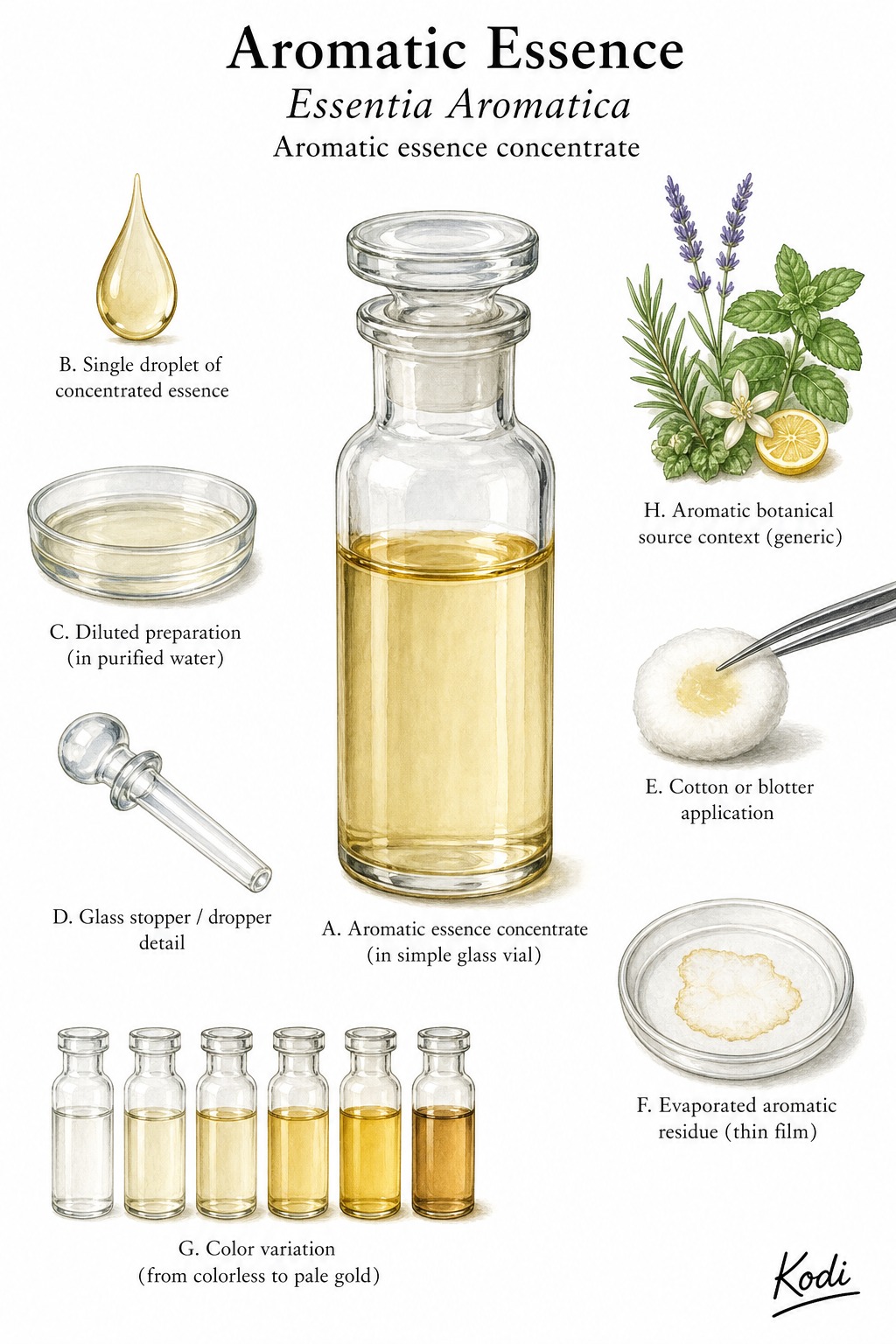
Known in TCM as Xiang Jing (香精), this acrid, warm herb enters the Lung, Spleen, and Stomach. Traditionally, it aromatically transforms turbidity and opens the senses - Xiang Jing is best understood as a concentrated aromatic essence used to freshen, awaken, and disperse heavy damp or stale sensory environments, most often applied for anxiety, nausea, and sinusitis. Modern research has identified Monoterpenes among its active constituents.
Part used: Extract/Essence
Also Known As
Latin: Essentia Aromatica | Pinyin: Xiang Jing | Chinese: 香精
TCM Properties
- Taste
- acrid
- Temperature
- warm
- Channels
- Lung, Spleen, Stomach
Traditional Use
Primary Actions
- Aromatically transforms turbidity and opens the senses - Xiang Jing is best understood as a concentrated aromatic essence used to freshen, awaken, and disperse heavy damp or stale sensory environments.
- May help redirect nausea and chest oppression when used as a carefully selected aromatic adjunct - in modern integrative practice, fragrant essences are sometimes inhaled or externally applied rather than decocted.
- Can support upper airway comfort through inhaled aroma - concentrated volatile preparations are used more for their immediate sensory action than for deep constitutional treatment.
Secondary Actions
- This is not a standard classical crude herb with a fixed pharmacopoeial identity; it appears to refer to generic fragrance essence or essential-oil concentrate.
- Because the source plant can vary dramatically, any TCM property assignment here is approximate and reflects the broader family of aromatic, opening substances rather than a single canonical materia medica item.
Classic Formulas
- No major canonical formula centers on Xiang Jing as an independent crude herb because the term functions more like a generic aromatic essence category than a fixed classical drug.
- The nearest classical analogues are aromatic-opening strategies using Huo Xiang, Pei Lan, Bing Pian, or Su He Xiang when turbidity, foul dampness, or sensory obstruction predominate.
- Modern usage is more consistent with inhaled drops, aromatic oils, or external preparations than with ordinary decoction formulas.
Classical References
- IMPORT NOTE: Xiang Jing is a nonstandard catalog entry and does not map cleanly to one universally recognized classical single-herb monograph.
- The profile here is intentionally conservative and inferred from the broader TCM logic of aromatic substances that open, transform turbidity, and refresh the upper burner.
- Because many commercial fragrance essences are synthetic or blended, medicinal use should be limited to authenticated, purpose-made aromatic products.
Modern Research
Active Compounds
- Monoterpenes such as limonene, linalool, and 1,8-cineole - commonly encountered in aromatic essence and essential-oil preparations
- Volatile esters, aldehydes, and terpenoid alcohols - major fragrance-active constituents that vary by source material
- Phenolic aromatic compounds - sometimes responsible for stronger antimicrobial or irritant effects
- Carrier solvents or synthetic fragrance additives - an important modern safety distinction for commercial essence products
Studied Effects
- A 2019 review found that many essential oils and their volatile constituents show anxiolytic activity in preclinical and early clinical settings, though results depend heavily on composition and delivery method (PMID 31148444).
- A review of aromatherapy for nausea and vomiting found suggestive but inconsistent evidence, which fits the modern use of aromatic essences as adjunctive rather than primary therapy (PMID 22784340).
- A 2015 review described broad antimicrobial activity of essential oils in vitro, but also emphasized major variability in composition, potency, and safe use across products (PMID 24915323).
PubMed References
Safety & Interactions
Contraindications
- Use of non-medical fragrance blends, perfume oils, or synthetic aromatics as though they were medicinal-grade products
- Severe fragrance sensitivity, reactive airway disease triggered by scents, or known contact allergy to aromatic oils
- Internal use in infants, young children, or pregnancy without qualified supervision
Cautions
- This entry is chemically nonstandard by definition, so safety depends almost entirely on the exact source material and whether the product is truly medicinal-grade.
- Concentrated aromatic essences can irritate skin, eyes, lungs, and mucous membranes and should not be assumed safe for oral use.
- MSK page not found - drug interaction data not available from Memorial Sloan Kettering integrative medicine database
Drug Interactions
- Sedatives or CNS-active aromatherapy products - theoretical additive calming or irritating effects depending on composition
- Topical or inhaled respiratory products - overlapping irritant burden if multiple volatile products are used at once
Conditions
Frequently Asked Questions
What is Aromatic Essence used for?
Aromatic Essence is traditionally used to Aromatically transforms turbidity and opens the senses - Xiang Jing is best understood as a concentrated aromatic essence used to freshen, awaken, and disperse heavy damp or stale sensory environments., May help redirect nausea and chest oppression when used as a carefully selected aromatic adjunct - in modern integrative practice, fragrant essences are sometimes inhaled or externally applied rather than decocted., Can support upper airway comfort through inhaled aroma - concentrated volatile preparations are used more for their immediate sensory action than for deep constitutional treatment.. Research has investigated its effects on: A 2019 review found that many essential oils and their volatile constituents show anxiolytic activity in preclinical and early clinical settings, though results depend heavily on composition and delivery method (PMID 31148444).; A review of aromatherapy for nausea and vomiting found suggestive but inconsistent evidence, which fits the modern use of aromatic essences as adjunctive rather than primary therapy (PMID 22784340)..
What are other names for Aromatic Essence?
Aromatic Essence is also known as Aromatica. In TCM: 香精 (Xiang Jing); Essentia Aromatica.
Is Aromatic Essence safe during pregnancy?
The safety of Aromatic Essence during pregnancy has not been established. Consult a qualified healthcare provider before use.
What are the contraindications for Aromatic Essence?
Aromatic Essence should not be used in: Use of non-medical fragrance blends, perfume oils, or synthetic aromatics as though they were medicinal-grade products; Severe fragrance sensitivity, reactive airway disease triggered by scents, or known contact allergy to aromatic oils; Internal use in infants, young children, or pregnancy without qualified supervision. Consult a qualified healthcare provider before use.
Does Aromatic Essence interact with any medications?
Aromatic Essence may interact with: Sedatives or CNS-active aromatherapy products - theoretical additive calming or irritating effects depending on composition; Topical or inhaled respiratory products - overlapping irritant burden if multiple volatile products are used at once. Always inform your healthcare provider of any herbal supplements you are taking.