Mantis Egg Case
- Chinese
- 桑螵蛸
- Pinyin
- Sang Piao Xiao
- Latin
- Ootheca Mantidis
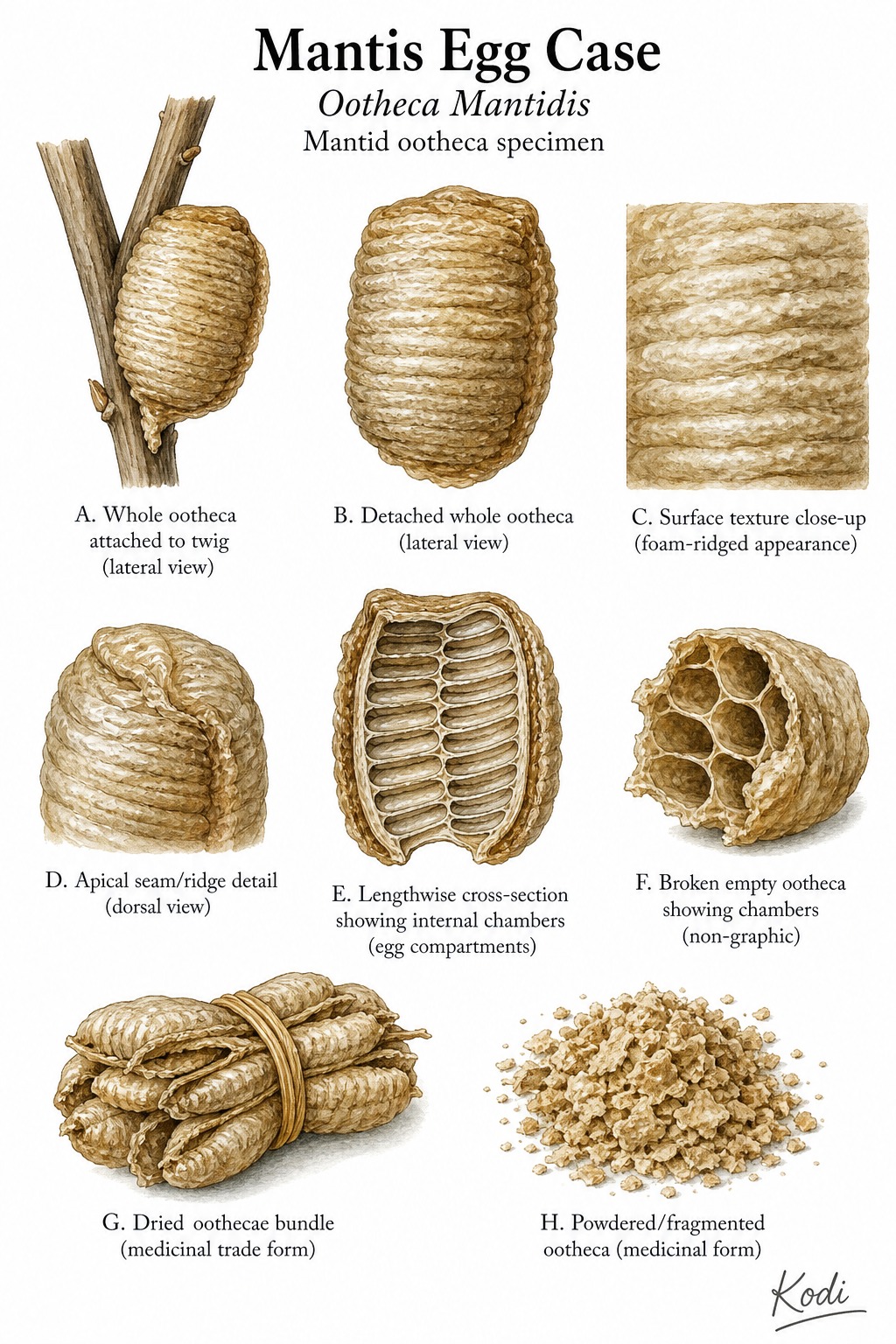
Known in TCM as Sang Piao Xiao (桑螵蛸), this sweet and salty, neutral herb enters the Kidney and Liver. Traditionally, it stabilizes Kidney qi and secures essence - Sang Piao Xiao is classically used for frequent urination, enuresis, spermatorrhea, and reproductive leakage patterns rooted in deficiency rather than heat or obstruction, most often applied for frequent urination, impotence, and leucorrhea. Modern research has identified Protein among its active constituents.
Part used: Egg case
Also Known As
Latin: Ootheca Mantidis | Pinyin: Sang Piao Xiao | Chinese: 桑螵蛸
TCM Properties
- Taste
- sweet, salty
- Temperature
- neutral
- Channels
- Kidney, Liver
Traditional Use
Primary Actions
- Stabilizes Kidney qi and secures essence - Sang Piao Xiao is classically used for frequent urination, enuresis, spermatorrhea, and reproductive leakage patterns rooted in deficiency rather than heat or obstruction.
- Tonifies without excessive harshness - compared with stronger astringent minerals or heating yang tonics, it is valued for gently securing the lower burner while still nourishing a weak Kidney system.
- Supports Heart-Kidney communication - traditional use also extends to forgetfulness, agitation, and insomnia when deficiency and poor essence containment disturb the shen.
Secondary Actions
- Because it is animal-derived, authentication and correct species identification matter more than with common plant herbs.
- Its best-known clinical identity is not as a broad tonic, but as a specialist deficiency-astringent for urinary leakage and essence instability.
Classic Formulas
- Sang Piao Xiao San - classic formula for frequent urination, enuresis, forgetfulness, and Heart-Kidney disharmony with deficiency.
- Kidney deficiency formulas may pair Sang Piao Xiao with Shan Zhu Yu, Long Gu, or Fu Pen Zi when leakage and weakness coexist.
- Traditional gynecologic use includes combinations for leucorrhea and lower burner instability when deficiency rather than damp-heat predominates.
Classical References
- Classical materia medica describe Sang Piao Xiao as a sweet, neutral insect medicine that secures the lower burner and tonifies deficiency.
- Traditional discussions repeatedly emphasize the difference between deficiency leakage, which Sang Piao Xiao can help, and damp-heat or strangury, which require clearing rather than astringing.
- Its role in Sang Piao Xiao San also gave it a lasting association with memory and shen symptoms linked to Heart-Kidney disharmony.
Modern Research
Active Compounds
- Protein and peptide fractions - the most discussed bioactive area in experimental Mantidis Ootheca research
- Lipid fractions - studied for antimicrobial and barrier-related activity
- Chitinous structural materials - relevant to material identity and extraction behavior
- Minor small-molecule constituents - incompletely characterized across different official source species
Studied Effects
- A repeated-dose mouse study found no major short-term toxicity signal for Mantidis Ootheca water extract at the tested doses, though that does not replace human safety evidence (PMID 31080484).
- A 2024 PCR barcode assay highlighted species-identification challenges in commercial Sang Piao Xiao supply chains, reinforcing the importance of authentication for animal-derived materia medica (PMID 39337711).
- An older pharmacologic comparison review summarized experimental findings for Mantidis Ootheca preparations, but the evidence base remains largely preclinical and heterogeneous (PMID 11038920).
PubMed References
- Two-Week Repeated Oral Dose Toxicity Study of Mantidis Ootheca Water Extract in C57BL/6 Mice (2019)
- Rapid Diagnostic PCR Assay Method for Species Identification of Mantidis Ootheca (Sangpiaoxiao) Based on Cytochrom C Oxidase I (COI) Barcode Analysis (2024)
- [Comparison of pharmacological studies on ootheca Mantidis] (2000)
Safety & Interactions
Contraindications
- Damp-heat strangury, acute urinary infection, or urinary retention caused by obstruction rather than deficiency
- Known allergy to insect-derived medicinal products
- Use without supervision in unexplained urinary symptoms
Cautions
- Sang Piao Xiao secures and astringes, so it can trap pathogens if used when heat, infection, or damp obstruction are the real cause of urinary symptoms.
- Animal-derived products need careful sourcing, species authentication, and contamination control.
- MSK page not found - drug interaction data not available from Memorial Sloan Kettering integrative medicine database
Conditions
- Frequent Urination Traditional ★★★★☆ JSON
- Impotence Traditional ★★★☆☆ JSON
- Leucorrhea Traditional ★★★☆☆ JSON
- Insomnia Traditional ★★☆☆☆ JSON
Frequently Asked Questions
What is Mantis Egg Case used for?
Mantis Egg Case is traditionally used to Stabilizes Kidney qi and secures essence - Sang Piao Xiao is classically used for frequent urination, enuresis, spermatorrhea, and reproductive leakage patterns rooted in deficiency rather than heat or obstruction., Tonifies without excessive harshness - compared with stronger astringent minerals or heating yang tonics, it is valued for gently securing the lower burner while still nourishing a weak Kidney system., Supports Heart-Kidney communication - traditional use also extends to forgetfulness, agitation, and insomnia when deficiency and poor essence containment disturb the shen.. Research has investigated its effects on: A repeated-dose mouse study found no major short-term toxicity signal for Mantidis Ootheca water extract at the tested doses, though that does not replace human safety evidence (PMID 31080484).; A 2024 PCR barcode assay highlighted species-identification challenges in commercial Sang Piao Xiao supply chains, reinforcing the importance of authentication for animal-derived materia medica (PMID 39337711)..
What are other names for Mantis Egg Case?
Mantis Egg Case is also known as Mantidis. In TCM: 桑螵蛸 (Sang Piao Xiao); Ootheca Mantidis.
Is Mantis Egg Case safe during pregnancy?
The safety of Mantis Egg Case during pregnancy has not been established. Consult a qualified healthcare provider before use.
What are the contraindications for Mantis Egg Case?
Mantis Egg Case should not be used in: Damp-heat strangury, acute urinary infection, or urinary retention caused by obstruction rather than deficiency; Known allergy to insect-derived medicinal products; Use without supervision in unexplained urinary symptoms. Consult a qualified healthcare provider before use.