Eclipta
- Chinese
- 墨旱莲
- Pinyin
- Han Lian Cao
- Latin
- Herba Ecliptae
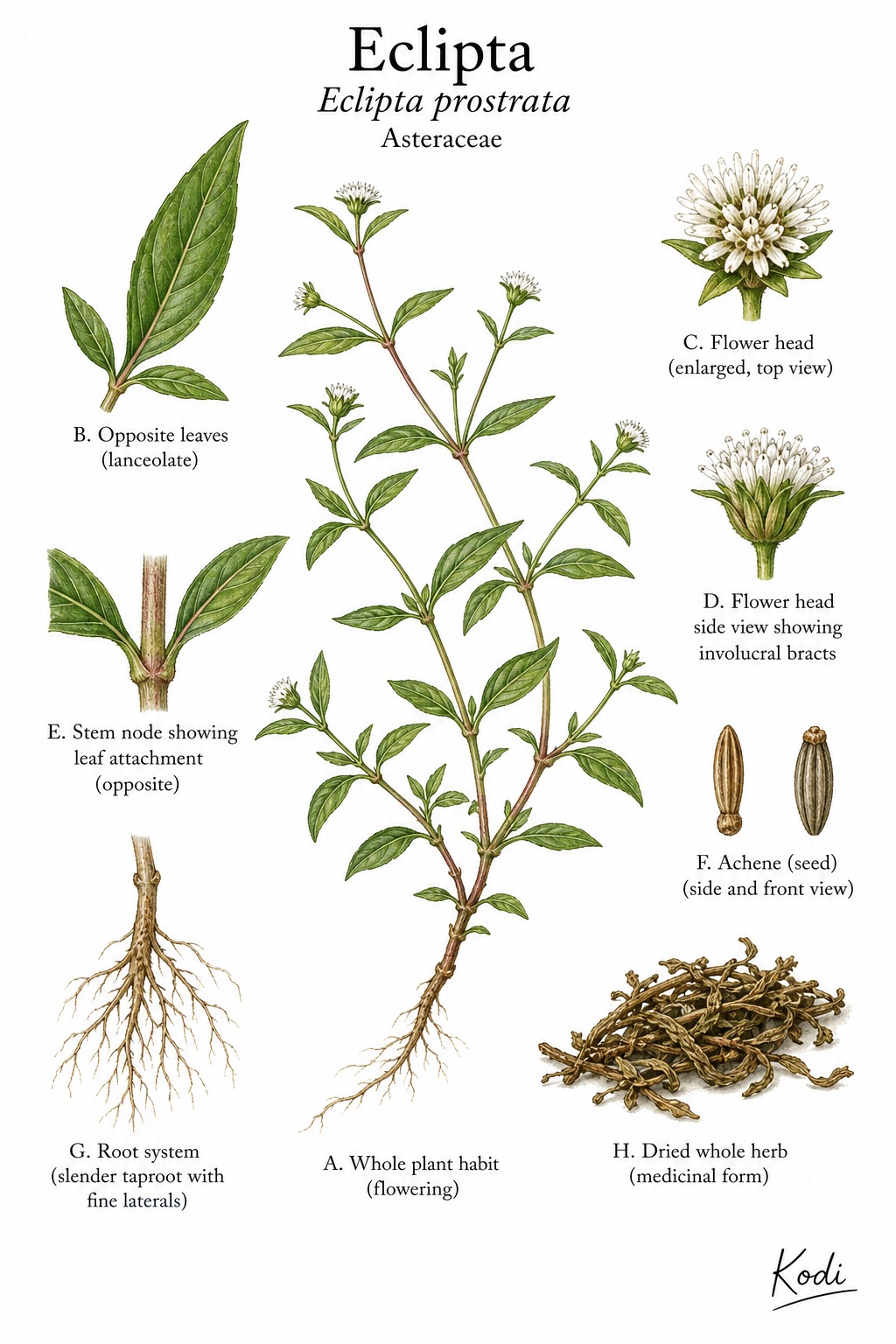
Known in TCM as Han Lian Cao (墨旱莲), this sweet and sour, cool herb enters the Kidney and Liver. Traditionally, it nourishes Liver and Kidney yin - Han Lian Cao is classically used for dizziness, tinnitus, weak low back and knees, premature graying, and other deficiency signs rooted in depleted Liver-Kidney essence, most often applied for hair loss, hematuria, and uterine bleeding. Modern research has identified Wedelolactone among its active constituents.
Part used: Whole herb
TCM Properties
- Taste
- sweet, sour
- Temperature
- cool
- Channels
- Kidney, Liver
Traditional Use
Primary Actions
- Nourishes Liver and Kidney yin - Han Lian Cao is classically used for dizziness, tinnitus, weak low back and knees, premature graying, and other deficiency signs rooted in depleted Liver-Kidney essence.
- Cools blood and stops bleeding - it is a standard gentle hemostatic herb for uterine bleeding, hematuria, nosebleeds, and other bleeding patterns with heat or yin deficiency in the background.
- Benefits the hair and preserves essence - traditional use strongly associates Han Lian Cao with darkening hair, reducing hair shedding, and treating signs of premature aging linked to deficiency.
Secondary Actions
- Han Lian Cao is often paired with Nu Zhen Zi as a balanced yin-nourishing combination that supports the Liver and Kidney without being overly cloying.
- Compared with hot astringent tonics, it has a cooler and more blood-focused profile, which is why it crosses naturally into bleeding and hair-support formulas.
Classic Formulas
- Er Zhi Wan - the classic Han Lian Cao and Nu Zhen Zi pair for Liver-Kidney yin deficiency, tinnitus, hair changes, and constitutional depletion.
- Bleeding formulas may combine Han Lian Cao with Ce Bai Ye, Bai Mao Gen, or other blood-cooling medicinals when heat and bleeding coexist.
- Modern hair and premature-graying formulas frequently use Han Lian Cao as the core essence-preserving herb.
Classical References
- Later materia medica consistently describe Han Lian Cao as a sweet-sour, cooling herb that supplements deficiency while stopping bleeding.
- Traditional texts link its blackening-hair reputation to nourishing Liver blood and Kidney essence rather than to simple topical cosmetic action.
- Its dual role in bleeding and deficiency makes it one of the more elegant examples of a hemostatic herb that simultaneously treats the root.
Modern Research
Active Compounds
- Wedelolactone and demethylwedelolactone - signature coumestans frequently discussed in Eclipta research
- Luteolin, apigenin, and related flavonoids - polyphenols tied to antioxidant and anti-inflammatory models
- Triterpenoids and sterols - broader constituents studied in hepatoprotective and metabolic work
- Polyacetylenes and minor phenolics - additional constituents contributing to the plant's chemical diversity
Studied Effects
- A 2019 review summarized Han Lian Cao's longstanding use for hemorrhagic disorders, respiratory complaints, hair loss, and Liver-Kidney deficiency while noting that most evidence remains preclinical or review-level (PMID 31395303).
- Phytochemical isolation work identified multiple Eclipta prostrata constituents with antitumor activity in experimental settings, helping explain why the herb attracts ongoing mechanistic research (PMID 22902823).
- A 2023 study found that Ecliptae herba extract and wedelolactone enhanced osteoblastogenesis through METTL3-mediated m6A signaling in bone marrow mesenchymal stem cells, supporting modern interest in bone-strengthening applications (PMID 37004744).
PubMed References
- A review on traditional uses, phytochemistry and pharmacology of Eclipta prostrata (L.) L (2019)
- Eclipta prostrata L. phytochemicals: isolation, structure elucidation, and their antitumor activity (2012)
- Chinese Ecliptae herba (Eclipta prostrata (L.) L.) extract and its component wedelolactone enhances osteoblastogenesis of bone marrow mesenchymal stem cells via targeting METTL3-mediated m6A RNA methylation (2023)
Safety & Interactions
Contraindications
- Marked Spleen Yang deficiency with loose stools and cold digestion
- Unexplained or emergency bleeding that needs immediate medical evaluation rather than self-treatment
Cautions
- Han Lian Cao is generally gentle, but large amounts of this cool herb may aggravate weak digestion in cold-sensitive patients.
- Most modern research focuses on extracts and isolated compounds, which should not be assumed equivalent to ordinary decoction use.
- MSK page not found - drug interaction data not available from Memorial Sloan Kettering integrative medicine database
Conditions
Frequently Asked Questions
What is Eclipta used for?
Eclipta is traditionally used to Nourishes Liver and Kidney yin - Han Lian Cao is classically used for dizziness, tinnitus, weak low back and knees, premature graying, and other deficiency signs rooted in depleted Liver-Kidney essence., Cools blood and stops bleeding - it is a standard gentle hemostatic herb for uterine bleeding, hematuria, nosebleeds, and other bleeding patterns with heat or yin deficiency in the background., Benefits the hair and preserves essence - traditional use strongly associates Han Lian Cao with darkening hair, reducing hair shedding, and treating signs of premature aging linked to deficiency.. Research has investigated its effects on: A 2019 review summarized Han Lian Cao's longstanding use for hemorrhagic disorders, respiratory complaints, hair loss, and Liver-Kidney deficiency while noting that most evidence remains preclinical or review-level (PMID 31395303).; Phytochemical isolation work identified multiple Eclipta prostrata constituents with antitumor activity in experimental settings, helping explain why the herb attracts ongoing mechanistic research (PMID 22902823)..
Is Eclipta safe during pregnancy?
The safety of Eclipta during pregnancy has not been established. Consult a qualified healthcare provider before use.
What are the contraindications for Eclipta?
Eclipta should not be used in: Marked Spleen Yang deficiency with loose stools and cold digestion; Unexplained or emergency bleeding that needs immediate medical evaluation rather than self-treatment. Consult a qualified healthcare provider before use.