Echinacea
- Chinese
- 紫锥花
- Pinyin
- Zi Zhui Hua
- Latin
- Echinacea purpurea
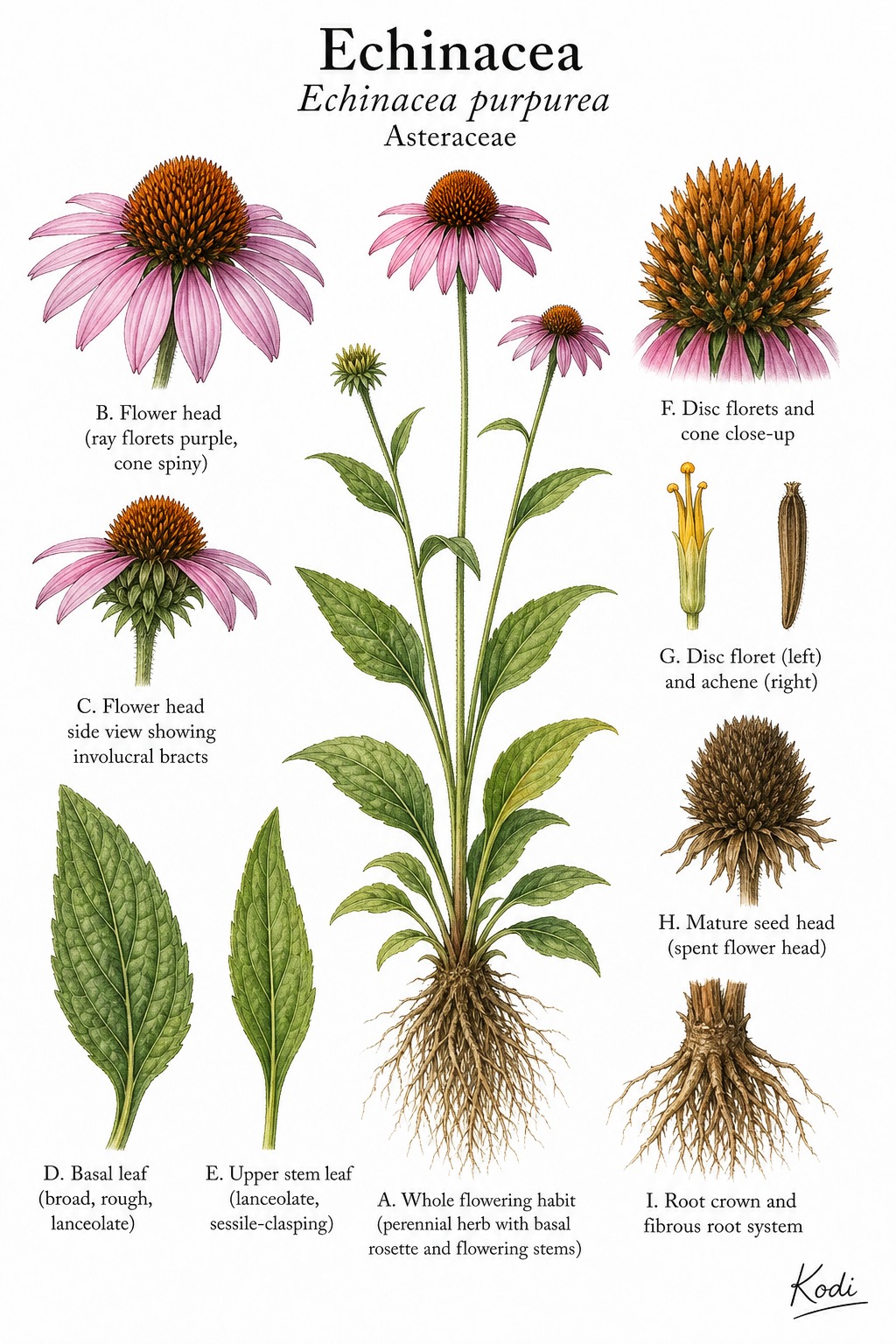
Known in TCM as Zi Zhui Hua (紫锥花), this acrid and sweet, cool herb enters the Lung and Spleen. Traditionally, it supports the exterior and upper respiratory tract - in integrative East-West herbal practice, echinacea is mapped as a short-term herb for sore throat, early respiratory infection, and recurrent exposure situations rather than as a deep tonic or long-term constitutional herb, most often applied for common cold, upper respiratory infection, and sore throat. Modern research has identified Alkamides among its active constituents.
TCM Properties
- Taste
- acrid, sweet
- Temperature
- cool
- Channels
- Lung, Spleen
Traditional Use
Primary Actions
- Supports the exterior and upper respiratory tract - in integrative East-West herbal practice, echinacea is mapped as a short-term herb for sore throat, early respiratory infection, and recurrent exposure situations rather than as a deep tonic or long-term constitutional herb.
- Assists immune response and toxin resolution - modern herbalists use it when swollen glands, throat irritation, and mild infectious symptoms suggest the body needs brief immune-modulating support.
- Can be used topically or internally - beyond capsules and tinctures for colds, echinacea has also been used in modern herbal medicine for mouth, throat, and superficial skin applications.
Secondary Actions
- Echinacea is a North American botanical and is not part of the classical Chinese materia medica, so any TCM channel and property mapping is modern and approximate rather than canonical.
- Commercial echinacea products vary widely by species, plant part, and extraction method, which helps explain why human trial results are inconsistent.
Classic Formulas
- No canonical Shang Han Lun or Jin Gui Yao Lue formula includes echinacea because it entered Chinese-style practice only in the modern integrative era.
- Contemporary practitioners sometimes combine echinacea with wind-heat or throat-soothing strategies, but these are modern custom formulas rather than classical precedents.
- Short-course tincture, tea, lozenge, and throat-support combinations are more representative of echinacea use than fixed historical TCM prescriptions.
Classical References
- Echinacea does not appear in the core classical Chinese materia medica canon because it is indigenous to North America rather than East Asia.
- Its present-day use in TCM settings is best understood as modern integrative adaptation, not as a traditional superior, middle, or lower grade Chinese herb.
- Most traditional use literature comes from North American and later Western herbal medicine rather than from early Chinese herbological texts.
Modern Research
Active Compounds
- Alkamides - lipophilic constituents often linked to echinacea's immunomodulatory signaling effects
- Cichoric acid and related caffeic acid derivatives - characteristic phenolics commonly used in standardization work
- Polysaccharides and glycoproteins - larger constituents studied for macrophage and innate-immune activity
- Flavonoids and minor phenolic compounds - broader antioxidant and phytochemical support matrix
Studied Effects
- A critical review concluded that echinacea has reasonably strong preclinical immunomodulatory data and suggestive but not definitive human evidence for acute upper respiratory infection support (PMID 12622467).
- A Cochrane review found mixed evidence for preventing and treating the common cold, with major heterogeneity between products, species, and trial design (PMID 24554461).
- Short-course echinacea root dosing altered CYP1A2 and CYP3A4 activity in vivo, which is more relevant clinically than many consumers realize when combining supplements and medicines (PMID 14749695).
- Echinacea purpurea flower extract and cichoric acid showed antiproliferative effects in colon cancer cell lines, but this remains in vitro work and does not establish a clinical anticancer role (PMID 22971663).
PubMed References
- Medicinal properties of Echinacea: a critical review (2003)
- Echinacea for preventing and treating the common cold (2014)
- The effect of echinacea (Echinacea purpurea root) on cytochrome P450 activity in vivo (2004)
- Cytotoxic effects of Echinacea purpurea flower extracts and cichoric acid on human colon cancer cells through induction of apoptosis (2012)
Safety & Interactions
Contraindications
- Known allergy to ragweed, daisies, chrysanthemums, or other Asteraceae family plants
- History of severe allergic reaction to echinacea products
- Use without clinician input in patients taking immunosuppressive therapy
Cautions
- Memorial Sloan Kettering notes that echinacea products can interact with medications and that supplement quality and composition vary considerably between brands.
- Side effects are usually mild, but rash, headache, nausea, dizziness, and stomach upset can occur, especially in sensitive users.
- Echinacea is better suited to short-term use during acute situations than to indefinite daily use as a generalized immune booster.
Drug Interactions
- Immunosuppressive medications - theoretical opposing immune effects
- CYP1A2 or CYP3A4 substrate drugs - echinacea root altered these pathways in a human pharmacokinetic study
Conditions
- Common Cold Research ★★☆☆☆ JSON
- Upper Respiratory Infection Research ★★☆☆☆ JSON
- Sore Throat Traditional ★★★☆☆ JSON
- Respiratory Infections Research ★★☆☆☆ JSON
Frequently Asked Questions
What is Echinacea used for?
Echinacea is traditionally used to Supports the exterior and upper respiratory tract - in integrative East-West herbal practice, echinacea is mapped as a short-term herb for sore throat, early respiratory infection, and recurrent exposure situations rather than as a deep tonic or long-term constitutional herb., Assists immune response and toxin resolution - modern herbalists use it when swollen glands, throat irritation, and mild infectious symptoms suggest the body needs brief immune-modulating support., Can be used topically or internally - beyond capsules and tinctures for colds, echinacea has also been used in modern herbal medicine for mouth, throat, and superficial skin applications.. Research has investigated its effects on: A critical review concluded that echinacea has reasonably strong preclinical immunomodulatory data and suggestive but not definitive human evidence for acute upper respiratory infection support (PMID 12622467).; A Cochrane review found mixed evidence for preventing and treating the common cold, with major heterogeneity between products, species, and trial design (PMID 24554461)..
Is Echinacea safe during pregnancy?
The safety of Echinacea during pregnancy has not been established. Consult a qualified healthcare provider before use.
What are the contraindications for Echinacea?
Echinacea should not be used in: Known allergy to ragweed, daisies, chrysanthemums, or other Asteraceae family plants; History of severe allergic reaction to echinacea products; Use without clinician input in patients taking immunosuppressive therapy. Consult a qualified healthcare provider before use.
Does Echinacea interact with any medications?
Echinacea may interact with: Immunosuppressive medications - theoretical opposing immune effects; CYP1A2 or CYP3A4 substrate drugs - echinacea root altered these pathways in a human pharmacokinetic study. Always inform your healthcare provider of any herbal supplements you are taking.