Guang Earthworm
- Chinese
- 广地龙
- Pinyin
- Guang Di Long
- Latin
- Pheretima aspergillum
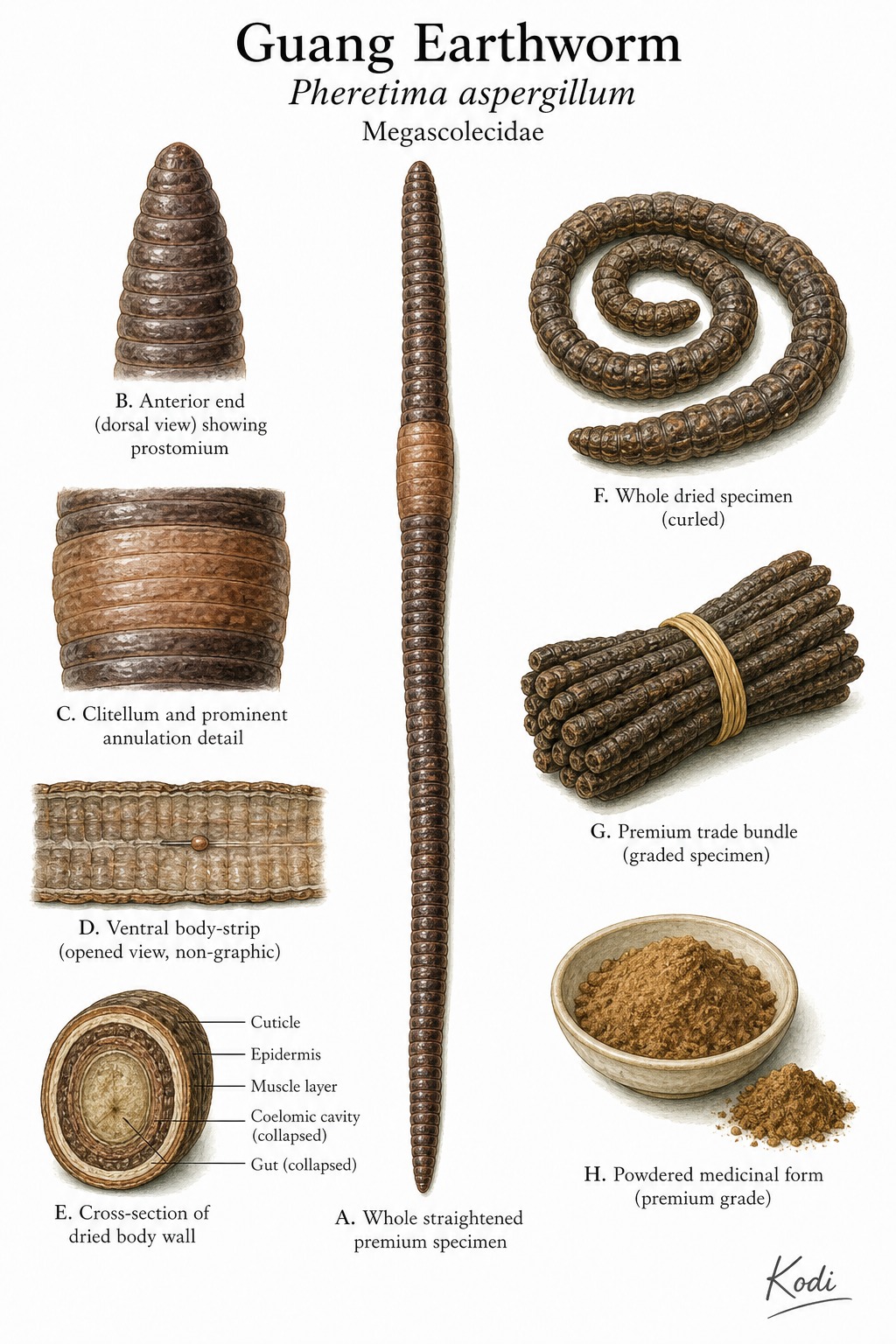
Known in TCM as Guang Di Long (广地龙), this salty, cold herb enters the Bladder, Liver, Lung, and Spleen. Traditionally, it opens channels and collaterals - Guang Di Long is the premium-grade earthworm source long favored when post-stroke numbness, hemiplegia, painful obstruction, or channel blockage need a strong penetrating animal medicine, most often applied for stroke, wheezing, and joint pain. Modern research has identified Lumbrokinase among its active constituents.
Also Known As
Latin: Pheretima aspergillum | Pinyin: Guang Di Long | Chinese: 广地龙
TCM Properties
- Taste
- salty
- Temperature
- cold
- Channels
- Bladder, Liver, Lung, Spleen
Traditional Use
Primary Actions
- Opens channels and collaterals - Guang Di Long is the premium-grade earthworm source long favored when post-stroke numbness, hemiplegia, painful obstruction, or channel blockage need a strong penetrating animal medicine.
- Clears Lung heat and calms wheezing - like Di Long generally, it is used for dyspnea, stubborn cough, and wheeze when heat and obstruction bind the Lung.
- Clears heat, extinguishes internal wind, and promotes urination - it can be chosen for spasms, red swollen painful joints, edema, or difficult urination when heat is part of the pattern.
Secondary Actions
- Guang Di Long specifically refers to the Guangdong-grade Pheretima aspergillum source, traditionally regarded as superior in authenticity and clinical strength.
- Modern quality control work focuses heavily on authentication because Guang Di Long is frequently adulterated with lower-value earthworm materials.
Classic Formulas
- Bu Yang Huan Wu Tang - a standard post-stroke formula in which Guang Di Long may be selected as the highest-quality channel-opening earthworm source.
- Guang Di Long with Ma Huang and Xing Ren - a traditional approach for Lung-heat wheezing and difficult breathing.
- Guang Di Long with heat-clearing and blood-invigorating herbs - used historically for red, swollen, painful obstruction and channel heat.
Classical References
- Chinese pharmacopoeial tradition distinguishes Guang-type and other Pheretima sources but preserves the same core functions of clearing heat, stopping spasms, and opening the channels.
- The designation Guang Di Long historically reflects daodi sourcing and quality preference rather than a totally different therapeutic category from Di Long.
- Its premium status is one reason authentication remains a major modern issue in the market.
Modern Research
Active Compounds
- Lumbrokinase and related fibrinolytic enzymes - major protein fractions associated with antithrombotic research
- Nucleosides such as hypoxanthine and inosine - important chemical markers in Guang Di Long quality-control studies
- Peptide and protein fractions - broader bioactive material investigated in antifibrotic and anti-inflammatory work
- Trace minerals and other matrix constituents - relevant to safety and quality assessment
Studied Effects
- Pheretima aspergillum improved neurologic recovery in a rat middle-cerebral-artery occlusion model, supporting the continued association of Guang Di Long with stroke and collateral-opening research (PMID 24082328).
- Recent clinical-interest literature on lumbrokinase supports ongoing stroke and thrombosis research, but standardized product quality remains a limiting issue for translation into routine care (PMID 40933244).
- Authentication and contamination studies show that modern Guang Di Long research is as much about confirming identity and market safety as about pharmacology alone.
PubMed References
- Effect of oral administration of Pheretima aspergillum (earthworm) in rats with cerebral infarction induced by middle-cerebral artery occlusion (2013)
- Therapeutic Potential of Lumbrokinase in Acute Ischemic Stroke: A Meta-Analysis of Efficacy and Safety (2024)
- Heavy Metals and Probabilistic Risk Assessment via Pheretima (a Traditional Chinese Medicine) Consumption in China (2022)
Safety & Interactions
Contraindications
- Cold deficiency patterns without heat or obstruction
- Known allergy to animal-derived medicines
- Active bleeding disorders without close supervision
Cautions
- Guang Di Long quality varies widely in commerce, and authentication matters because adulteration is common.
- Coagulation effects and contamination concerns, including heavy metals in some market samples, warrant more caution than its common-label simplicity suggests.
- MSK page not found - drug interaction data not available from Memorial Sloan Kettering integrative medicine database
Drug Interactions
- Anticoagulants or antiplatelet drugs - theoretical additive bleeding risk
- Fibrinolytic or thrombolytic medications - theoretical additive clot-dissolving effect
Conditions
Frequently Asked Questions
What is Guang Earthworm used for?
Guang Earthworm is traditionally used to Opens channels and collaterals - Guang Di Long is the premium-grade earthworm source long favored when post-stroke numbness, hemiplegia, painful obstruction, or channel blockage need a strong penetrating animal medicine., Clears Lung heat and calms wheezing - like Di Long generally, it is used for dyspnea, stubborn cough, and wheeze when heat and obstruction bind the Lung., Clears heat, extinguishes internal wind, and promotes urination - it can be chosen for spasms, red swollen painful joints, edema, or difficult urination when heat is part of the pattern.. Research has investigated its effects on: Pheretima aspergillum improved neurologic recovery in a rat middle-cerebral-artery occlusion model, supporting the continued association of Guang Di Long with stroke and collateral-opening research (PMID 24082328).; Recent clinical-interest literature on lumbrokinase supports ongoing stroke and thrombosis research, but standardized product quality remains a limiting issue for translation into routine care (PMID 40933244)..
What are other names for Guang Earthworm?
Guang Earthworm is also known as Pheretima. In TCM: 广地龙 (Guang Di Long); Pheretima aspergillum.
Is Guang Earthworm safe during pregnancy?
The safety of Guang Earthworm during pregnancy has not been established. Consult a qualified healthcare provider before use.
What are the contraindications for Guang Earthworm?
Guang Earthworm should not be used in: Cold deficiency patterns without heat or obstruction; Known allergy to animal-derived medicines; Active bleeding disorders without close supervision. Consult a qualified healthcare provider before use.
Does Guang Earthworm interact with any medications?
Guang Earthworm may interact with: Anticoagulants or antiplatelet drugs - theoretical additive bleeding risk; Fibrinolytic or thrombolytic medications - theoretical additive clot-dissolving effect. Always inform your healthcare provider of any herbal supplements you are taking.