Doubleteeth Pubescent Angelica Root
- Chinese
- 独活
- Pinyin
- Du Huo
- Latin
- Radix Angelicae Pubescentis
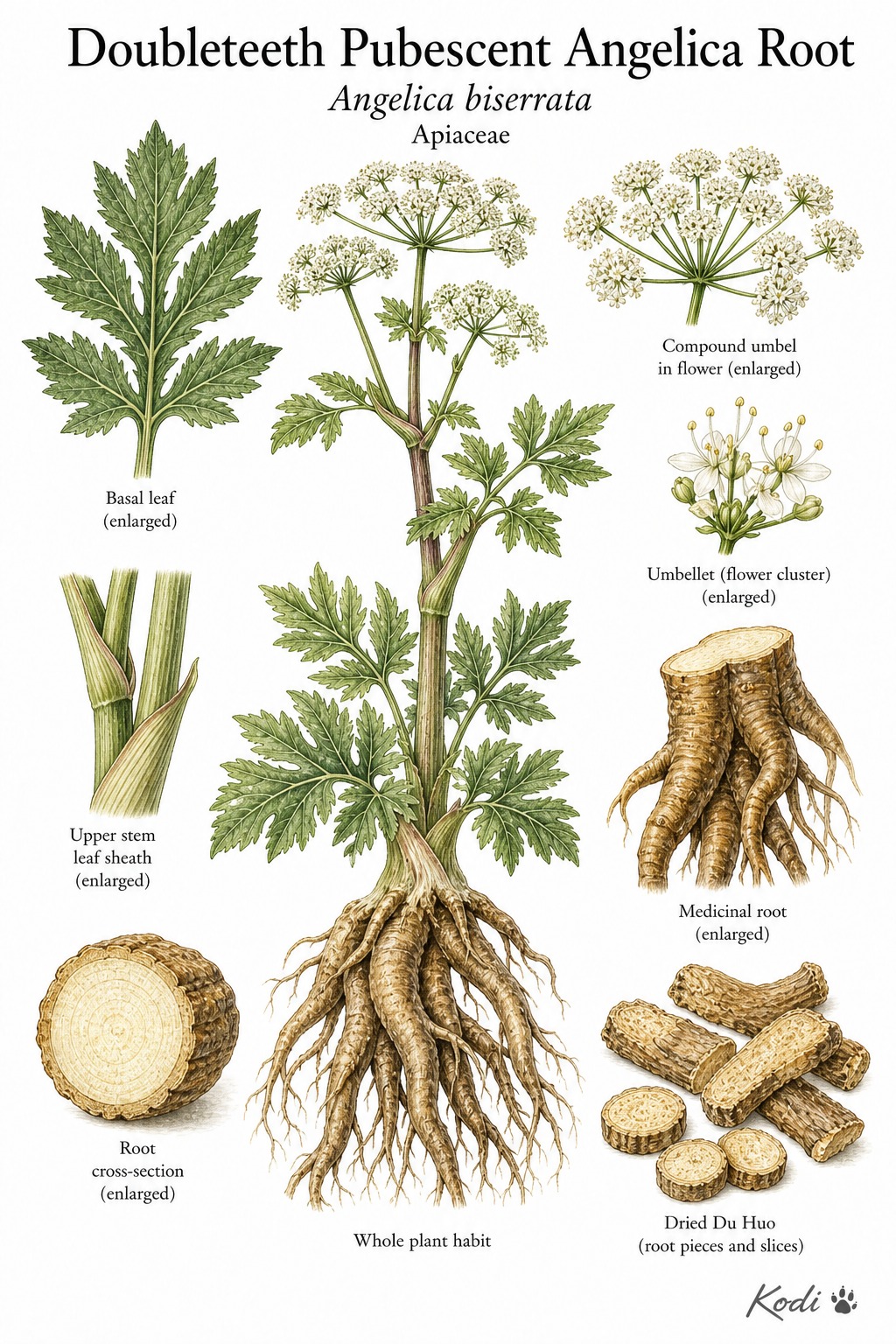
Known in TCM as Du Huo (独活), this bitter and acrid, slightly warm herb enters the Kidney and Urinary Bladder. Traditionally, it dispels wind-damp and alleviates pain - Du Huo is a classic herb for painful obstruction patterns, especially when aching, heaviness, and stiffness affect the lower back, hips, and legs, most often applied for rheumatism, joint pain, and low back pain. Modern research has identified Osthol among its active constituents.
Part used: Root
Also Known As
Latin: Radix Angelicae Pubescentis | Pinyin: Du Huo | Chinese: 独活
TCM Properties
- Taste
- bitter, acrid
- Temperature
- slightly warm
- Channels
- Kidney, Urinary Bladder
Traditional Use
Primary Actions
- Dispels wind-damp and alleviates pain - Du Huo is a classic herb for painful obstruction patterns, especially when aching, heaviness, and stiffness affect the lower back, hips, and legs.
- Targets the lower body in wind-cold-damp patterns - compared with many other expelling herbs, Du Huo is especially valued when symptoms center below the waist.
- Releases the exterior and treats headache - traditional use extends to headache from external wind-cold, particularly when body pain and dampness are also present.
Secondary Actions
- Its specialty is lower-body wind-damp pain, which is why Du Huo appears so often in Bi-syndrome formulas for the lumbar region and knees.
- Because it is gently warm and dispersing rather than strongly tonic, it is commonly paired with blood and Liver-Kidney support herbs when chronic deficiency and pain coexist.
Classic Formulas
- Du Huo Ji Sheng Tang - the best-known Du Huo formula for chronic wind-cold-damp Bi with low-back and knee pain on a background of qi-blood and Liver-Kidney deficiency.
- Qiang Huo Sheng Shi Tang family strategies - use Du Huo when exterior dampness and aching affect the body, especially the lower half.
- Du Huo with Sang Ji Sheng and Niu Xi - traditional pairing logic when painful obstruction is chronic and centered in the low back and legs.
Classical References
- Traditional materia medica describe Du Huo as bitter, acrid, and slightly warm, used to dispel wind, overcome dampness, and relieve pain.
- Its long-standing reputation for lower-body Bi syndrome explains why it remains one of the signature herbs for chronic low-back, hip, and leg pain in TCM practice.
Modern Research
Active Compounds
- Osthol - a characteristic coumarin with anti-inflammatory and analgesic research relevance
- Columbianadin and related coumarins - important phytochemical markers of Angelica pubescens
- Imperatorin and isoimperatorin - coumarins contributing to anti-inflammatory and vascular pharmacology discussions
- Volatile oils and additional phenolic constituents - broader supportive phytochemical fractions
Studied Effects
- A major 2020 review summarized the phytochemistry, pharmacology, and pharmacokinetics of Angelicae Pubescentis Radix and highlighted anti-inflammatory, analgesic, and neuroprotective potential relevant to Du Huo's classic pain indications (PMID 32256373).
- Angelica pubescens root extract showed anti-photoaging and anti-inflammatory activity in UVB-exposed fibroblasts, illustrating broader tissue-protective effects beyond pain applications (PMID 29996001).
- Recent experimental work on Angelica pubescens polysaccharides found anti-inflammatory and rheumatoid-arthritis-modulating effects in preclinical models, supporting continuing modern interest in its Bi-syndrome relevance (PMID 40473161).
PubMed References
- Traditional Chinese Medicine of Angelicae Pubescentis Radix: A Review of Phytochemistry, Pharmacology and Pharmacokinetics (2020)
- Anti-photoaging effects of Angelica pubescens root ethanol extract in human dermal fibroblasts (2018)
- Angelica pubescens polysaccharides ameliorate rheumatoid arthritis by modulating inflammatory pathways and gut microbiota in rats (2025)
Safety & Interactions
Contraindications
- Yin deficiency heat patterns
- Blood deficiency with dryness and no wind-damp obstruction
Cautions
- Du Huo is best matched to cold-damp painful obstruction rather than to hot, inflamed pain from marked deficiency heat.
- Most modern evidence remains preclinical rather than derived from large human pain trials.
Conditions
- Rheumatism Traditional ★★★★☆ JSON
- Joint Pain Traditional ★★★★☆ JSON
- Low Back Pain Traditional ★★★☆☆ JSON
- Headache Traditional ★★☆☆☆ JSON
Frequently Asked Questions
What is Doubleteeth Pubescent Angelica Root used for?
Doubleteeth Pubescent Angelica Root is traditionally used to Dispels wind-damp and alleviates pain - Du Huo is a classic herb for painful obstruction patterns, especially when aching, heaviness, and stiffness affect the lower back, hips, and legs., Targets the lower body in wind-cold-damp patterns - compared with many other expelling herbs, Du Huo is especially valued when symptoms center below the waist., Releases the exterior and treats headache - traditional use extends to headache from external wind-cold, particularly when body pain and dampness are also present.. Research has investigated its effects on: A major 2020 review summarized the phytochemistry, pharmacology, and pharmacokinetics of Angelicae Pubescentis Radix and highlighted anti-inflammatory, analgesic, and neuroprotective potential relevant to Du Huo's classic pain indications (PMID 32256373).; Angelica pubescens root extract showed anti-photoaging and anti-inflammatory activity in UVB-exposed fibroblasts, illustrating broader tissue-protective effects beyond pain applications (PMID 29996001)..
What are other names for Doubleteeth Pubescent Angelica Root?
Doubleteeth Pubescent Angelica Root is also known as Angelica. In TCM: 独活 (Du Huo); Radix Angelicae Pubescentis.
Is Doubleteeth Pubescent Angelica Root safe during pregnancy?
The safety of Doubleteeth Pubescent Angelica Root during pregnancy has not been established. Consult a qualified healthcare provider before use.
What are the contraindications for Doubleteeth Pubescent Angelica Root?
Doubleteeth Pubescent Angelica Root should not be used in: Yin deficiency heat patterns; Blood deficiency with dryness and no wind-damp obstruction. Consult a qualified healthcare provider before use.