Dogbane Leaf
- Chinese
- 罗布麻叶
- Pinyin
- Luo Bu Ma Ye
- Latin
- Folium Apocyni Veneti
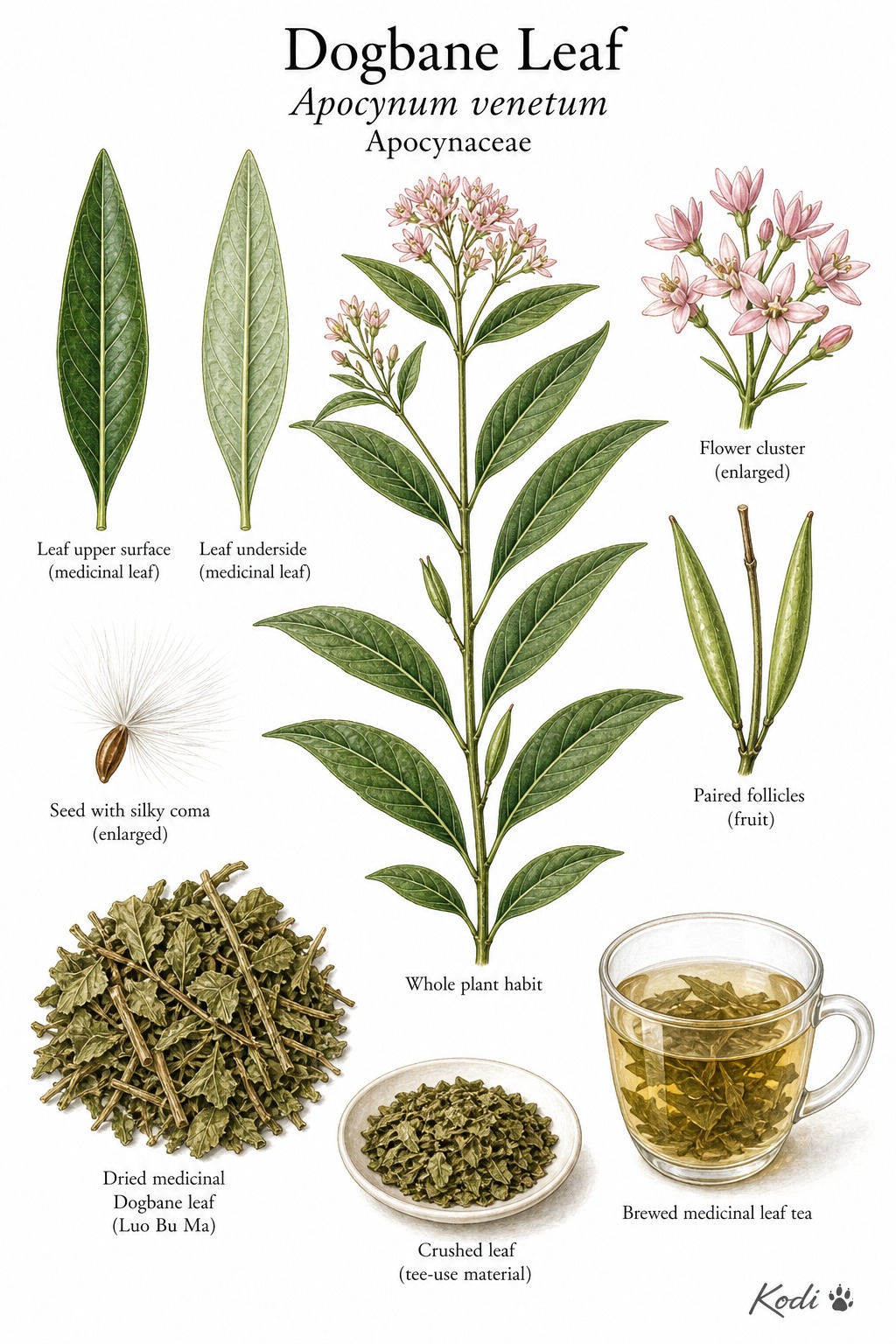
Known in TCM as Luo Bu Ma Ye (罗布麻叶), this sweet and bitter, cool herb enters the Liver. Traditionally, it clears heat and helps lower rising pressure - Luo Bu Ma leaf is used in modern TCM practice for hypertension-like presentations with dizziness, headache, irritability, and Liver heat or rising Yang patterns, most often applied for hypertension, edema, and insomnia. Modern research has identified Flavonoids among its active constituents.
Part used: Leaf
Also Known As
Latin: Folium Apocyni Veneti | Pinyin: Luo Bu Ma Ye | Chinese: 罗布麻叶
TCM Properties
- Taste
- sweet, bitter
- Temperature
- cool
- Channels
- Liver
Traditional Use
Primary Actions
- Clears heat and helps lower rising pressure - Luo Bu Ma leaf is used in modern TCM practice for hypertension-like presentations with dizziness, headache, irritability, and Liver heat or rising Yang patterns.
- Strengthens the Heart and promotes urination - traditional indications extend to palpitations, edema, and fluid retention when heat and circulatory strain coexist.
- Calms agitation and eases restlessness - the leaf is widely used as a medicinal tea when irritability, poor sleep, and tension accompany elevated pressure.
Secondary Actions
- Luo Bu Ma sits at the border of herb and tea, and many people encounter it more often in medicated-tea or wellness-drink form than in classical decoction formulas.
- The leaf material is the part most commonly used; later shorthand often says Luo Bu Ma even when the actual medicinal item is Luo Bu Ma Ye.
Classic Formulas
- Luo Bu Ma tea preparations - later medicinal-tea traditions use the leaf alone or with Ju Hua for dizziness, irritability, and elevated pressure.
- Luo Bu Ma with Ze Xie or Che Qian Zi - later pairing logic when head pressure coexists with edema and scanty urination.
Classical References
- TCM Wiki describes Luo Bu Ma as sweet, bitter, and cool, entering the Liver channel, with actions of clearing heat, decreasing blood pressure, strengthening the heart, and inducing diuresis.
- Modern Chinese herb manuals commonly present Luo Bu Ma as a mild but useful leaf for hypertension, edema, and agitation, especially in tea form.
Modern Research
Active Compounds
- Flavonoids such as hyperoside, isoquercitrin, and quercetin derivatives - major bioactive constituents repeatedly linked to vascular and antioxidant activity
- Chlorogenic acid and related phenolic acids - polyphenols contributing to anti-inflammatory and metabolic research interest
- Polysaccharides - investigated for gut, metabolic, and immunomodulatory effects
- Dietary fiber fractions - part of the leaf's modern functional-food profile
Studied Effects
- A 2024 review cataloged hundreds of compounds from Apocynum venetum leaves and summarized broad antioxidant, anti-inflammatory, cardioprotective, and metabolic research around the plant (PMID 39447713).
- In a 2023 experimental study, Apocynum venetum leaf extract improved doxorubicin-induced cardiotoxicity in mice, supporting ongoing cardiovascular interest in the herb beyond its traditional tea reputation (PMID 38074154).
- Polysaccharide-rich Apocynum venetum leaf extracts improved glucose and lipid metabolism and modulated gut microbiota in diabetic mice, illustrating the modern functional-food direction of Luo Bu Ma research (PMID 32361160).
PubMed References
- An Updated Comprehensive Review of Phytochemistry and Pharmacology of Apocynum venetum L. Leaves (2024)
- Apocynum venetum leaf extract alleviates doxorubicin-induced cardiotoxicity via activating OSM and restoring the gut microbiota composition in mice (2023)
- Hypoglycemic and hypolipidemic effects of polysaccharide-rich extracts from Apocynum venetum leaves and their effective constituents (2020)
Safety & Interactions
Contraindications
- Low blood pressure or marked deficiency with dizziness from non-heat causes
- Spleen deficiency with loose stools if cooling teas aggravate digestion
Cautions
- Although often sold as a tea, Luo Bu Ma can still have physiologic effects and is not equivalent to an inert beverage.
- Its cooling and pressure-lowering profile may be too dispersing for depleted or hypotensive users.
- Modern research is promising but remains far stronger in preclinical and functional-food settings than in large clinical trials.
Drug Interactions
- Antihypertensive drugs or diuretics - Luo Bu Ma may add to blood-pressure-lowering or fluid-lowering effects.
- Sedatives - calming tea or extract use may increase drowsiness in sensitive users.
Conditions
Frequently Asked Questions
What is Dogbane Leaf used for?
Dogbane Leaf is traditionally used to Clears heat and helps lower rising pressure - Luo Bu Ma leaf is used in modern TCM practice for hypertension-like presentations with dizziness, headache, irritability, and Liver heat or rising Yang patterns., Strengthens the Heart and promotes urination - traditional indications extend to palpitations, edema, and fluid retention when heat and circulatory strain coexist., Calms agitation and eases restlessness - the leaf is widely used as a medicinal tea when irritability, poor sleep, and tension accompany elevated pressure.. Research has investigated its effects on: A 2024 review cataloged hundreds of compounds from Apocynum venetum leaves and summarized broad antioxidant, anti-inflammatory, cardioprotective, and metabolic research around the plant (PMID 39447713).; In a 2023 experimental study, Apocynum venetum leaf extract improved doxorubicin-induced cardiotoxicity in mice, supporting ongoing cardiovascular interest in the herb beyond its traditional tea reputation (PMID 38074154)..
What are other names for Dogbane Leaf?
Dogbane Leaf is also known as Apocyni. In TCM: 罗布麻叶 (Luo Bu Ma Ye); Folium Apocyni Veneti.
Is Dogbane Leaf safe during pregnancy?
The safety of Dogbane Leaf during pregnancy has not been established. Consult a qualified healthcare provider before use.
What are the contraindications for Dogbane Leaf?
Dogbane Leaf should not be used in: Low blood pressure or marked deficiency with dizziness from non-heat causes; Spleen deficiency with loose stools if cooling teas aggravate digestion. Consult a qualified healthcare provider before use.
Does Dogbane Leaf interact with any medications?
Dogbane Leaf may interact with: Antihypertensive drugs or diuretics - Luo Bu Ma may add to blood-pressure-lowering or fluid-lowering effects.; Sedatives - calming tea or extract use may increase drowsiness in sensitive users.. Always inform your healthcare provider of any herbal supplements you are taking.