Dodder Seed
- Chinese
- 菟丝子
- Pinyin
- Tu Si Zi
- Latin
- Semen Cuscutae
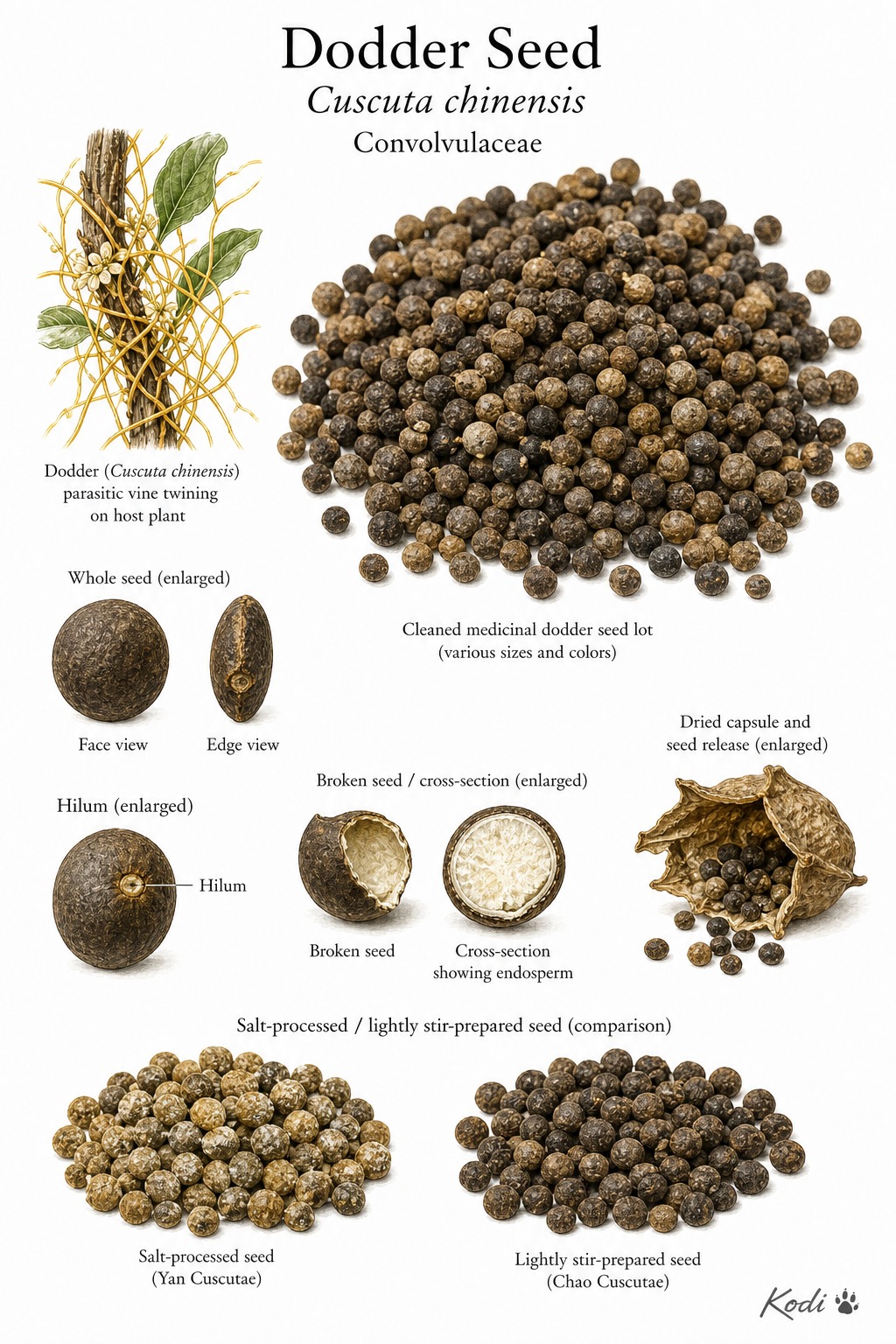
Known in TCM as Tu Si Zi (菟丝子), this sweet and astringent, slightly warm herb enters the Kidney, Spleen, and Liver. Traditionally, it tonifies the Kidneys and supplements essence without being overly harsh - Tu Si Zi is used for infertility, impotence, spermatorrhea, sore low back, and constitutional weakness rooted in Kidney deficiency, most often applied for infertility, threatened miscarriage, and frequent urination. Modern research has identified Hyperoside among its active constituents.
Part used: Seed
Also Known As
Latin: Semen Cuscutae | Pinyin: Tu Si Zi | Chinese: 菟丝子
TCM Properties
- Taste
- sweet, astringent
- Temperature
- slightly warm
- Channels
- Kidney, Spleen, Liver
Traditional Use
Primary Actions
- Tonifies the Kidneys and supplements essence without being overly harsh - Tu Si Zi is used for infertility, impotence, spermatorrhea, sore low back, and constitutional weakness rooted in Kidney deficiency.
- Secures essence and reduces urination - its astringing side makes it especially useful when weakness causes nocturnal emission, frequent urination, enuresis, or leukorrhea.
- Nourishes the Liver and improves vision - traditional use extends to blurry or dim vision associated with Liver-Kidney deficiency.
- Tonifies the Spleen to stop diarrhea and calms the fetus - the herb is unusual among Kidney tonics for also appearing in deficiency-type diarrhea and threatened-miscarriage formulas.
Secondary Actions
- Classical teaching often praises Tu Si Zi as supplementing without being too drying or too cloying, which explains its broad use across mixed yin-yang deficiency patterns.
- Salt processing or cake-style preparation is traditionally used to direct it more strongly to the Kidneys and lower burner.
Classic Formulas
- Wu Zi Yan Zong Wan - major reproductive and fertility formula using Tu Si Zi to tonify Kidney essence and support semen quality.
- Shou Tai Wan - classic formula using Tu Si Zi to secure the Kidneys and calm the fetus in threatened miscarriage from deficiency.
- Vision-supporting formulas with Gou Qi Zi and Shu Di Huang - common Liver-Kidney combination logic for blurred vision and weakness.
Classical References
- TCM Wiki describes Tu Si Zi as sweet, astringent, and slightly warm, entering the Kidney, Spleen, and Liver channels, with actions of tonifying the Kidneys, nourishing essence, improving vision, securing leakage, checking diarrhea, and preventing miscarriage.
- Traditional comparisons often contrast Tu Si Zi with stronger Yang tonics by noting that it nourishes and secures with less drying heat.
Modern Research
Active Compounds
- Hyperoside - a major flavonol glycoside often highlighted in pharmacology reviews
- Quercetin and kaempferol derivatives - flavonoid constituents linked to antioxidant and anti-inflammatory activity
- Chlorogenic acid and related phenolics - additional small molecules contributing to broader activity profiles
Studied Effects
- A systematic review of Cuscuta chinensis summarized ethnopharmacology, phytochemistry, and pharmacology across many traditional uses, providing the broadest modern background for Tu Si Zi (PMID 25281912).
- Bioassay-guided research identified Tu Si Zi components that promoted neural stem cell proliferation, illustrating a modern regenerative research direction that remains preclinical (PMID 34771043).
- Hyperoside-centered review work continues to support antioxidant, anti-inflammatory, and neuroprotective interpretations of one important Tu Si Zi constituent (PMID 35561084).
PubMed References
- Cuscuta chinensis Lam.: A systematic review on ethnopharmacology, phytochemistry and pharmacology of an important traditional herbal medicine (2014)
- Study on Active Components of Cuscuta chinensis Promoting Neural Stem Cells Proliferation: Bioassay-Guided Fractionation (2021)
- Hyperoside: A review on its sources, biological activities, and molecular mechanisms (2022)
Safety & Interactions
Contraindications
- Yin deficiency with pronounced heat
- Constipation from dryness or heat
- Painful dark scanty urination from excess heat
Cautions
- Although Tu Si Zi appears in miscarriage-prevention formulas, pregnancy use should still be formula-based and practitioner-directed rather than casual self-use.
- Commercial seed products vary in processing quality, which can shift the balance between tonic and astringing effects.
Conditions
- Infertility Traditional ★★★★☆ JSON
- Threatened Miscarriage Traditional ★★★★☆ JSON
- Frequent Urination Traditional ★★★★☆ JSON
- Blurred Vision Traditional ★★★☆☆ JSON
- Diarrhea Traditional ★★★☆☆ JSON
Frequently Asked Questions
What is Dodder Seed used for?
Dodder Seed is traditionally used to Tonifies the Kidneys and supplements essence without being overly harsh - Tu Si Zi is used for infertility, impotence, spermatorrhea, sore low back, and constitutional weakness rooted in Kidney deficiency., Secures essence and reduces urination - its astringing side makes it especially useful when weakness causes nocturnal emission, frequent urination, enuresis, or leukorrhea., Nourishes the Liver and improves vision - traditional use extends to blurry or dim vision associated with Liver-Kidney deficiency., Tonifies the Spleen to stop diarrhea and calms the fetus - the herb is unusual among Kidney tonics for also appearing in deficiency-type diarrhea and threatened-miscarriage formulas.. Research has investigated its effects on: A systematic review of Cuscuta chinensis summarized ethnopharmacology, phytochemistry, and pharmacology across many traditional uses, providing the broadest modern background for Tu Si Zi (PMID 25281912).; Bioassay-guided research identified Tu Si Zi components that promoted neural stem cell proliferation, illustrating a modern regenerative research direction that remains preclinical (PMID 34771043)..
What are other names for Dodder Seed?
Dodder Seed is also known as Cuscuta. In TCM: 菟丝子 (Tu Si Zi); Semen Cuscutae.
Is Dodder Seed safe during pregnancy?
The safety of Dodder Seed during pregnancy has not been established. Consult a qualified healthcare provider before use.
What are the contraindications for Dodder Seed?
Dodder Seed should not be used in: Yin deficiency with pronounced heat; Constipation from dryness or heat; Painful dark scanty urination from excess heat. Consult a qualified healthcare provider before use.