Dendrobium Stem
- Chinese
- 石斛
- Pinyin
- Shi Hu
- Latin
- Herba Dendrobii
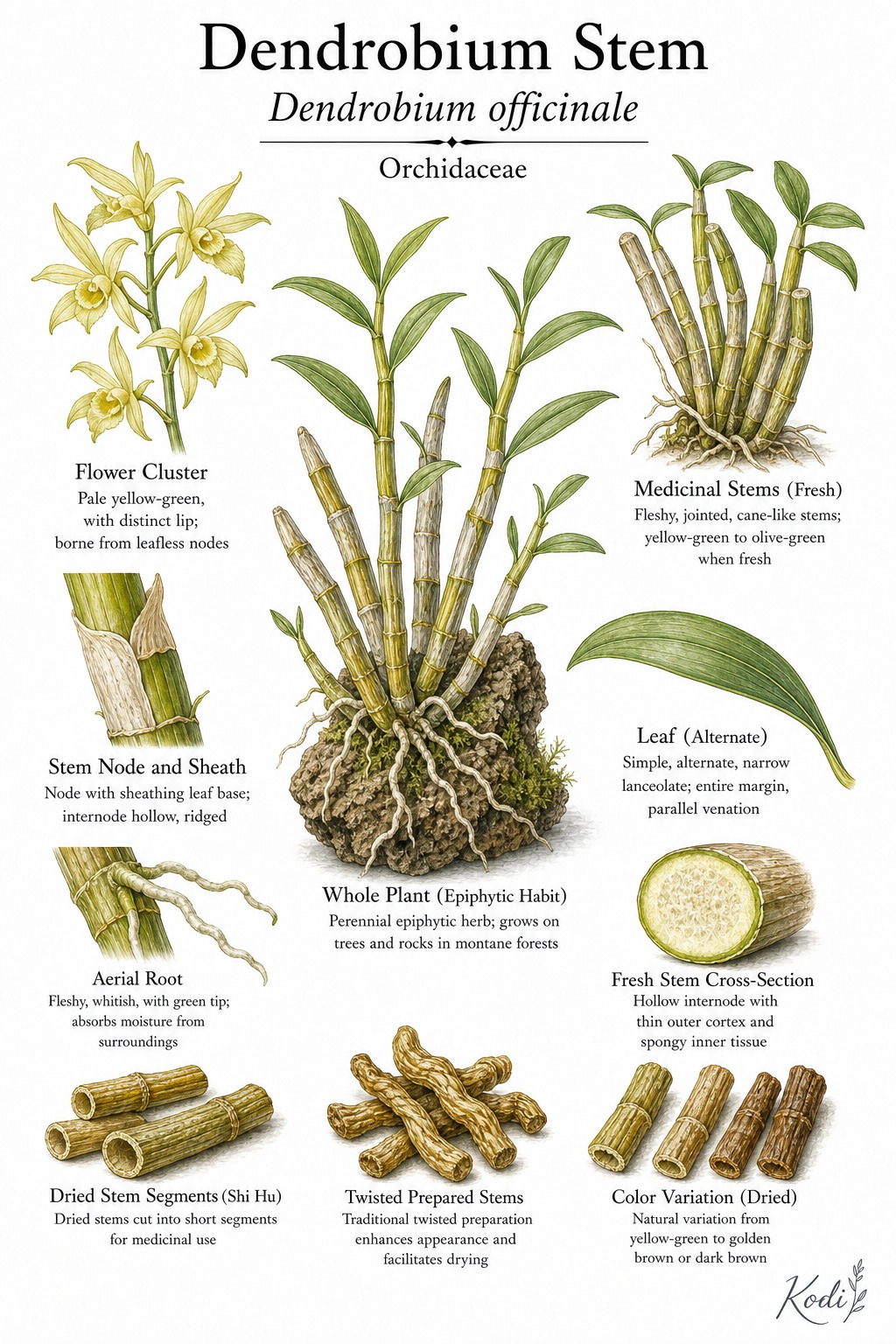
Known in TCM as Shi Hu (石斛), this sweet, slightly cold herb enters the Stomach and Kidney. Traditionally, it nourishes Stomach Yin and generates fluids - Shi Hu is a classic herb for dry mouth, thirst, hunger without desire to eat, and burning or uncomfortable epigastric sensation from fluid depletion and yin deficiency, most often applied for digestive weakness, poor appetite, and blurred vision. Modern research has identified Polysaccharides among its active constituents.
Part used: Whole herb
Also Known As
Latin: Herba Dendrobii | Pinyin: Shi Hu | Chinese: 石斛
TCM Properties
- Taste
- sweet
- Temperature
- slightly cold
- Channels
- Stomach, Kidney
Traditional Use
Primary Actions
- Nourishes Stomach Yin and generates fluids - Shi Hu is a classic herb for dry mouth, thirst, hunger without desire to eat, and burning or uncomfortable epigastric sensation from fluid depletion and yin deficiency.
- Nourishes Kidney Yin and clears deficiency heat - traditional use includes low-grade fever, wasting, and weakness patterns where deep yin depletion has begun to affect the lower burner.
- Benefits the eyes and sinews in deficiency patterns - later teaching extends Shi Hu to blurred vision and weakness of tendons or bones when Liver-Kidney yin is depleted.
Secondary Actions
- Among yin tonics, Shi Hu is valued for combining moisture-restoring and heat-clearing actions without being excessively cloying.
- Tea-like use of selected Shi Hu preparations is a common traditional strategy when gentle, sustained fluid restoration is desired.
Classic Formulas
- Qing Re Bao Jin Tang - classical warm-disease formula using Shi Hu to replenish fluids injured by heat.
- Shi Hu Ye Guang Wan - eye-focused formula pairing Shi Hu with Liver-Kidney nourishing herbs for dim or blurry vision from deficiency.
- Shi Hu with Mai Men Dong and Yu Zhu - common Stomach-Yin pairing logic for dryness and poor appetite.
Classical References
- TCM Wiki classifies Shi Hu as sweet and slightly cold, entering the Stomach and Kidney channels, with the central actions of nourishing yin of the Stomach and Kidneys and clearing deficiency heat.
- Traditional indication sets emphasize both fluid depletion in the middle burner and deficiency heat or eye weakness rooted in Kidney depletion.
Modern Research
Active Compounds
- Polysaccharides - the best-studied high-molecular-weight constituents linked to mucosal, immunologic, and microbiota effects
- Bibenzyls and phenanthrenes - characteristic Dendrobium secondary metabolites investigated for antioxidant and anti-inflammatory properties
- Alkaloids - lower-abundance constituents contributing to broader pharmacologic profiling
- Flavonoids - supportive antioxidant constituents present in some species and preparations
Studied Effects
- A 2021 review summarized traditional uses, phytochemistry, pharmacology, and quality-control issues of Dendrobium officinale, supporting modern interest in mucosal protection, metabolic regulation, and immunomodulation while noting the complexity of species substitution (PMID 34421620).
- Experimental work reported that Dendrobium officinale polysaccharide reduced intestinal inflammation through extracellular-vesicle-associated mechanisms, expanding the modern anti-inflammatory profile beyond the classic stomach-yin framework (PMID 34739249).
- Recent studies also continue to highlight microbiota and neuro-supportive directions for Dendrobium polysaccharides, but these remain predominantly preclinical rather than practice-changing clinical evidence.
PubMed References
Safety & Interactions
Contraindications
- Early externally contracted disease without clear fluid injury
- Marked damp obstruction with thick greasy coating and no yin-deficiency signs
Cautions
- Species substitution is common in commercial Dendrobium products, so quality control matters for any modern extract-based use.
- Most modern studies focus on Dendrobium officinale or defined polysaccharide fractions rather than the full traditional herb category of Shi Hu.
Classic formulas that use Dendrobium Stem
Herbs are rarely taken alone in Chinese medicine. These formula pages show what this herb does inside a classic prescription and which pattern that prescription is chosen for.
Conditions
- Digestive Weakness Traditional ★★★☆☆ JSON
- Poor Appetite Traditional ★★★☆☆ JSON
- Blurred Vision Traditional ★★☆☆☆ JSON
- Fatigue Traditional ★★☆☆☆ JSON
Frequently Asked Questions
What is Dendrobium Stem used for?
Dendrobium Stem is traditionally used to Nourishes Stomach Yin and generates fluids - Shi Hu is a classic herb for dry mouth, thirst, hunger without desire to eat, and burning or uncomfortable epigastric sensation from fluid depletion and yin deficiency., Nourishes Kidney Yin and clears deficiency heat - traditional use includes low-grade fever, wasting, and weakness patterns where deep yin depletion has begun to affect the lower burner., Benefits the eyes and sinews in deficiency patterns - later teaching extends Shi Hu to blurred vision and weakness of tendons or bones when Liver-Kidney yin is depleted.. Research has investigated its effects on: A 2021 review summarized traditional uses, phytochemistry, pharmacology, and quality-control issues of Dendrobium officinale, supporting modern interest in mucosal protection, metabolic regulation, and immunomodulation while noting the complexity of species substitution (PMID 34421620).; Experimental work reported that Dendrobium officinale polysaccharide reduced intestinal inflammation through extracellular-vesicle-associated mechanisms, expanding the modern anti-inflammatory profile beyond the classic stomach-yin framework (PMID 34739249)..
What are other names for Dendrobium Stem?
Dendrobium Stem is also known as Dendrobium. In TCM: 石斛 (Shi Hu); Herba Dendrobii.
Is Dendrobium Stem safe during pregnancy?
The safety of Dendrobium Stem during pregnancy has not been established. Consult a qualified healthcare provider before use.
What are the contraindications for Dendrobium Stem?
Dendrobium Stem should not be used in: Early externally contracted disease without clear fluid injury; Marked damp obstruction with thick greasy coating and no yin-deficiency signs. Consult a qualified healthcare provider before use.