Deer Placenta
- Chinese
- 鹿胎
- Pinyin
- Lu Tai
- Latin
- Placenta Cervi
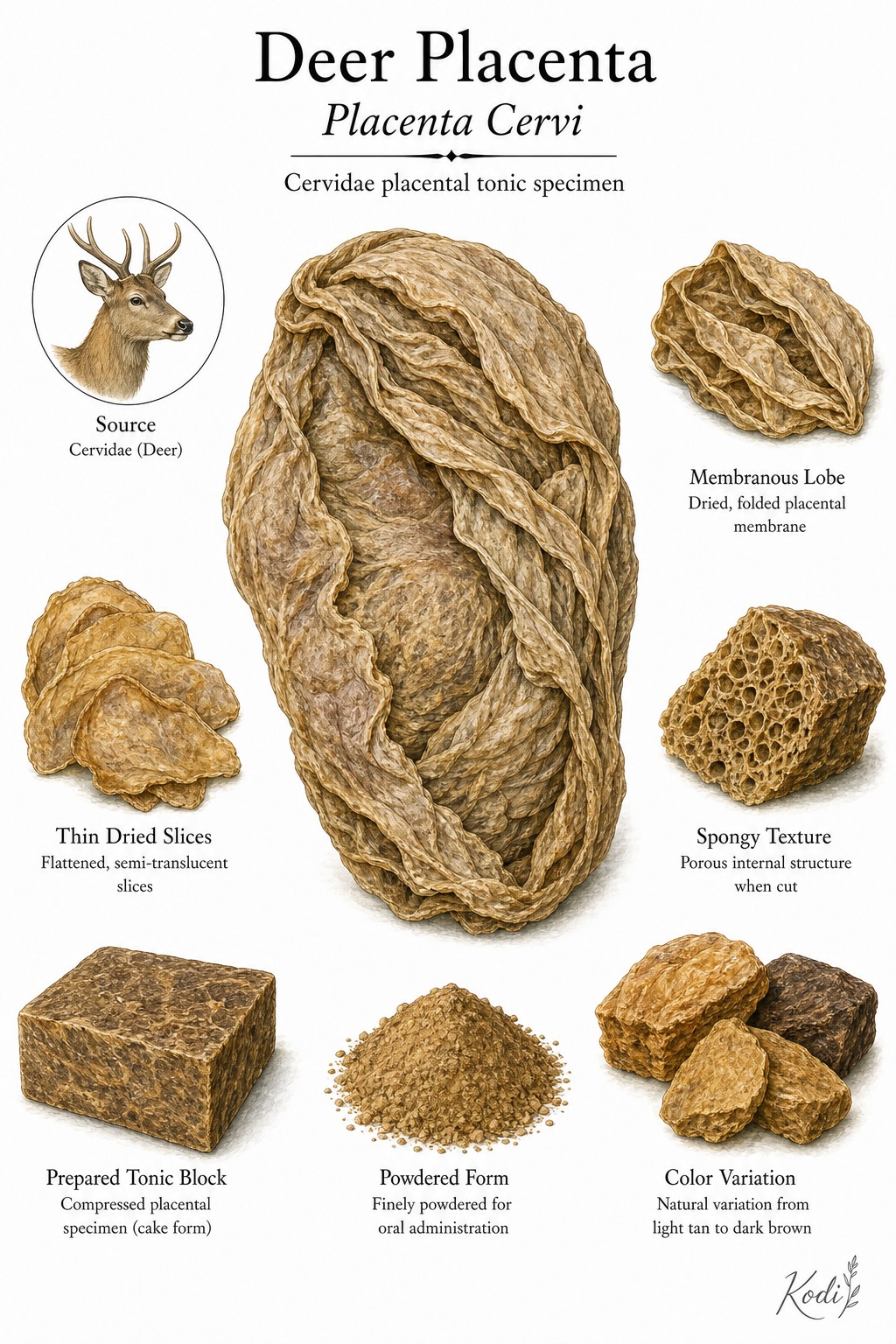
Known in TCM as Lu Tai (鹿胎), this salty, warm herb enters the Kidney. Traditionally, it warms and supplements Kidney Yang and essence - Lu Tai is regarded as a blood-and-flesh tonic used for exhaustion, weak low back and knees, cold infertility patterns, and reproductive debility rooted in deep deficiency rather than excess, most often applied for infertility, menstrual irregularities, and fatigue.
Part used: Placenta
Also Known As
Latin: Placenta Cervi | Pinyin: Lu Tai | Chinese: 鹿胎
TCM Properties
- Taste
- salty
- Temperature
- warm
- Channels
- Kidney
Traditional Use
Primary Actions
- Warms and supplements Kidney Yang and essence - Lu Tai is regarded as a blood-and-flesh tonic used for exhaustion, weak low back and knees, cold infertility patterns, and reproductive debility rooted in deep deficiency rather than excess.
- Supports fertility and uterine warmth in deficiency-cold patterns - later gynecologic use emphasizes Lu Tai for irregular menses, cold womb infertility, and long-standing weakness with poor reproductive vigor.
- Assists fatigue and wasting from chronic deficiency - traditional use extends to severe tiredness, emaciation, and lack of strength when constitutional depletion is the larger picture.
Secondary Actions
- Compared with more common deer products such as Lu Rong and Lu Jiao Jiao, Lu Tai is usually described as a richer but narrower specialty tonic reserved for deeper reproductive and jing depletion.
- Because it is an animal product with strong supplementing character, most traditional use is formula-based rather than casual single-herb self-use.
Classic Formulas
- Lu Tai Wan - later gynecologic patent-formula tradition using Lu Tai for menstrual weakness, cold uterus, and infertility from deficiency-cold.
- Kidney-and-blood tonic combinations with Ren Shen, Shu Di Huang, Dang Gui, and Lu Rong - common pairing logic when the goal is to warm essence, enrich blood, and restore reproductive strength.
Classical References
- Modern TCM herb summaries consistently place Lu Tai in the Kidney-Yang tonic category and describe it as a warming, essence-supplementing animal substance used mainly for infertility, weakness, and cold-type gynecologic disorders.
- Trade and formula literature in Chinese medicine often treats Lu Tai as a stronger specialty tonic for constitutional and reproductive depletion rather than as a routine daily tonic.
Modern Research
Studied Effects
- Direct indexed modern research on Lu Tai as a distinct crude TCM drug is sparse, so most current claims remain extrapolated from traditional practice and commercial deer-placenta products rather than robust peer-reviewed clinical trials.
- Because composition can vary by source and processing method, contemporary safety and efficacy interpretation should be conservative and quality-control focused.
Safety & Interactions
Contraindications
- Yin deficiency with heat or flaring fire
- Damp-Heat patterns rather than deficiency-cold
- Unverified animal source or poorly documented processing
Cautions
- Lu Tai is a niche animal-derived tonic and should be sourced only from highly verified suppliers because identity, processing, and contamination standards vary widely.
- Pregnancy use should be practitioner-directed only; although deer products appear in reproductive formulas, this is not a general-use pregnancy herb.
- Modern published evidence is thin relative to the strength of commercial vitality claims.
Conditions
- Infertility Traditional ★★★★☆ JSON
- Menstrual Irregularities Traditional ★★★☆☆ JSON
- Fatigue Traditional ★★★☆☆ JSON
- Impotence Traditional ★★★☆☆ JSON
Frequently Asked Questions
What is Deer Placenta used for?
Deer Placenta is traditionally used to Warms and supplements Kidney Yang and essence - Lu Tai is regarded as a blood-and-flesh tonic used for exhaustion, weak low back and knees, cold infertility patterns, and reproductive debility rooted in deep deficiency rather than excess., Supports fertility and uterine warmth in deficiency-cold patterns - later gynecologic use emphasizes Lu Tai for irregular menses, cold womb infertility, and long-standing weakness with poor reproductive vigor., Assists fatigue and wasting from chronic deficiency - traditional use extends to severe tiredness, emaciation, and lack of strength when constitutional depletion is the larger picture.. Research has investigated its effects on: Direct indexed modern research on Lu Tai as a distinct crude TCM drug is sparse, so most current claims remain extrapolated from traditional practice and commercial deer-placenta products rather than robust peer-reviewed clinical trials.; Because composition can vary by source and processing method, contemporary safety and efficacy interpretation should be conservative and quality-control focused..
What are other names for Deer Placenta?
Deer Placenta is also known as Cervi. In TCM: 鹿胎 (Lu Tai); Placenta Cervi.
Is Deer Placenta safe during pregnancy?
The safety of Deer Placenta during pregnancy has not been established. Consult a qualified healthcare provider before use.
What are the contraindications for Deer Placenta?
Deer Placenta should not be used in: Yin deficiency with heat or flaring fire; Damp-Heat patterns rather than deficiency-cold; Unverified animal source or poorly documented processing. Consult a qualified healthcare provider before use.