Dandelion
- Chinese
- 蒲公英
- Pinyin
- Pu Gong Ying
- Latin
- Herba Taraxaci
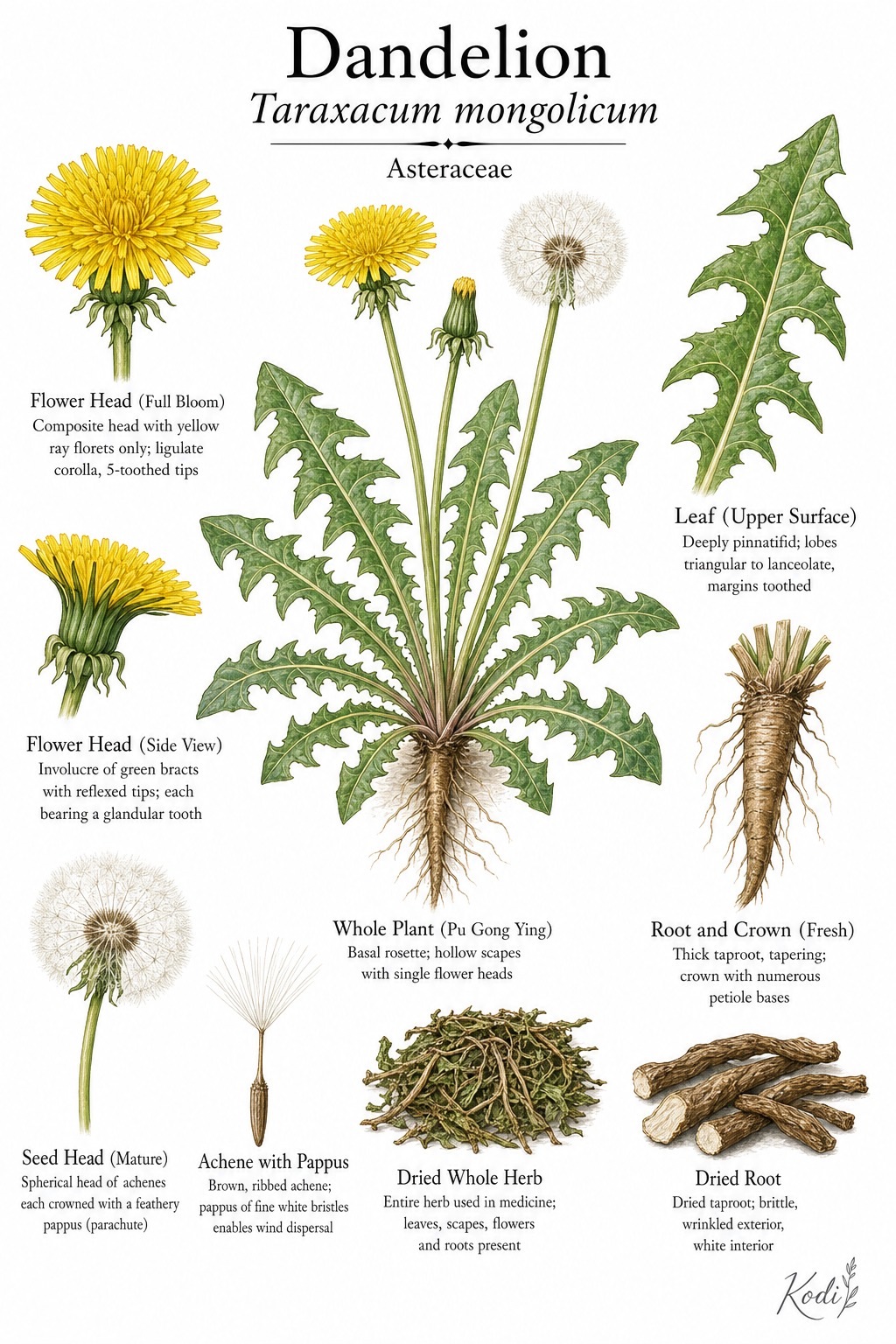
Known in TCM as Pu Gong Ying (蒲公英), this bitter and sweet, cold herb enters the Liver, Stomach, and Lung. Traditionally, it clears heat and resolves toxicity - Pu Gong Ying is a major herb for boils, furuncles, breast abscess, and other hot toxic swellings, whether superficial or internal, most often applied for breast abscess, mastitis, and abscess. Modern research has identified Taraxasterol among its active constituents.
Part used: Whole herb
Also Known As
Latin: Herba Taraxaci | Pinyin: Pu Gong Ying | Chinese: 蒲公英
TCM Properties
- Taste
- bitter, sweet
- Temperature
- cold
- Channels
- Liver, Stomach, Lung
Traditional Use
Primary Actions
- Clears heat and resolves toxicity - Pu Gong Ying is a major herb for boils, furuncles, breast abscess, and other hot toxic swellings, whether superficial or internal.
- Reduces breast swelling and supports resolution of mammary abscess - it is one of the best-known herbs for painful red breast lumps, mastitis-type presentations, and nodular heat toxicity in the breast.
- Clears fire and toxicity from the throat, eyes, and gums - it is used for sore throat, red painful eyes, and gum swelling when heat or toxin rises upward.
- Clears damp-heat and promotes urination - traditional use also includes painful urinary difficulty, damp-heat jaundice, and heat-type diarrhea or dysentery.
Secondary Actions
- Pu Gong Ying is stronger at heat-toxin and abscess work than many ordinary food-grade dandelion preparations, even though it remains gentler on the Stomach than some bitter detoxifying herbs.
- Fresh juice, thick decoction, and topical applications all appear in traditional practice, especially for breast abscess, boils, and venomous bites.
Classic Formulas
- Wu Wei Xiao Du Yin - Pu Gong Ying is one of the key toxin-resolving herbs in this classic formula for boils, carbuncles, and early suppurative swellings.
- Pu Gong Ying with Gua Lou and Jin Yin Hua - a classic breast-abscess and nodulation-clearing strategy.
- Pu Gong Ying with Yin Chen, Zhi Zi, and Da Huang - a damp-heat clearing combination for jaundice and lower-burner heat accumulation.
Classical References
- Traditional texts describe Pu Gong Ying as bitter, sweet, and cold, entering the Liver, Stomach, and Lung to clear heat, remove toxicity, reduce abscesses, and drain damp-heat.
- Its special reputation for breast abscess comes from its ability to clear heat-toxin from the Liver and Stomach while also helping the breast tissue soften and discharge.
- Because Pu Gong Ying also clears the throat, eyes, gums, and urinary tract, it is broader than a simple skin-detox herb.
Modern Research
Active Compounds
- Taraxasterol - a major triterpenoid associated with anti-inflammatory and metabolic studies
- Chicoric acid and chlorogenic acid - prominent phenolic acids with antioxidant and anti-inflammatory interest
- Flavonoids such as luteolin derivatives - relevant to anti-inflammatory and antioxidant activity
- Polysaccharides - immunomodulatory fractions increasingly studied in Taraxacum mongolicum
Studied Effects
- A 2023 review summarized the chemical constituents and pharmacologic effects of the Taraxacum genus and confirms why Pu Gong Ying remains one of the most widely studied heat-clearing medicinal plants (PMID 37446683).
- In a mouse model of Staphylococcus aureus mastitis, Taraxacum mongolicum reduced inflammatory signaling through TLR2, NF-kappaB, and MAPK pathways, which strongly aligns with the herb's traditional use for mastitis and breast abscess (PMID 33212175).
- An antioxidant-identification study characterized multiple active radical-scavenging constituents from Taraxacum mongolicum, supporting the herb's modern anti-inflammatory and protective profile (PMID 18801488).
PubMed References
- Dandelion (Taraxacum Genus): A Review of Chemical Constituents and Pharmacological Effects (2023)
- Taraxacum mongolicum protects against Staphylococcus aureus-infected mastitis by exerting anti-inflammatory role via TLR2-NF-kappaB/MAPKs pathways in mice (2021)
- Identification of antioxidants from Taraxacum mongolicum by high-performance liquid chromatography-diode array detection-radical-scavenging detection-electrospray ionization mass spectrometry and nuclear magnetic resonance experiments (2009)
Safety & Interactions
Contraindications
- Known allergy to dandelion or other Asteraceae plants
- Use of high-dose extracts without attention to blood sugar or diuretic effects
Cautions
- Memorial Sloan Kettering notes that dandelion can cause heartburn, stomach upset, rash, mild diarrhea, and low blood sugar in susceptible users.
- MSK also notes preclinical estrogenic activity and advises caution with concentrated supplement use when hormone sensitivity is a concern.
- Large amounts of tea or extract are more likely to cause side effects or medication interactions than ordinary food use.
Drug Interactions
Dandelion supplements may add to the effects of diuretics or glucose-lowering medicine and may alter the metabolism of some prescription drugs. Much of the metabolism evidence is preclinical, but a transplant case report makes concentrated tea and extract use worth reviewing with a clinician.
- Diuretics … Dandelion may add to diuretic effects and increase urination. (Moderate) Source: Memorial Sloan Kettering About Herbs
- Insulin and other glucose-lowering medicines … Preclinical evidence suggests an additive glucose-lowering effect. (Uncertain) Source: Memorial Sloan Kettering About Herbs
- CYP1A2 and CYP3A4 substrate medicines … Laboratory and animal findings suggest dandelion may change drug metabolism. A case report described toxic immunosuppressant levels after a tea containing dandelion. (Moderate) Source: Memorial Sloan Kettering About Herbs
- UGT substrate medicines … Animal research suggests dandelion may alter glucuronidation and drug levels. Clinical relevance is not known. (Uncertain) Source: Memorial Sloan Kettering About Herbs
Conditions
- Breast Abscess Traditional ★★★★☆ JSON
- Mastitis Research ★★★★☆ JSON
- Abscess Traditional ★★★★☆ JSON
- Sore Throat Traditional ★★★☆☆ JSON
- Urinary Tract Infection Traditional ★★☆☆☆ JSON
Frequently Asked Questions
What is Dandelion used for?
Dandelion is traditionally used to Clears heat and resolves toxicity - Pu Gong Ying is a major herb for boils, furuncles, breast abscess, and other hot toxic swellings, whether superficial or internal., Reduces breast swelling and supports resolution of mammary abscess - it is one of the best-known herbs for painful red breast lumps, mastitis-type presentations, and nodular heat toxicity in the breast., Clears fire and toxicity from the throat, eyes, and gums - it is used for sore throat, red painful eyes, and gum swelling when heat or toxin rises upward., Clears damp-heat and promotes urination - traditional use also includes painful urinary difficulty, damp-heat jaundice, and heat-type diarrhea or dysentery.. Research has investigated its effects on: A 2023 review summarized the chemical constituents and pharmacologic effects of the Taraxacum genus and confirms why Pu Gong Ying remains one of the most widely studied heat-clearing medicinal plants (PMID 37446683).; In a mouse model of Staphylococcus aureus mastitis, Taraxacum mongolicum reduced inflammatory signaling through TLR2, NF-kappaB, and MAPK pathways, which strongly aligns with the herb's traditional use for mastitis and breast abscess (PMID 33212175)..
What are other names for Dandelion?
Dandelion is also known as Taraxaci. In TCM: 蒲公英 (Pu Gong Ying); Herba Taraxaci.
Is Dandelion safe during pregnancy?
The safety of Dandelion during pregnancy has not been established. Consult a qualified healthcare provider before use.
What are the contraindications for Dandelion?
Dandelion should not be used in: Known allergy to dandelion or other Asteraceae plants; Use of high-dose extracts without attention to blood sugar or diuretic effects. Consult a qualified healthcare provider before use.
Does Dandelion interact with any medications?
Dandelion may interact with: Diuretics - Dandelion may add to diuretic effects and increase urination. - (Moderate severity); Insulin and other glucose-lowering medicines - Preclinical evidence suggests an additive glucose-lowering effect. - (Uncertain severity); CYP1A2 and CYP3A4 substrate medicines - Laboratory and animal findings suggest dandelion may change drug metabolism. A case report described toxic immunosuppressant levels after a tea containing dandelion. - (Moderate severity); UGT substrate medicines - Animal research suggests dandelion may alter glucuronidation and drug levels. Clinical relevance is not known. - (Uncertain severity). Always inform your healthcare provider of any herbal supplements you are taking.