Crystal Sugar
- Chinese
- 冰糖
- Pinyin
- Bing Tang
- Latin
- Saccharum Crystallidum
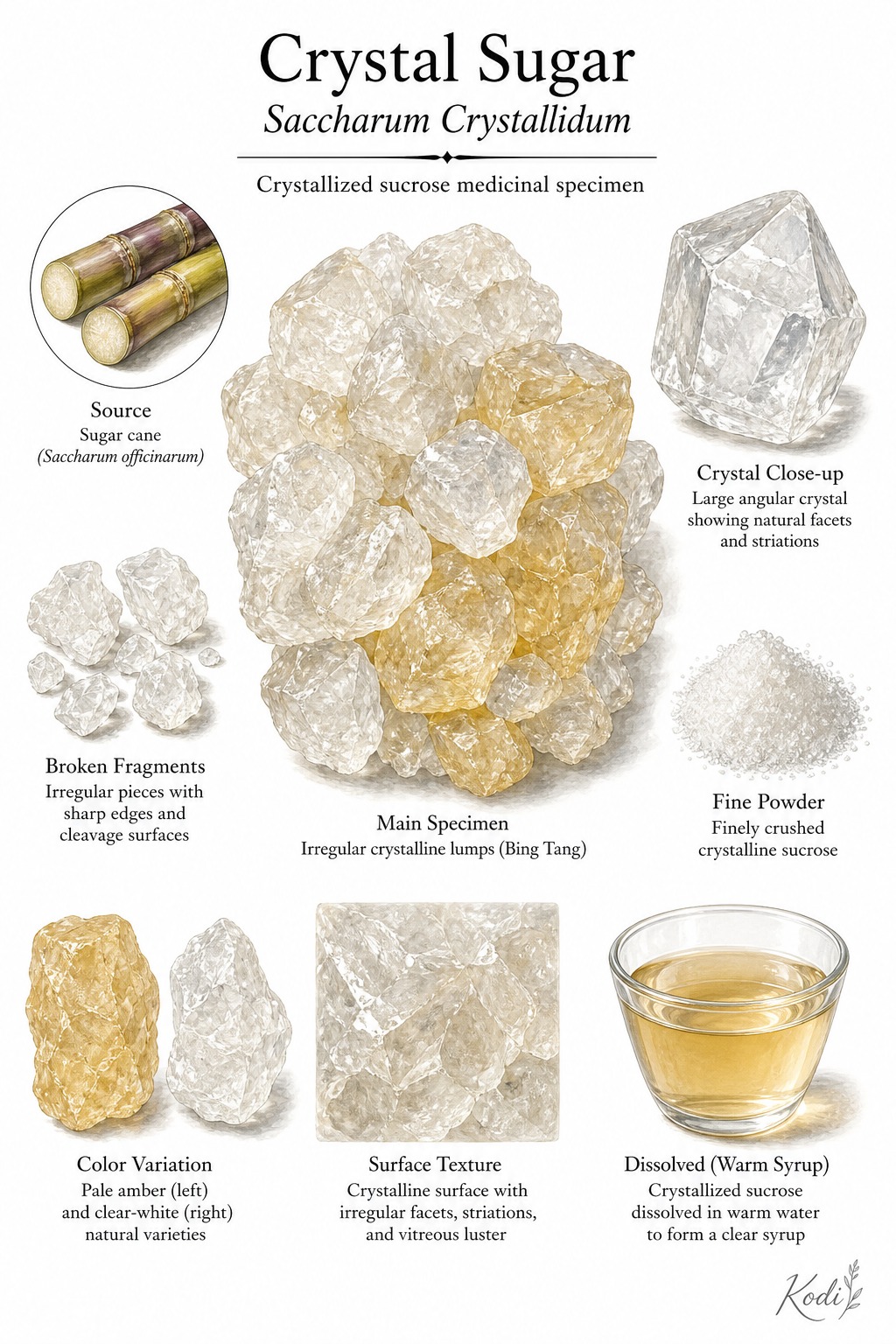
Known in TCM as Bing Tang (冰糖), this sweet, neutral herb enters the Lung and Spleen. Traditionally, it moistens the Lung and relieves dryness-type cough - Bing Tang is a gentle food-medicine ingredient used when Lung dryness causes an irritated throat, dry cough, or scanty blood-streaked sputum, most often applied for dry cough, cough, and digestive weakness. Modern research has identified Sucrose among its active constituents.
Part used: Sugar
Also Known As
Latin: Saccharum Crystallidum | Pinyin: Bing Tang | Chinese: 冰糖
TCM Properties
- Taste
- sweet
- Temperature
- neutral
- Channels
- Lung, Spleen
Traditional Use
Primary Actions
- Moistens the Lung and relieves dryness-type cough - Bing Tang is a gentle food-medicine ingredient used when Lung dryness causes an irritated throat, dry cough, or scanty blood-streaked sputum.
- Strengthens the Spleen and harmonizes the Stomach - traditional dietetic use includes mild Spleen-Stomach Qi weakness, poor appetite, and recovery from depletion when a soft, nourishing sweet is appropriate.
- Soothes the throat and moderates harsh herbs - rock sugar is often added to stewed or decocted remedies to soften irritation and make dry-cough formulas easier to take.
Secondary Actions
- Bing Tang belongs more to medicinal food therapy than to forceful crude-herb treatment, so it is usually combined with foods or demulcent herbs rather than used alone as a major intervention.
- Its neutral, moistening quality makes it gentler than warming brown sugar for respiratory dryness, but it remains a concentrated sweet and should still be used thoughtfully.
Classic Formulas
- Bing Tang stewed with pear - the classic household pairing for dry cough, throat irritation, and mild heat-dryness affecting the Lung.
- Chuan Bei Mu stewed with pear and Bing Tang - a traditional food-therapy preparation for lingering dry cough with sticky scant phlegm or throat discomfort.
- Bing Tang with Bai He or Sha Shen in sweet soups - a dietetic approach to moistening dryness and supporting gentle recovery.
Classical References
- Traditional references describe Bing Tang as sweet and neutral, entering the Lung and Spleen to moisten the Lung, relieve cough, and support the middle burner.
- Unlike stronger medicinal sugars such as Hong Tang, Bing Tang is valued for being relatively neutral and soothing rather than warming or Blood-moving.
- Its role in cough preparations is often supportive and harmonizing, which is why it appears so frequently in medicinal stews and convalescent recipes.
Modern Research
Active Compounds
- Sucrose - the dominant carbohydrate and principal sweetening constituent
- Trace minerals - minor residual constituents that vary with source and processing
- Water-soluble crystallized sugar matrix - the processed form that makes Bing Tang useful as a food-therapy carrier rather than as a phytochemical-rich herb
Studied Effects
- Modern literature on Bing Tang itself is limited because it is primarily a processed sugar rather than a phytochemically distinctive medicinal herb.
- Its present-day relevance is mainly as a soothing food-therapy ingredient and delivery vehicle in traditional respiratory preparations rather than as a stand-alone evidence-based treatment.
- From a modern safety perspective, the main concern is glycemic load and overuse in patients with metabolic disease, not hidden herb-drug pharmacology.
Safety & Interactions
Contraindications
- Poorly controlled diabetes
- Pronounced damp-phlegm accumulation with heavy digestion
Cautions
- Bing Tang is gentle in traditional use but still delivers a substantial sugar load, so repeated medicinal use may be inappropriate for patients with hyperglycemia or metabolic syndrome.
- It is best understood as a supportive food-medicine ingredient and should not replace treatment for persistent cough, hemoptysis, or serious digestive disease.
- MSK page not found - drug interaction data not available from Memorial Sloan Kettering integrative medicine database
Classic formulas that use Crystal Sugar
Herbs are rarely taken alone in Chinese medicine. These formula pages show what this herb does inside a classic prescription and which pattern that prescription is chosen for.
Conditions
- Dry Cough Traditional ★★★☆☆ JSON
- Cough Traditional ★★☆☆☆ JSON
- Digestive Weakness Traditional ★★☆☆☆ JSON
- Poor Appetite Traditional ★☆☆☆☆ JSON
Frequently Asked Questions
What is Crystal Sugar used for?
Crystal Sugar is traditionally used to Moistens the Lung and relieves dryness-type cough - Bing Tang is a gentle food-medicine ingredient used when Lung dryness causes an irritated throat, dry cough, or scanty blood-streaked sputum., Strengthens the Spleen and harmonizes the Stomach - traditional dietetic use includes mild Spleen-Stomach Qi weakness, poor appetite, and recovery from depletion when a soft, nourishing sweet is appropriate., Soothes the throat and moderates harsh herbs - rock sugar is often added to stewed or decocted remedies to soften irritation and make dry-cough formulas easier to take.. Research has investigated its effects on: Modern literature on Bing Tang itself is limited because it is primarily a processed sugar rather than a phytochemically distinctive medicinal herb.; Its present-day relevance is mainly as a soothing food-therapy ingredient and delivery vehicle in traditional respiratory preparations rather than as a stand-alone evidence-based treatment..
What are other names for Crystal Sugar?
Crystal Sugar is also known as Crystallidum. In TCM: 冰糖 (Bing Tang); Saccharum Crystallidum.
Is Crystal Sugar safe during pregnancy?
The safety of Crystal Sugar during pregnancy has not been established. Consult a qualified healthcare provider before use.
What are the contraindications for Crystal Sugar?
Crystal Sugar should not be used in: Poorly controlled diabetes; Pronounced damp-phlegm accumulation with heavy digestion. Consult a qualified healthcare provider before use.