Natural Ox Bezoar
- Chinese
- 牛黄
- Pinyin
- Niu Huang
- Latin
- Calculus Bovis
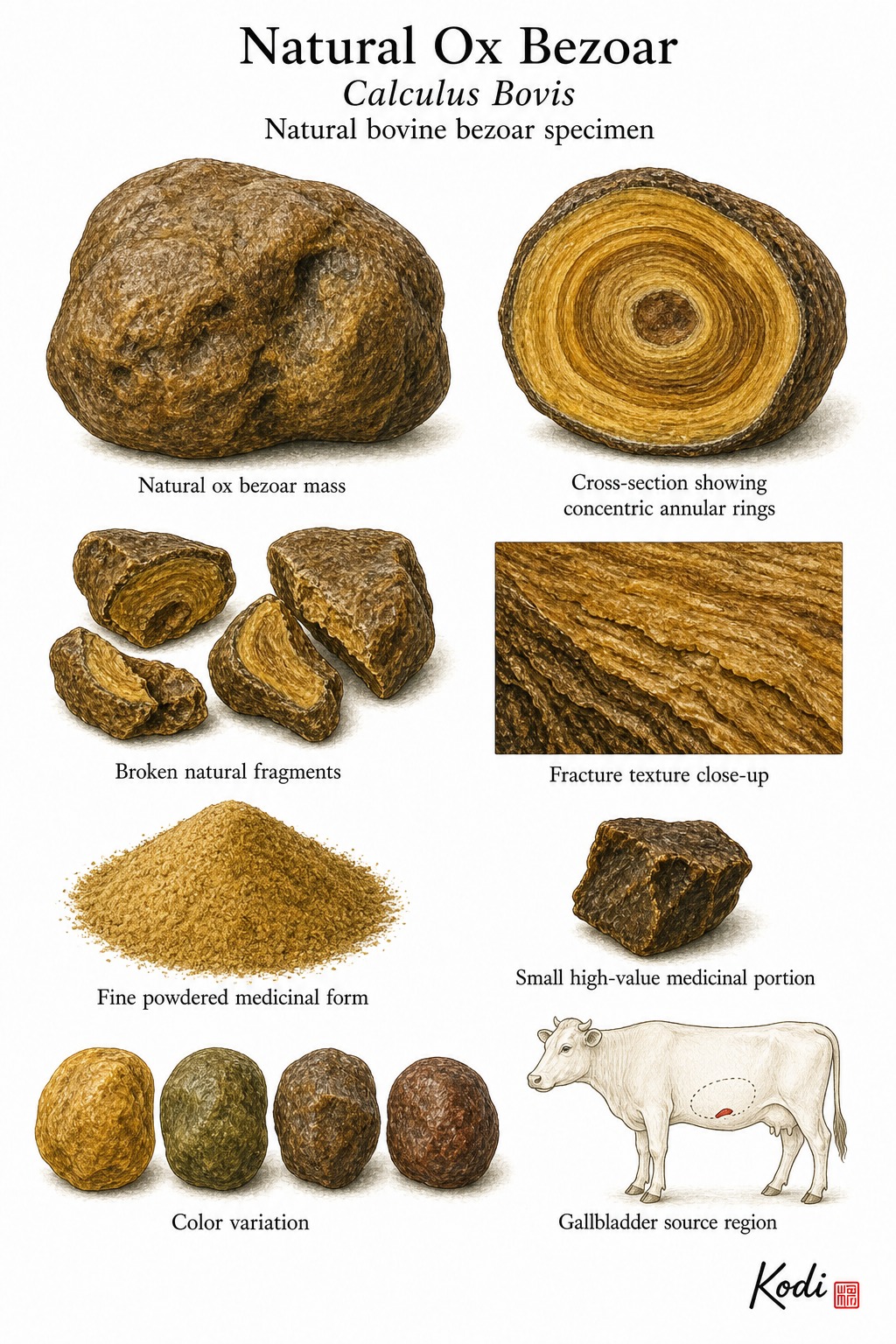
Known in TCM as Niu Huang (牛黄), this bitter, cool herb enters the Heart and Liver. Traditionally, it opens the Heart orifices and revives consciousness - Niu Huang is one of the classic substances for hot-closed patterns with fever, delirium, stroke-like collapse, and phlegm-heat clouding the spirit, most often applied for fever, stroke, and epilepsy. Modern research has identified Bilirubin among its active constituents.
Part used: Bezoar/Calculus
Also Known As
Latin: Calculus Bovis | Pinyin: Niu Huang | Chinese: 牛黄
TCM Properties
- Taste
- bitter
- Temperature
- cool
- Channels
- Heart, Liver
Traditional Use
Primary Actions
- Opens the Heart orifices and revives consciousness - Niu Huang is one of the classic substances for hot-closed patterns with fever, delirium, stroke-like collapse, and phlegm-heat clouding the spirit.
- Clears Heat, resolves toxicity, and benefits the throat and mouth - it is used for severe sore throat, oral ulcers, carbuncles, and fire-toxin conditions where intense heat affects the upper body.
- Extinguishes Liver Wind and stops convulsions - classical indications include high-fever convulsions, infantile fright-spasm patterns, and heat stirring internal wind.
Secondary Actions
- Natural Niu Huang is regarded as stronger and more prized than artificial substitutes, which is why formulas often distinguish between natural, cultured, and artificial bezoar materials.
- Its classical use is usually in powders and high-value emergency formulas rather than in routine large-dose decoctions.
Classic Formulas
- An Gong Niu Huang Wan - iconic emergency formula for heat entering the Pericardium with coma, delirium, and hot-closed stroke patterns.
- Xi Huang Wan - toxin-resolving formula for deep abscesses and masses in which Niu Huang works with She Xiang and resins.
- Niu Huang Qing Xin Wan - broad orifice-opening and heat-clearing patent-style formula for phlegm-heat disturbing the spirit.
- Pediatric convulsion powders and formulas - traditional use for high-fever wind and phlegm-heat agitation in children.
Classical References
- Traditional herb texts describe Niu Huang as bitter and cool, entering the Heart and Liver to open the orifices, extinguish wind, and clear toxin.
- Its presence in An Gong Niu Huang Wan made it one of the most famous emergency medicinals for hot-closed presentations in warm-disease medicine.
- Classical and modern practice both distinguish natural Niu Huang from artificial substitutes, recognizing that they are related but not identical substances.
Modern Research
Active Compounds
- Bilirubin - one of the most important marker constituents in natural bezoar
- Bile acids including cholic and hyodeoxycholic acids - major bioactive fractions linked with anti-inflammatory and neurovascular research
- Cholesterol and other sterol components - structural constituents of the gallstone matrix
- Taurine and related small molecules - supportive compounds discussed in bezoar pharmacology
Studied Effects
- A 2020 review summarized the traditional use, chemistry, pharmacology, and toxicology of Calculus bovis, highlighting anti-inflammatory, neuroprotective, antipyretic, and anticonvulsant research while also stressing sourcing and standardization issues (PMID 32068140).
- Hyodeoxycholic acid, a bile-acid constituent associated with Calculus bovis, protected the neurovascular unit against oxygen-glucose deprivation and reoxygenation injury in vitro, offering a mechanistic bridge to the classic stroke and heat-closed indications (PMID 31290452).
- In vitro cultured calculus bovis was reported to reduce cerebral ischemia-reperfusion injury through effects on microglial polarization and NLRP3-related inflammatory pathways, reinforcing modern interest in the bezoar category for neuroinflammatory brain injury models (PMID 40065708).
PubMed References
- Calculus bovis: A review of the traditional usages, origin, chemistry, pharmacological activities and toxicology (2020)
- Hyodeoxycholic acid protects the neurovascular unit against oxygen-glucose deprivation and reoxygenation-induced injury in vitro (2019)
- [In vitro cultured calculus bovis alleviates cerebral ischemia/reperfusion injury through regulating microglial polarization and inhibiting NLRP3] (2025)
Safety & Interactions
Contraindications
- Pregnancy
- Cold-closed patterns without heat
- Spleen-Stomach deficiency cold requiring warming treatment instead of bitter-cool opening
Cautions
- Natural Niu Huang is a potent high-value emergency substance and should not be used casually as a general wellness supplement.
- Its traditional indications are for hot-closed and toxic patterns; using it in cold collapse or non-heat presentations is classically inappropriate.
- Natural, cultured, and artificial bezoars are related but not identical, so product identity must be explicit.
- MSK page not found - drug interaction data not available from Memorial Sloan Kettering integrative medicine database
Conditions
Frequently Asked Questions
What is Natural Ox Bezoar used for?
Natural Ox Bezoar is traditionally used to Opens the Heart orifices and revives consciousness - Niu Huang is one of the classic substances for hot-closed patterns with fever, delirium, stroke-like collapse, and phlegm-heat clouding the spirit., Clears Heat, resolves toxicity, and benefits the throat and mouth - it is used for severe sore throat, oral ulcers, carbuncles, and fire-toxin conditions where intense heat affects the upper body., Extinguishes Liver Wind and stops convulsions - classical indications include high-fever convulsions, infantile fright-spasm patterns, and heat stirring internal wind.. Research has investigated its effects on: A 2020 review summarized the traditional use, chemistry, pharmacology, and toxicology of Calculus bovis, highlighting anti-inflammatory, neuroprotective, antipyretic, and anticonvulsant research while also stressing sourcing and standardization issues (PMID 32068140).; Hyodeoxycholic acid, a bile-acid constituent associated with Calculus bovis, protected the neurovascular unit against oxygen-glucose deprivation and reoxygenation injury in vitro, offering a mechanistic bridge to the classic stroke and heat-closed indications (PMID 31290452)..
What are other names for Natural Ox Bezoar?
Natural Ox Bezoar is also known as Bovis. In TCM: 牛黄 (Niu Huang); Calculus Bovis.
Is Natural Ox Bezoar safe during pregnancy?
Natural Ox Bezoar is not recommended during pregnancy.
What are the contraindications for Natural Ox Bezoar?
Natural Ox Bezoar should not be used in: Pregnancy; Cold-closed patterns without heat; Spleen-Stomach deficiency cold requiring warming treatment instead of bitter-cool opening. Consult a qualified healthcare provider before use.