Scouring Rush Herb
- Chinese
- 木贼
- Pinyin
- Mu Zei
- Latin
- Herba Equiseti Hiemalis
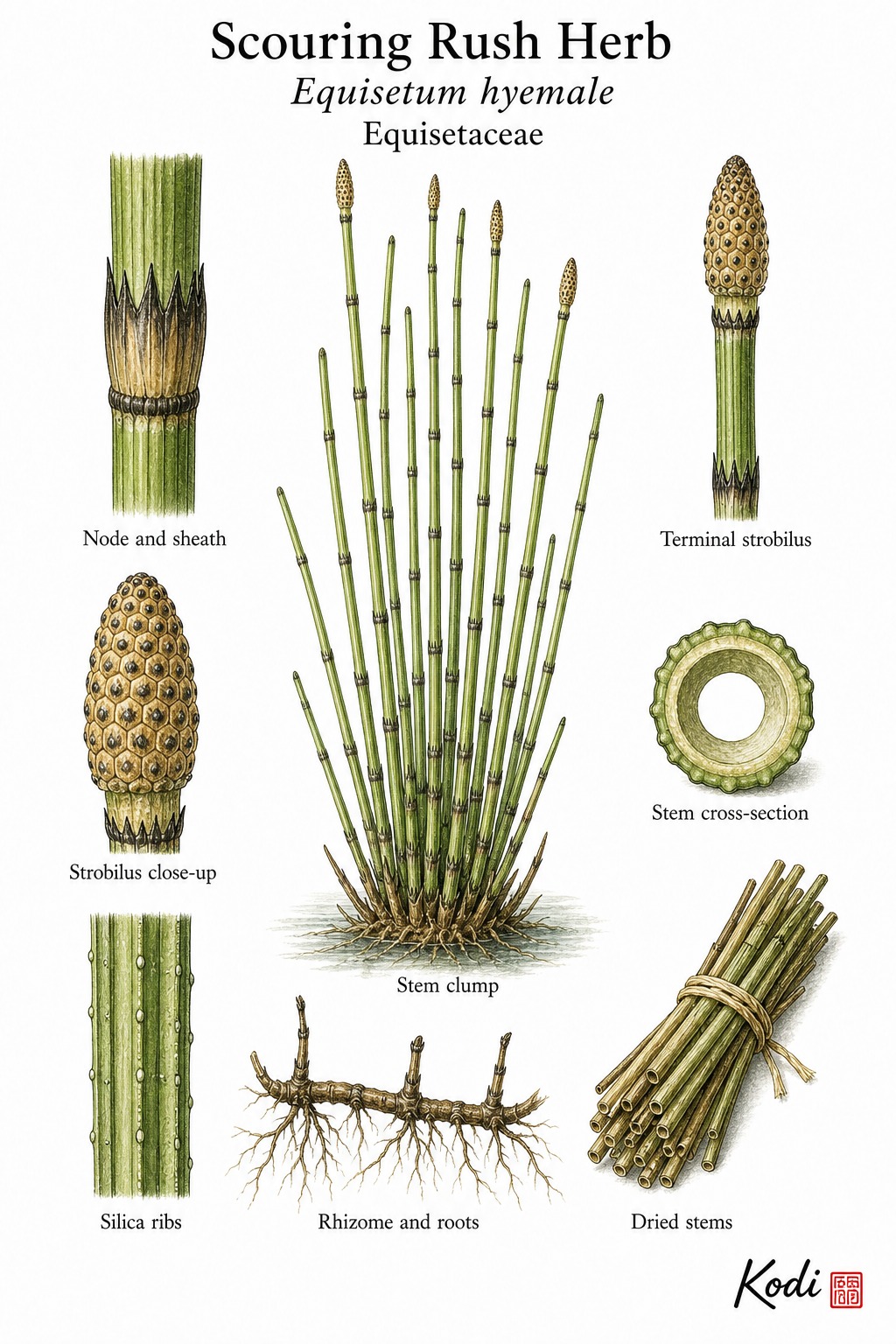
Known in TCM as Mu Zei (木贼), this acrid and bitter, slightly cold herb enters the Liver and Lung. Traditionally, it disperses wind-heat and clears the eyes - Mu Zei is primarily used for red, swollen, painful, tearing eyes when wind-heat or Liver heat rises upward to the head, most often applied for conjunctivitis, blurred vision, and wind heat. Modern research has identified Phenolic among its active constituents.
Part used: Whole herb
Also Known As
Latin: Herba Equiseti Hiemalis | Pinyin: Mu Zei | Chinese: 木贼
TCM Properties
- Taste
- acrid, bitter
- Temperature
- slightly cold
- Channels
- Liver, Lung
Traditional Use
Primary Actions
- Disperses wind-heat and clears the eyes - Mu Zei is primarily used for red, swollen, painful, tearing eyes when wind-heat or Liver heat rises upward to the head.
- Improves vision and removes superficial visual obstruction - it is classically selected for nebula, corneal haze, pterygium-style overgrowth, blurred vision, and persistent cloudiness on the eye surface.
- Vents wind-heat from the head - when eye redness is accompanied by mild headache or irritability from upward-moving heat, Mu Zei helps direct the disturbance outward.
- Supports treatment of upper-body heat with bleeding or irritation - later materia medica sometimes extends its use to hemorrhoidal bleeding or hematemesis associated with heat, although its modern use remains overwhelmingly eye-focused.
Secondary Actions
- Mu Zei is usually paired with other eye herbs such as Ju Hua, Chan Tui, Mi Meng Hua, or Jue Ming Zi because it is best at dispersing the superficial wind-heat component rather than nourishing deficiency.
- The rough silica-rich stems are broken or bundled before decoction, and the herb is typically used for short eye-focused courses rather than long-term tonic therapy.
Classic Formulas
- Mu Zei San - traditional eye-focused powder or decoction strategy for superficial visual obstruction, pterygium, or lingering wind-heat irritation.
- Mu Zei with Ju Hua and Chan Tui - common wind-heat eye combination for red, painful, tearing eyes with light sensitivity or headache.
- Mu Zei with Mi Meng Hua and Jue Ming Zi - vision-clearing pairing for corneal haze, glare, blurred vision, or superficial eye opacity.
- Mu Zei with Sang Ye and Bo He - exterior-releasing combination when eye redness appears together with wind-heat headache or early-stage upper-body heat.
Classical References
- Later materia medica classifies Mu Zei among herbs that disperse wind-heat upward and benefit the eyes, especially when there is redness, pain, or superficial visual obstruction.
- Traditional teaching particularly remembers Mu Zei for tui yi-style eye cloudiness and pterygium-like overgrowth, which explains why it appears more often in ophthalmic than in systemic formulas.
- Standard modern herbology texts keep Mu Zei in the exterior-releasing category but note that its clinical identity is much more eye-specific than that label alone suggests.
Modern Research
Active Compounds
- Phenolic compounds and flavonoids - the dominant antioxidant fraction identified in Equisetum hyemale extracts
- Phenyl glycosides including 2-(sophorosyl)-1-(4-hydroxyphenyl)ethanone - distinctive constituents isolated from the aerial parts
- Sterols - part of the mixed lipophilic fraction described in wound-healing and extract-characterization studies
- Lignans and phenylpropanoids - supportive constituents reported in modern phytochemical screening
- Silica- and mineral-rich structural fraction - a traditional hallmark of horsetail species, although pharmacologic work now focuses more on the phenolic profile
Studied Effects
- Ethanolic and methanolic extracts of Equisetum hyemale showed antioxidant activity and notable antifungal activity against Trichophyton rubrum and Microsporum canis, supporting part of the herb's traditional anti-irritation and external-use reputation (PMID 25587637).
- A 40% ethanolic extract accelerated wound healing in diabetic rats, increased IL-10, inhibited MCP-1 release, limited Staphylococcus aureus and Escherichia coli growth, and enhanced fibroblast collagen synthesis (PMID 37111271).
- A 2025 phytochemistry and ADMET study reported strong ABTS radical-scavenging activity but only weak antibacterial activity, while also finding moderate cytotoxicity in some cancer cell lines and short-exposure toxicity in C. elegans, arguing for caution with concentrated extracts (PMID 41471390).
PubMed References
- Phytochemical Characterization, Antimicrobial Activity, and Antioxidant Potential of Equisetum hyemale L. (Equisetaceae) Extracts (2015)
- Horsetail (Equisetum hyemale) Extract Accelerates Wound Healing in Diabetic Rats by Modulating IL-10 and MCP-1 Release and Collagen Synthesis (2023)
- Equisetum hyemale L. Extracts: Phytochemistry, Biological Performance, ADMET Profiling, and Toxicity Predictions (2025)
- A new phenyl glycoside from the aerial parts of Equisetum hyemale (2014)
Safety & Interactions
Contraindications
- Blurred vision from Liver-Kidney deficiency or Blood deficiency without wind-heat or superficial obstruction
- Pronounced Qi and fluid depletion without an exterior or eye-heat component
Cautions
- Long-term heavy use of horsetail-family herbs may contribute to thiamine depletion in animal data and is not appropriate as unsupervised chronic self-treatment.
- Modern extract studies found moderate in vitro cytotoxicity and short-exposure toxicity in C. elegans, so concentrated extract products deserve more caution than traditional short-course decoctions.
- Its light, dispersing, and mildly drying nature can aggravate depletion or frequent urination in sensitive patients if overused.
- MSK page not found - drug interaction data not available from Memorial Sloan Kettering integrative medicine database
Conditions
- Conjunctivitis Traditional ★★★★☆ JSON
- Blurred Vision Traditional ★★★★☆ JSON
- Wind Heat Traditional ★★★☆☆ JSON
- Headache Traditional ★★☆☆☆ JSON
Frequently Asked Questions
What is Scouring Rush Herb used for?
Scouring Rush Herb is traditionally used to Disperses wind-heat and clears the eyes - Mu Zei is primarily used for red, swollen, painful, tearing eyes when wind-heat or Liver heat rises upward to the head., Improves vision and removes superficial visual obstruction - it is classically selected for nebula, corneal haze, pterygium-style overgrowth, blurred vision, and persistent cloudiness on the eye surface., Vents wind-heat from the head - when eye redness is accompanied by mild headache or irritability from upward-moving heat, Mu Zei helps direct the disturbance outward., Supports treatment of upper-body heat with bleeding or irritation - later materia medica sometimes extends its use to hemorrhoidal bleeding or hematemesis associated with heat, although its modern use remains overwhelmingly eye-focused.. Research has investigated its effects on: Ethanolic and methanolic extracts of Equisetum hyemale showed antioxidant activity and notable antifungal activity against Trichophyton rubrum and Microsporum canis, supporting part of the herb's traditional anti-irritation and external-use reputation (PMID 25587637).; A 40% ethanolic extract accelerated wound healing in diabetic rats, increased IL-10, inhibited MCP-1 release, limited Staphylococcus aureus and Escherichia coli growth, and enhanced fibroblast collagen synthesis (PMID 37111271)..
What are other names for Scouring Rush Herb?
Scouring Rush Herb is also known as Equiseti. In TCM: 木贼 (Mu Zei); Herba Equiseti Hiemalis.
Is Scouring Rush Herb safe during pregnancy?
The safety of Scouring Rush Herb during pregnancy has not been established. Consult a qualified healthcare provider before use.
What are the contraindications for Scouring Rush Herb?
Scouring Rush Herb should not be used in: Blurred vision from Liver-Kidney deficiency or Blood deficiency without wind-heat or superficial obstruction; Pronounced Qi and fluid depletion without an exterior or eye-heat component. Consult a qualified healthcare provider before use.