Prepared Aconite Lateral Root
- Chinese
- 附子
- Pinyin
- Fu Zi
- Latin
- Aconiti Lateralis Radix Praeparata
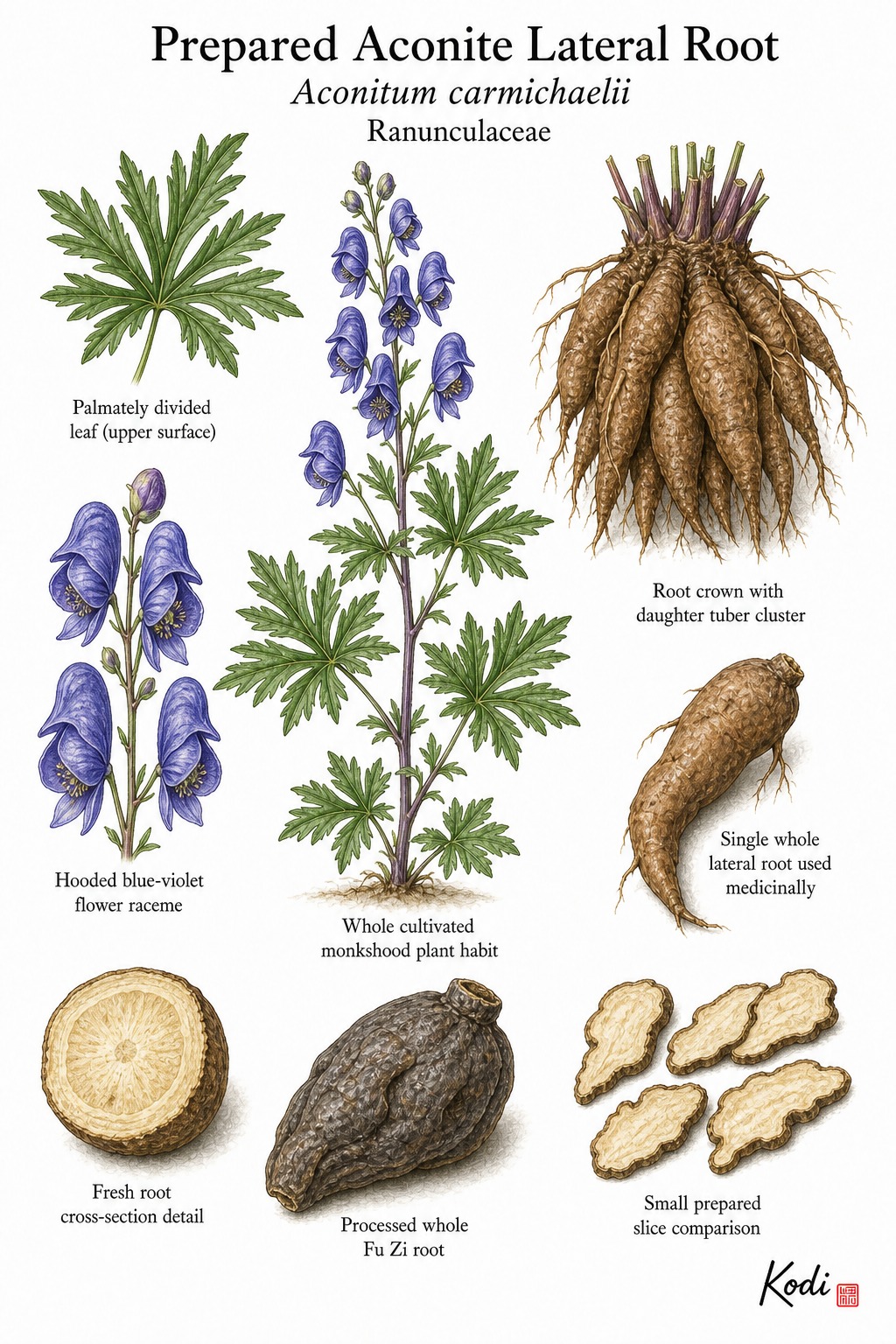
Known in TCM as Fu Zi (附子), this acrid and sweet, hot herb enters the Heart, Kidney, and Spleen. Traditionally, it restores devastated Yang and rescues collapse - Fu Zi is one of the central herbs for cold collapse with icy extremities, faint pulse, somnolence, or severe exhaustion of Yang, most often applied for kidney yang deficiency, edema, and diarrhea. Modern research has identified Aconitine, among its active constituents.
Also Known As
Latin: Aconiti Lateralis Radix Praeparata | Pinyin: Fu Zi | Chinese: 附子
TCM Properties
- Taste
- acrid, sweet
- Temperature
- hot
- Channels
- Heart, Kidney, Spleen
Traditional Use
Primary Actions
- Restores devastated Yang and rescues collapse - Fu Zi is one of the central herbs for cold collapse with icy extremities, faint pulse, somnolence, or severe exhaustion of Yang.
- Warms fire and assists Heart, Spleen, and Kidney Yang - it is used for edema, watery diarrhea, abdominal cold pain, fatigue, impotence, and chronic cold weakness when deficient cold is deep and persistent.
- Warms the channels and alleviates severe cold pain - classical use includes cold-damp Bi, fixed joint pain, cold low-back pain, and painful obstruction that needs stronger warming than milder channel herbs can provide.
- Supports Heart Yang and unblocks chest Yang - Fu Zi appears in formulas for chest pain, palpitations, weak circulation, and collapse-level cold when impaired Yang transformation affects the cardiovascular system.
Secondary Actions
- Fu Zi is the category name for the processed daughter root and includes commercial forms such as salted fuzi, black slices, and white slices; proper processing changes toxicity far more than the pinyin label alone suggests.
- It is rarely used alone; classic formulas almost always pair it with ginger, licorice, ginseng, Bai Zhu, Fu Ling, or warming Kidney herbs to steer its intense heat toward rescue, water metabolism, or pain relief.
Classic Formulas
- Si Ni Tang - core Shaoyin rescue formula for devastated Yang, cold extremities, and a nearly extinguished pulse.
- Zhen Wu Tang - warms Spleen and Kidney Yang while mobilizing water for edema, dizziness, abdominal pain, and deficiency-cold fluid retention.
- Fu Zi Li Zhong Tang - middle-burner warming formula for Spleen-Yang deficiency with abdominal cold, chronic diarrhea, and weak digestion.
- You Gui Wan - deeply warming Kidney-Yang formula in which Fu Zi helps restore fire at the gate of vitality for cold infertility, weakness, and lower-body debility.
Classical References
- Shen Nong Ben Cao Jing places Fu Zi among strongly acting lower-grade medicinals, reflecting its potency for cold accumulation and pain but also its toxicity.
- Shang Han Lun and Jin Gui Yao Lue use Fu Zi centrally for Shaoyin collapse, edema, cold pain, and debility, always within carefully constructed formulas rather than casual self-use.
- Chinese Pharmacopoeia guidance continues the classical emphasis on processed lateral root only, pregnancy caution, and specific herb incompatibility traditions.
Modern Research
Active Compounds
- Aconitine, mesaconitine, and hypaconitine - toxic diester diterpenoid alkaloids that define raw aconite cardiotoxicity
- Neoline and other aminoalcohol-type alkaloids - less toxic processed aconite constituents associated with cardiotonic research
- Benzoylaconine, benzoylmesaconine, and benzoylhypaconine - hydrolysis products formed during processing and prolonged decoction
- Fuzi polysaccharides and glucans - non-alkaloid constituents with emerging immunomodulatory interest
- C19-diterpenoid alkaloid arabinosides - aqueous-extract constituents studied for analgesic activity
Studied Effects
- A 2023 review summarized Fu Zi pharmacology and toxicology and concluded that processing shifts diester alkaloids toward less toxic forms while retaining anti-inflammatory, cardiovascular, and immune activity (PMID 36257343).
- Several aqueous-extract arabinoside alkaloids from lateral roots showed greater than 65% inhibition of acetic-acid-induced writhing in mice, supporting the classic pain-relieving reputation of processed Fu Zi (PMID 29881680).
- A Fuzi polysaccharide fraction called FPS1-2 reversed cyclophosphamide-induced immunosuppression in mice and modulated CD4-positive T-cell differentiation, cytokine secretion, short-chain fatty acids, and gut dysbiosis (PMID 39490860).
PubMed References
- Ethnopharmacological use, pharmacology, toxicology, phytochemistry, and progress in Chinese crude drug processing of the lateral root of Aconitum carmichaelii Debeaux. (Fuzi): A review (2023)
- C19-Diterpenoid alkaloid arabinosides from an aqueous extract of the lateral root of Aconitum carmichaelii and their analgesic activities (2018)
- Structural characterization and immunomodulatory activity of polysaccharides from the lateral roots of Aconitum carmichaelii (2024)
- Cardioprotective effects and concentration-response relationship of aminoalcohol-diterpenoid alkaloids from Aconitum carmichaelii (2021)
Safety & Interactions
Contraindications
- Pregnancy
- Heat patterns, Yin deficiency with heat, or true interior heat without cold
- Raw or inadequately processed aconite for internal use
- Unsupervised use in children or frail patients
Cautions
- Fu Zi is one of the most toxic medicinals in the Chinese materia medica; even prepared forms require expert dosing, authenticated sourcing, and pre-decoction.
- Toxicity symptoms can begin within 30 minutes to a few hours and include numbness, vomiting, diarrhea, weakness, hypotension, and life-threatening arrhythmias.
- Traditional incompatibility cautions remain for Ban Xia, the Gua Lou group, Tian Hua Fen, Bai Ji, Bai Lian, and the Bei Mu group.
- MSK page not found - drug interaction data not available from Memorial Sloan Kettering integrative medicine database
Drug Interactions
- Cardiac glycosides such as digoxin - additive arrhythmogenic risk
- Class I and III antiarrhythmic drugs - unpredictable electrophysiologic interaction
- Beta-blockers or other rate-slowing agents - may worsen bradycardia or mask early toxicity
- QT-prolonging medications - additive risk of malignant ventricular arrhythmia
Classic formulas that use Prepared Aconite Lateral Root
Herbs are rarely taken alone in Chinese medicine. These formula pages show what this herb does inside a classic prescription and which pattern that prescription is chosen for.
Conditions
- Kidney Yang Deficiency Traditional ★★★★★ JSON
- Edema Traditional ★★★★☆ JSON
- Diarrhea Traditional ★★★★☆ JSON
- Chest Pain Traditional ★★★☆☆ JSON
- Palpitations Traditional ★★★☆☆ JSON
Frequently Asked Questions
What is Prepared Aconite Lateral Root used for?
Prepared Aconite Lateral Root is traditionally used to Restores devastated Yang and rescues collapse - Fu Zi is one of the central herbs for cold collapse with icy extremities, faint pulse, somnolence, or severe exhaustion of Yang., Warms fire and assists Heart, Spleen, and Kidney Yang - it is used for edema, watery diarrhea, abdominal cold pain, fatigue, impotence, and chronic cold weakness when deficient cold is deep and persistent., Warms the channels and alleviates severe cold pain - classical use includes cold-damp Bi, fixed joint pain, cold low-back pain, and painful obstruction that needs stronger warming than milder channel herbs can provide., Supports Heart Yang and unblocks chest Yang - Fu Zi appears in formulas for chest pain, palpitations, weak circulation, and collapse-level cold when impaired Yang transformation affects the cardiovascular system.. Research has investigated its effects on: A 2023 review summarized Fu Zi pharmacology and toxicology and concluded that processing shifts diester alkaloids toward less toxic forms while retaining anti-inflammatory, cardiovascular, and immune activity (PMID 36257343).; Several aqueous-extract arabinoside alkaloids from lateral roots showed greater than 65% inhibition of acetic-acid-induced writhing in mice, supporting the classic pain-relieving reputation of processed Fu Zi (PMID 29881680)..
What are other names for Prepared Aconite Lateral Root?
Prepared Aconite Lateral Root is also known as Aconiti. In TCM: 附子 (Fu Zi); Aconiti Lateralis Radix Praeparata.
Is Prepared Aconite Lateral Root safe during pregnancy?
Prepared Aconite Lateral Root is not recommended during pregnancy.
What are the contraindications for Prepared Aconite Lateral Root?
Prepared Aconite Lateral Root should not be used in: Pregnancy; Heat patterns, Yin deficiency with heat, or true interior heat without cold; Raw or inadequately processed aconite for internal use; Unsupervised use in children or frail patients. Consult a qualified healthcare provider before use.
Does Prepared Aconite Lateral Root interact with any medications?
Prepared Aconite Lateral Root may interact with: Cardiac glycosides such as digoxin - additive arrhythmogenic risk; Class I and III antiarrhythmic drugs - unpredictable electrophysiologic interaction; Beta-blockers or other rate-slowing agents - may worsen bradycardia or mask early toxicity; QT-prolonging medications - additive risk of malignant ventricular arrhythmia. Always inform your healthcare provider of any herbal supplements you are taking.