Common Carpesium Fruit
- Chinese
- 鹤虱
- Pinyin
- He Shi
- Latin
- Fructus Carpesii
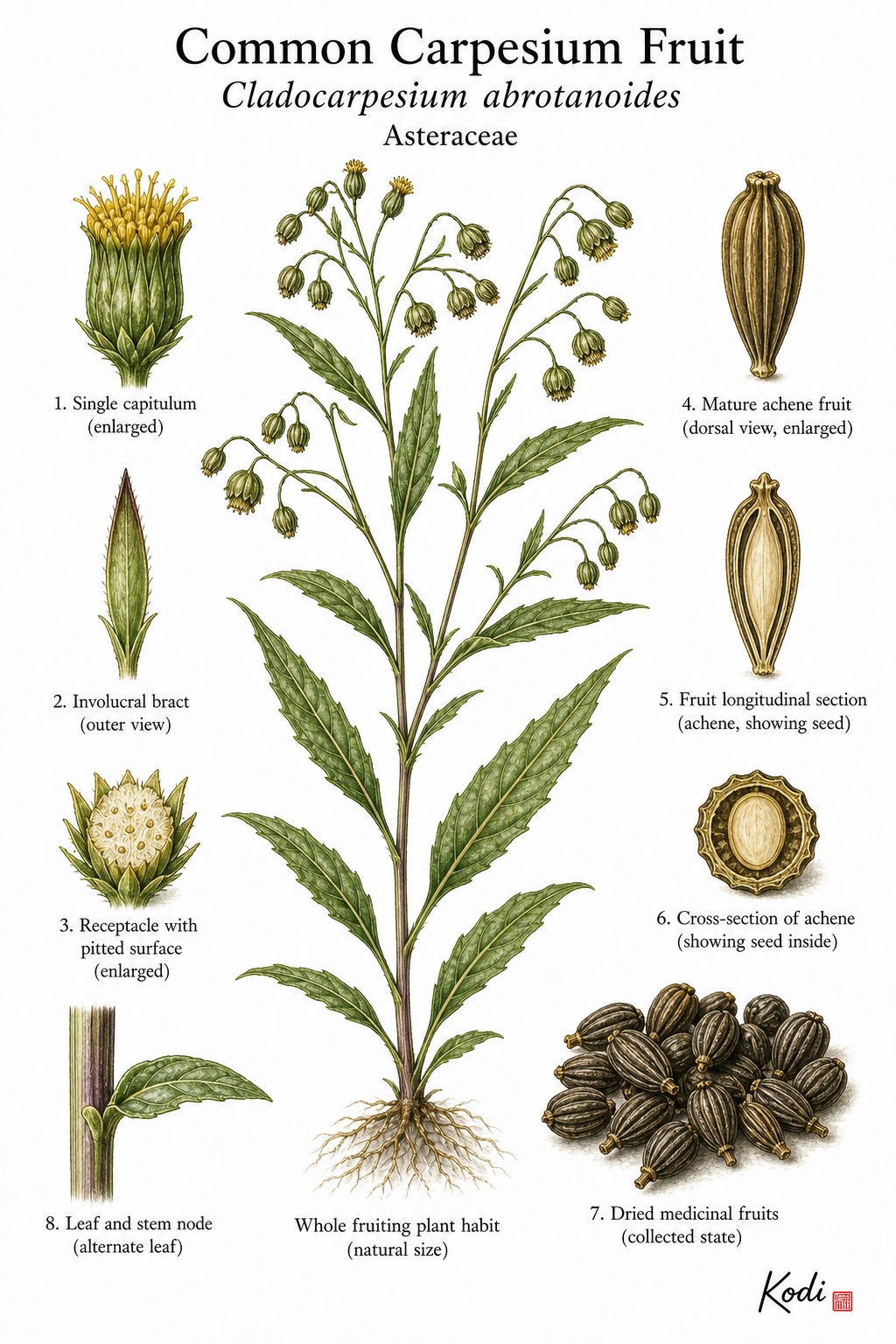
Known in TCM as He Shi (鹤虱), this bitter and acrid, neutral herb enters the Spleen and Stomach. Traditionally, it kills intestinal parasites and alleviates pain - He Shi is a focused anthelmintic for roundworms, pinworms, hookworms, and tapeworm-type infestations marked by intermittent cramping abdominal pain, especially when worms disturb the middle burner and the patient feels pain that comes and goes without a clear food trigger, most often applied for intestinal parasites, abdominal pain, and abdominal distension. Modern research has identified Sesquiterpene among its active constituents.
Part used: Fruit
Also Known As
Latin: Fructus Carpesii | Pinyin: He Shi | Chinese: 鹤虱
TCM Properties
- Taste
- bitter, acrid
- Temperature
- neutral
- Channels
- Spleen, Stomach
Traditional Use
Primary Actions
- Kills intestinal parasites and alleviates pain - He Shi is a focused anthelmintic for roundworms, pinworms, hookworms, and tapeworm-type infestations marked by intermittent cramping abdominal pain, especially when worms disturb the middle burner and the patient feels pain that comes and goes without a clear food trigger.
- Resolves accumulation caused by chronic worm burden - beyond simply attacking worms, He Shi is used when parasite infestation has already produced abdominal distension, poor appetite, thin limbs with a swollen belly in children, foul breath, or long-standing digestive stagnation.
- Assists with parasite-related childhood malnutrition patterns - traditional texts and later clinical summaries use it when children eat poorly or fail to thrive because worms are consuming nourishment and weakening Spleen transport, making the herb part of a broader strategy to remove the pathogen before rebuilding digestion.
- Can be applied externally for localized parasite or toxic-itch presentations - later practice extends He Shi into washes, powders, or suppository-style use for pinworm-related anal itching and some genital itching or toxic sores, though its main internal identity remains parasite killing.
Secondary Actions
- He Shi is slightly toxic and therefore classically prescribed in short courses, often combined with purgative, Qi-moving, or Spleen-supporting herbs so dead parasites are expelled instead of remaining lodged in the intestines.
- There is longstanding botanical confusion between true northern He Shi from Carpesium abrotanoides and southern substitutes derived from wild carrot or other regional species, so identification matters when comparing older formula records.
Classic Formulas
- Hua Chong Wan (化虫丸) - classic pediatric worm formula pairing He Shi with Bing Lang, Ku Lian Pi, Hu Fen, and Bai Fan to address abdominal pain, malnutrition, vomiting, and restless worm accumulation.
- He Shi with Bing Lang - broad-spectrum parasite-killing strategy in which He Shi attacks the worms while Bing Lang helps drive them downward and out through the bowels.
- He Shi with Shi Jun Zi - child-friendly pairing used when roundworm infestation coexists with poor appetite and weak digestion, because Shi Jun Zi is gentler while He Shi adds stronger killing power.
- He Shi with Bai Bu, Ku Lian Pi, or She Chuang Zi - external or suppository-style approach for pinworm-related itching or lower-orifice irritation.
Classical References
- Tang-era materia medica records He Shi as bitter, neutral, and slightly toxic, primarily for roundworm and pinworm disorders, often given as a powder or pill with fatty broth to improve delivery and expulsion.
- Ben Cao Tu Jing calls He Shi one of the most important herbs in parasite-killing prescriptions, reinforcing its narrow but important role in classic anti-worm therapy.
- Later sources such as Ri Hua Zi Ben Cao and Ling Nan Cai Yao Lu broaden the picture by noting use for malarial-type disorders, sores, snake toxin, and external application, but these remain secondary to its core identity as a parasite herb.
Modern Research
Active Compounds
- Sesquiterpene lactones including carabranolides and carabrol-type constituents - fruit-focused natural-product studies repeatedly highlight these compounds in anti-inflammatory and cytotoxicity screening
- Eremophilane-type sesquiterpenes such as the carperemophilanes - distinctive secondary metabolites isolated from Carpesium abrotanoides that help define its modern phytochemical profile
- Maleimide-bearing compounds such as carpesiumaleimides - unusual constituents reported from the plant and of interest in cancer-cell-line and structure-activity research
- Sterol, fatty-acid, and volatile-oil fractions - older pharmacognosy reports describe supporting constituent groups that likely contribute to the herb's broader biologic activity
Studied Effects
- A modern review of Carpesium abrotanoides summarized anti-inflammatory, cytotoxic, antimicrobial, and insecticidal findings across the plant's metabolites, while also noting that traditional anthelmintic use still needs stronger clinical validation (PMID 35736748).
- NMR-guided isolation work on the fruits identified anti-inflammatory carabranolides, giving direct constituent-level support for why He Shi continues to attract pharmacology interest beyond its classical parasite niche (PMID 38986603).
- New eremophilane-type sesquiterpenes and maleimide-bearing compounds isolated from Carpesium abrotanoides showed measurable cytotoxic activity in vitro, underscoring that modern research is currently stronger in natural-product discovery than in human therapeutic trials (PMID 31398449).
PubMed References
- Ethnobotanical Uses, Phytochemical Composition, Biosynthesis, and Pharmacological Activities of Carpesium abrotanoides L. (Asteraceae) (2022)
- NMR-Guided Isolation of Anti-inflammatory Carabranolides from the Fruits of Carpesium abrotanoides L (2024)
- New eremophilane-type sesquiterpenes and maleimide-bearing compounds from Carpesium abrotanoides L (2019)
Safety & Interactions
Contraindications
- Pregnancy
- Marked debility or frailty without clear parasite excess
- Chronic abdominal pain from deficiency-cold rather than worm accumulation
Cautions
- He Shi is classically described as slightly toxic and should generally be used in short courses; higher doses may cause dizziness, nausea, tinnitus, abdominal discomfort, or central nervous system depression.
- Authentic sourcing matters because northern He Shi from Carpesium abrotanoides and southern substitute forms called Nan He Shi are not identical materials in historical commerce.
- Persistent abdominal pain, suspected parasitic infection, anemia, weight loss, or visible worms still warrant conventional medical evaluation rather than self-treatment alone.
- MSK page not found - drug interaction data not available from Memorial Sloan Kettering integrative medicine database
Conditions
- Intestinal Parasites Traditional ★★★★★ JSON
- Abdominal Pain Traditional ★★★★☆ JSON
- Abdominal Distension Traditional ★★☆☆☆ JSON
- Poor Appetite Traditional ★★☆☆☆ JSON
Frequently Asked Questions
What is Common Carpesium Fruit used for?
Common Carpesium Fruit is traditionally used to Kills intestinal parasites and alleviates pain - He Shi is a focused anthelmintic for roundworms, pinworms, hookworms, and tapeworm-type infestations marked by intermittent cramping abdominal pain, especially when worms disturb the middle burner and the patient feels pain that comes and goes without a clear food trigger., Resolves accumulation caused by chronic worm burden - beyond simply attacking worms, He Shi is used when parasite infestation has already produced abdominal distension, poor appetite, thin limbs with a swollen belly in children, foul breath, or long-standing digestive stagnation., Assists with parasite-related childhood malnutrition patterns - traditional texts and later clinical summaries use it when children eat poorly or fail to thrive because worms are consuming nourishment and weakening Spleen transport, making the herb part of a broader strategy to remove the pathogen before rebuilding digestion., Can be applied externally for localized parasite or toxic-itch presentations - later practice extends He Shi into washes, powders, or suppository-style use for pinworm-related anal itching and some genital itching or toxic sores, though its main internal identity remains parasite killing.. Research has investigated its effects on: A modern review of Carpesium abrotanoides summarized anti-inflammatory, cytotoxic, antimicrobial, and insecticidal findings across the plant's metabolites, while also noting that traditional anthelmintic use still needs stronger clinical validation (PMID 35736748).; NMR-guided isolation work on the fruits identified anti-inflammatory carabranolides, giving direct constituent-level support for why He Shi continues to attract pharmacology interest beyond its classical parasite niche (PMID 38986603)..
What are other names for Common Carpesium Fruit?
Common Carpesium Fruit is also known as Carpesium. In TCM: 鹤虱 (He Shi); Fructus Carpesii.
Is Common Carpesium Fruit safe during pregnancy?
Common Carpesium Fruit is not recommended during pregnancy.
What are the contraindications for Common Carpesium Fruit?
Common Carpesium Fruit should not be used in: Pregnancy; Marked debility or frailty without clear parasite excess; Chronic abdominal pain from deficiency-cold rather than worm accumulation. Consult a qualified healthcare provider before use.