Costus Root
- Chinese
- 木香
- Pinyin
- Mu Xiang
- Latin
- Radix Aucklandiae
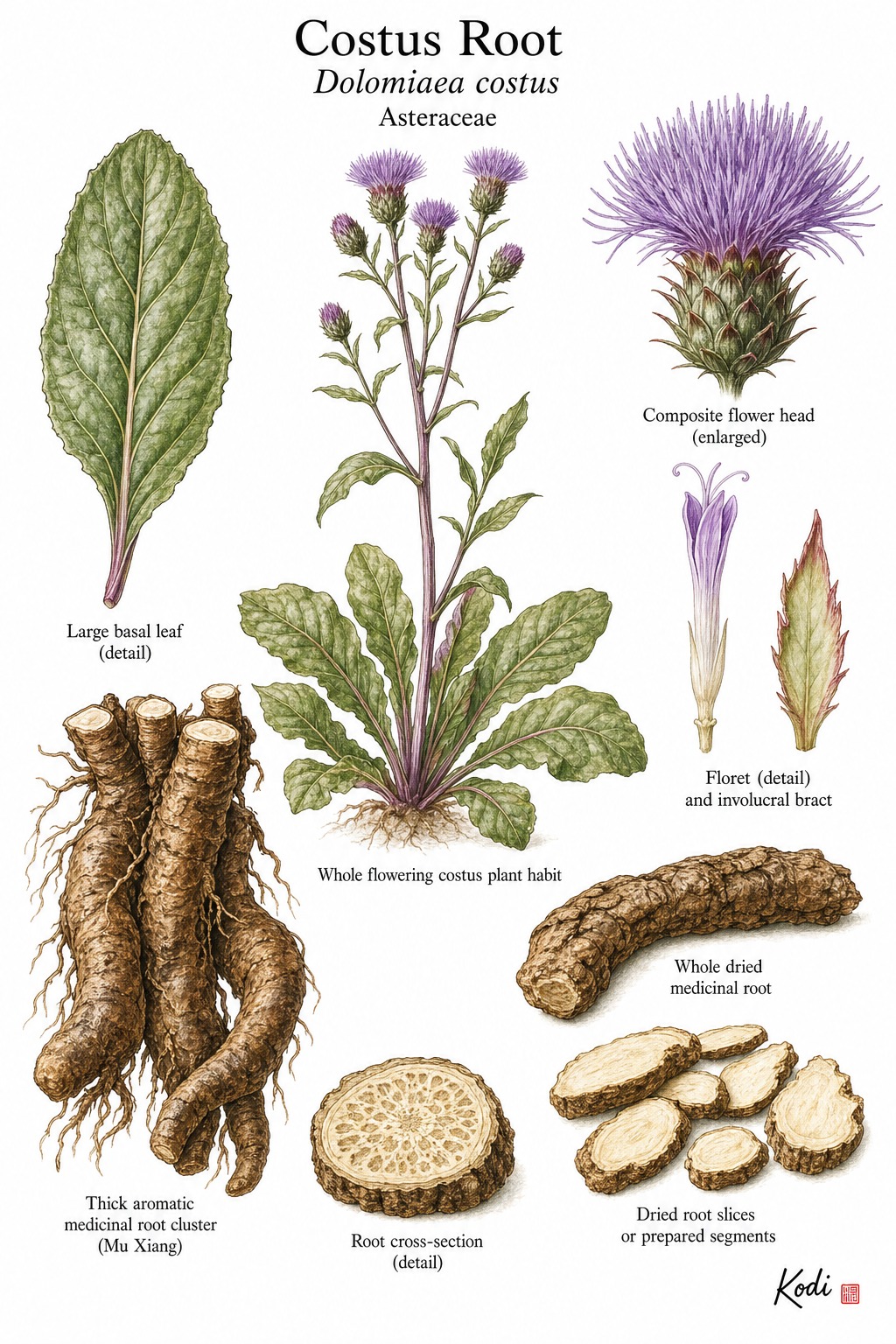
Known in TCM as Mu Xiang (木香), this acrid and bitter, warm herb enters the Spleen, Stomach, Large Intestine, Triple Burner, and Gallbladder. Traditionally, it moves Qi and alleviates pain in the middle burner - Mu Xiang is a premier aromatic regulator for epigastric and abdominal fullness, bloating, cramping, belching, and cold or food-stagnation digestive pain when obstruction rather than deficiency is the main problem, most often applied for abdominal pain, abdominal distension, and indigestion. Modern research has identified Costunolide among its active constituents.
Part used: Root
Also Known As
Latin: Radix Aucklandiae | Pinyin: Mu Xiang | Chinese: 木香
TCM Properties
- Taste
- acrid, bitter
- Temperature
- warm
- Channels
- Spleen, Stomach, Large Intestine, Triple Burner, Gallbladder
Traditional Use
Primary Actions
- Moves Qi and alleviates pain in the middle burner - Mu Xiang is a premier aromatic regulator for epigastric and abdominal fullness, bloating, cramping, belching, and cold or food-stagnation digestive pain when obstruction rather than deficiency is the main problem.
- Strengthens the Spleen and promotes digestion - a small dose is often added to tonic or damp-transforming formulas so the rich ingredients do not create stagnation, making it particularly useful when weak transport and retained food coexist.
- Regulates intestinal Qi and relieves dysenteric tenesmus - Mu Xiang is classically valued for painful urgent bowel movements, diarrhea with incomplete evacuation, or damp-heat dysentery patterns in which the intestines are blocked and the bowels cannot descend smoothly.
- Promotes Qi movement through the San Jiao and lower burner - beyond the Stomach and intestines, Mu Xiang is used for chest, flank, or lower-abdominal constrained pain when cold and stagnant Qi impede the normal up-and-down movement of the torso.
Secondary Actions
- The baked form, Wei Mu Xiang, is preferred when a gentler, more bowel-stabilizing action is wanted for loose stools, dysentery, or pediatric digestive weakness.
- Modern sourcing still requires attention because older literature and commercial channels historically confused true Mu Xiang with Chuan Mu Xiang, Tu Mu Xiang, and especially Qing Mu Xiang from Aristolochia, which has a very different safety profile.
Classic Formulas
- Mu Xiang Bing Lang Wan (木香槟榔丸) - classic accumulation-breaking formula in which Mu Xiang drives Qi through the intestines for food stagnation, constipation, and dysenteric tenesmus with marked abdominal oppression.
- Xiang Sha Liu Jun Zi Tang (香砂六君子汤) - Spleen-tonifying formula where Mu Xiang prevents cloying tonics from worsening fullness, nausea, and post-prandial bloating while gently restoring digestive movement.
- Xiang Lian Wan (香连丸) - pairing of Mu Xiang with Huang Lian for damp-heat dysentery, abdominal cramping, and the classic li ji hou zhong sensation of urgent but incomplete evacuation.
- Mu Xiang Shun Qi Tang (木香顺气汤) - broad Qi-regulating formula that resolves dampness, distension, and wandering abdominal or torso pain by restoring the smooth movement of Qi through the San Jiao.
Classical References
- Ben Cao Hui Yan describes Guang Mu Xiang as the master herb for treating Qi, harmonizing Stomach Qi, descending Lung Qi, dispersing Liver Qi, warming Kidney Qi, and governing Qi movement above and below, inside and outside the body.
- Ben Cao Jing Shu cautions against its use in Yin deficiency, internal heat, Lung heat from deficiency, and major Qi collapse, emphasizing that a moving aromatic should not be mistaken for a general tonic.
- Historical materia medica notes that the modern pharmacopoeial Mu Xiang became clearly fixed as the imported Asteraceae root during the Tang period, while confusion with Aristolochia-type Qing Mu Xiang later created clinically important safety problems that modern identification standards now aim to prevent.
Modern Research
Active Compounds
- Costunolide (sesquiterpene lactone) - a signature Mu Xiang constituent studied for anti-inflammatory, anti-colitis, and gastrointestinal-protective effects
- Dehydrocostus lactone (sesquiterpene lactone) - a co-marker compound with strong relevance to colitis, inflammatory signaling, and pharmacokinetic research
- Saussureamines A, B, and C (amino acid-sesquiterpene adducts) - distinctive root constituents associated with anti-ulcer and digestive-pharmacology research
- Volatile oils including alpha-curcumene and 8-cedren-13-ol - aromatic constituents that help explain the herb's penetrating fragrance and some antimicrobial or motility-related interest
- Flavonoid and phenolic fractions including apigenin, luteolin, diosmetin, quercetin, and related glycosides - compounds identified in modern extract profiling relevant to antioxidant and hepatoprotective research
Studied Effects
- Ethanolic extract of Saussurea lappa root reduced inflammatory cytokines, oxidative stress markers, and joint pathology in adjuvant-induced monoarthritis, supporting a modern anti-inflammatory rationale for the herb's pain-relieving reputation (PMID 26479340).
- UPLC-profiled Saussurea costus root extract showed hepatoprotective effects in vivo with modulation of HNF-1alpha, Sirtuin-1, C/ebpalpha, miRNA-34a, and miRNA-223, illustrating that modern Mu Xiang research extends well beyond simple aroma and motility concepts (PMID 35566153).
- Dehydrocostus lactone suppressed dextran-sulfate-sodium-induced colitis through IKKalpha/beta-NF-kappaB and Keap1-Nrf2 signaling, providing a mechanistic bridge to Mu Xiang's classic bowel-focused role in dysenteric and inflammatory intestinal patterns (PMID 35321327).
PubMed References
- Evaluation of anti-inflammatory potential of the ethanolic extract of the Saussurea lappa root (costus) on adjuvant-induced monoarthritis in rats (2016)
- Tentatively Identified (UPLC/T-TOF-MS/MS) Compounds in the Extract of Saussurea costus Roots Exhibit In Vivo Hepatoprotection via Modulation of HNF-1alpha, Sirtuin-1, C/ebpalpha, miRNA-34a and miRNA-223 (2022)
- Dehydrocostus Lactone Suppresses Dextran Sulfate Sodium-Induced Colitis by Targeting the IKKalpha/beta-NF-kappaB and Keap1-Nrf2 Signalling Pathways (2022)
Safety & Interactions
Contraindications
- Yin deficiency with internal heat
- Lung deficiency with heat
- Severe Qi deficiency or collapse without stagnation
- Blood deficiency with marked dryness
Cautions
- Large doses or prolonged unsupervised use can irritate the gastrointestinal tract and may be too drying for depleted constitutions.
- Authentic identification matters because historical confusion with Qing Mu Xiang from Aristolochia species carries nephrotoxic and carcinogenic implications that do not belong to true Radix Aucklandiae.
- Rare contact-allergic or pustular reactions have been reported around Mu Xiang exposure, so discontinue if rash or obvious hypersensitivity develops.
- MSK page not found - drug interaction data not available from Memorial Sloan Kettering integrative medicine database
Classic formulas that use Costus Root
Herbs are rarely taken alone in Chinese medicine. These formula pages show what this herb does inside a classic prescription and which pattern that prescription is chosen for.
Conditions
- Abdominal Pain Traditional ★★★★☆ JSON
- Abdominal Distension Traditional ★★★★☆ JSON
- Indigestion Traditional ★★★★☆ JSON
- Poor Appetite Traditional ★★★☆☆ JSON
- Diarrhea Traditional ★★★☆☆ JSON
- Dysentery Traditional ★★★☆☆ JSON
Frequently Asked Questions
What is Costus Root used for?
Costus Root is traditionally used to Moves Qi and alleviates pain in the middle burner - Mu Xiang is a premier aromatic regulator for epigastric and abdominal fullness, bloating, cramping, belching, and cold or food-stagnation digestive pain when obstruction rather than deficiency is the main problem., Strengthens the Spleen and promotes digestion - a small dose is often added to tonic or damp-transforming formulas so the rich ingredients do not create stagnation, making it particularly useful when weak transport and retained food coexist., Regulates intestinal Qi and relieves dysenteric tenesmus - Mu Xiang is classically valued for painful urgent bowel movements, diarrhea with incomplete evacuation, or damp-heat dysentery patterns in which the intestines are blocked and the bowels cannot descend smoothly., Promotes Qi movement through the San Jiao and lower burner - beyond the Stomach and intestines, Mu Xiang is used for chest, flank, or lower-abdominal constrained pain when cold and stagnant Qi impede the normal up-and-down movement of the torso.. Research has investigated its effects on: Ethanolic extract of Saussurea lappa root reduced inflammatory cytokines, oxidative stress markers, and joint pathology in adjuvant-induced monoarthritis, supporting a modern anti-inflammatory rationale for the herb's pain-relieving reputation (PMID 26479340).; UPLC-profiled Saussurea costus root extract showed hepatoprotective effects in vivo with modulation of HNF-1alpha, Sirtuin-1, C/ebpalpha, miRNA-34a, and miRNA-223, illustrating that modern Mu Xiang research extends well beyond simple aroma and motility concepts (PMID 35566153)..
What are other names for Costus Root?
Costus Root is also known as Aucklandia. In TCM: 木香 (Mu Xiang); Radix Aucklandiae.
Is Costus Root safe during pregnancy?
The safety of Costus Root during pregnancy has not been established. Consult a qualified healthcare provider before use.
What are the contraindications for Costus Root?
Costus Root should not be used in: Yin deficiency with internal heat; Lung deficiency with heat; Severe Qi deficiency or collapse without stagnation; Blood deficiency with marked dryness. Consult a qualified healthcare provider before use.