Colored Mistletoe Herb
- Chinese
- 槲寄生
- Pinyin
- Hu Ji Sheng
- Latin
- Herba Visci
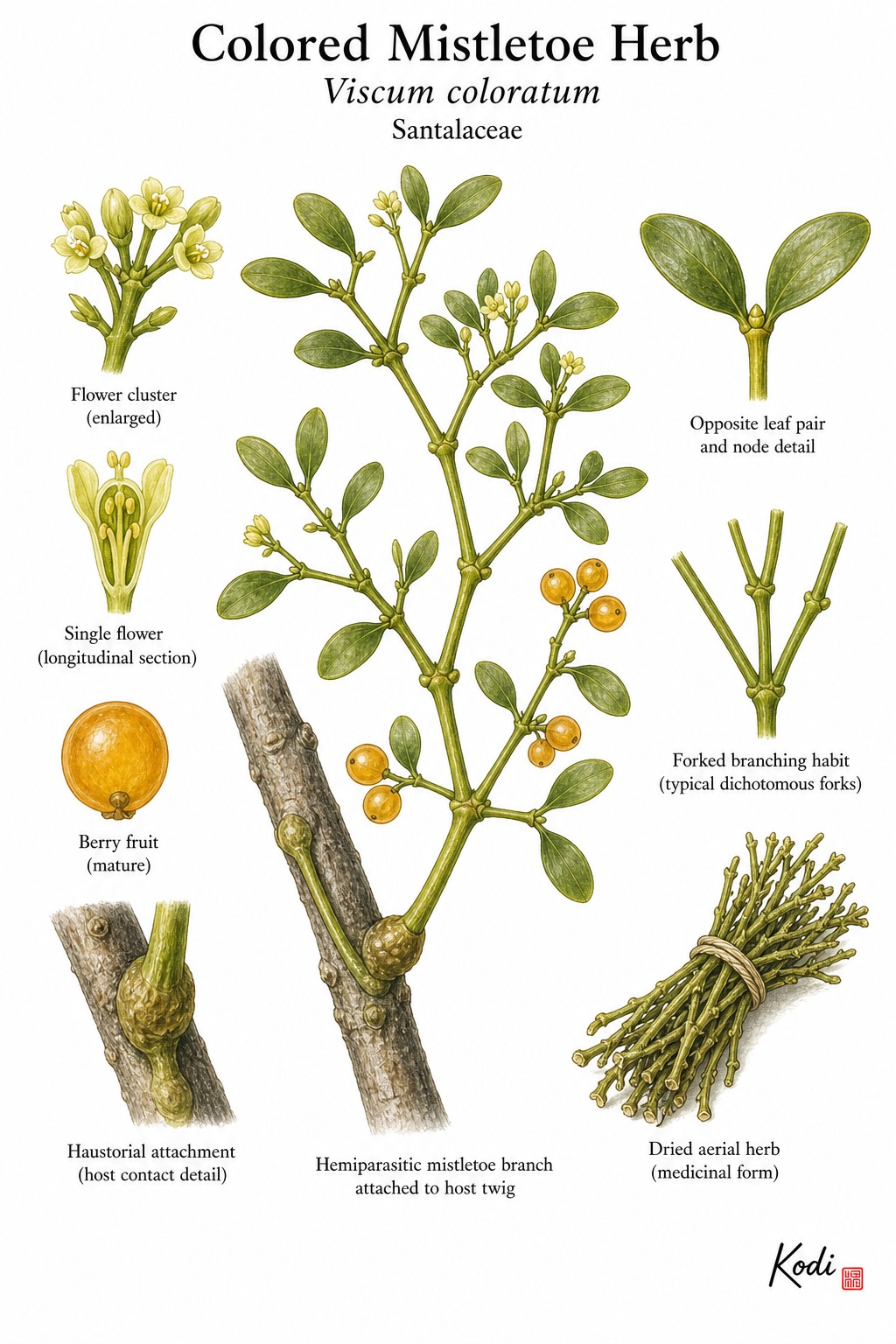
Known in TCM as Hu Ji Sheng (槲寄生), this bitter, neutral herb enters the Kidney and Liver. Traditionally, it dispels wind-damp and alleviates painful obstruction - Hu Ji Sheng is used for chronic rheumatic pain, sore low back and knees, and weakness of sinews and bones when obstruction and deficiency coexist, most often applied for joint pain, low back pain, and threatened miscarriage. Modern research has identified Flavonoids among its active constituents.
Part used: Whole herb
Also Known As
Latin: Herba Visci | Pinyin: Hu Ji Sheng | Chinese: 槲寄生
TCM Properties
- Taste
- bitter
- Temperature
- neutral
- Channels
- Kidney, Liver
Traditional Use
Primary Actions
- Dispels wind-damp and alleviates painful obstruction - Hu Ji Sheng is used for chronic rheumatic pain, sore low back and knees, and weakness of sinews and bones when obstruction and deficiency coexist.
- Tonifies the Liver and Kidneys and strengthens sinews and bones - beyond dispersing, it supports the deeper weakness that often underlies chronic joint and low-back presentations.
- Calms the fetus - traditional use extends to threatened miscarriage and pregnancy low-back pain when deficiency and instability are prominent.
Secondary Actions
- Hu Ji Sheng has long been confused or conflated with Sang Ji Sheng, but modern materia medica generally treats Viscum coloratum and Taxillus chinensis as related yet distinct records.
- Compared with the gentler, sweeter Sang Ji Sheng profile, Hu Ji Sheng is often described as a little more bitter and dispersing while still nourishing Liver-Kidney deficiency.
Classic Formulas
- Hu Ji Sheng with Du Huo and Qin Jiao - wind-damp painful-obstruction strategy when deficiency also weakens the sinews.
- Hu Ji Sheng with Xu Duan and Tu Si Zi - fetus-calming and Kidney-supportive pairing logic for threatened miscarriage or pregnancy low-back weakness.
- Hu Ji Sheng with Niu Xi and Du Zhong - chronic low-back and knee weakness combination rooted in Liver-Kidney deficiency.
Classical References
- American Dragon describes Hu Ji Sheng as bitter and neutral, entering the Liver and Kidney, dispelling wind-damp, tonifying the Liver and Kidneys, strengthening sinews and bones, and calming the fetus.
- Me & Qi notes that Hu Ji Sheng and Sang Ji Sheng were historically used under overlapping names, but modern scholars and pharmacopoeias separate Viscum coloratum from Taxillus-based Sang Ji Sheng.
- This historical name overlap is important context for the record: Hu Ji Sheng is close to but not identical with the Sang Ji Sheng entry already in the library.
Modern Research
Active Compounds
- Flavonoids and flavanones - key constituents highlighted in Viscum coloratum chemistry studies
- Diphenylpropane and related phenolic compounds such as viscolin - compounds discussed in neutrophil and anti-inflammatory work
- Additional triterpenoids and steroids - part of the broader phytochemical profile
- Host-dependent metabolite profile - a meaningful quality variable in parasitic medicinal plants
Studied Effects
- A 2024 study found that Viscum coloratum improved collagen-induced rheumatoid arthritis in rats while reducing inflammatory and bone-destructive changes, providing a modern correlate for its traditional wind-damp and sinew-bone use (PMID 38490288).
- An earlier study showed that compounds isolated from Viscum coloratum inhibited superoxide anion generation in human neutrophils, supporting anti-inflammatory interest at the molecular level (PMID 16819234).
- Viscum coloratum also demonstrated anti-colitic effects through mast-cell-related mechanisms in experimental work, showing that its modern pharmacology extends beyond the musculoskeletal sphere (PMID 30612453).
- Quality-control studies continue to emphasize fingerprinting and source variation, which matters because this parasitic herb can vary by host and is often confused with related mistletoe records (PMID 29403689).
PubMed References
- Effects of Viscum coloratum (Kom.) Nakai on collagen-induced rheumatoid arthritis (2024)
- The inhibition of superoxide anion generation in human neutrophils by Viscum coloratum (2006)
- Anticolitic Effect of Viscum coloratum through Suppression of Mast Cell Activation (2019)
- Development of the fingerprints for the quality evaluation of Viscum coloratum by high Performance liquid chromatography (2018)
Safety & Interactions
Contraindications
- Acute severe damp-heat bi or exuberant excess without underlying deficiency support needs
- Unsourced parasitic-plant material of uncertain host origin
Cautions
- Hu Ji Sheng and Sang Ji Sheng are historically entangled names, so source authentication matters more than readers might expect.
- Because parasitic herbs can vary by host tree, batch-to-batch chemistry may differ more than with ordinary nonparasitic roots.
- Threatened miscarriage and persistent joint disease require diagnosis; this herb should not replace obstetric or rheumatologic evaluation when symptoms are serious.
Conditions
- Joint Pain Traditional ★★★★☆ JSON
- Low Back Pain Traditional ★★★★☆ JSON
- Threatened Miscarriage Traditional ★★★☆☆ JSON
- Rheumatism Traditional ★★★☆☆ JSON
Frequently Asked Questions
What is Colored Mistletoe Herb used for?
Colored Mistletoe Herb is traditionally used to Dispels wind-damp and alleviates painful obstruction - Hu Ji Sheng is used for chronic rheumatic pain, sore low back and knees, and weakness of sinews and bones when obstruction and deficiency coexist., Tonifies the Liver and Kidneys and strengthens sinews and bones - beyond dispersing, it supports the deeper weakness that often underlies chronic joint and low-back presentations., Calms the fetus - traditional use extends to threatened miscarriage and pregnancy low-back pain when deficiency and instability are prominent.. Research has investigated its effects on: A 2024 study found that Viscum coloratum improved collagen-induced rheumatoid arthritis in rats while reducing inflammatory and bone-destructive changes, providing a modern correlate for its traditional wind-damp and sinew-bone use (PMID 38490288).; An earlier study showed that compounds isolated from Viscum coloratum inhibited superoxide anion generation in human neutrophils, supporting anti-inflammatory interest at the molecular level (PMID 16819234)..
What are other names for Colored Mistletoe Herb?
Colored Mistletoe Herb is also known as Visci. In TCM: 槲寄生 (Hu Ji Sheng); Herba Visci.
Is Colored Mistletoe Herb safe during pregnancy?
The safety of Colored Mistletoe Herb during pregnancy has not been established. Consult a qualified healthcare provider before use.
What are the contraindications for Colored Mistletoe Herb?
Colored Mistletoe Herb should not be used in: Acute severe damp-heat bi or exuberant excess without underlying deficiency support needs; Unsourced parasitic-plant material of uncertain host origin. Consult a qualified healthcare provider before use.