Coin-Like White-Banded Snake
- Chinese
- 金钱白花蛇
- Pinyin
- Jin Qian Bai Hua She
- Latin
- Bungarus Parvus
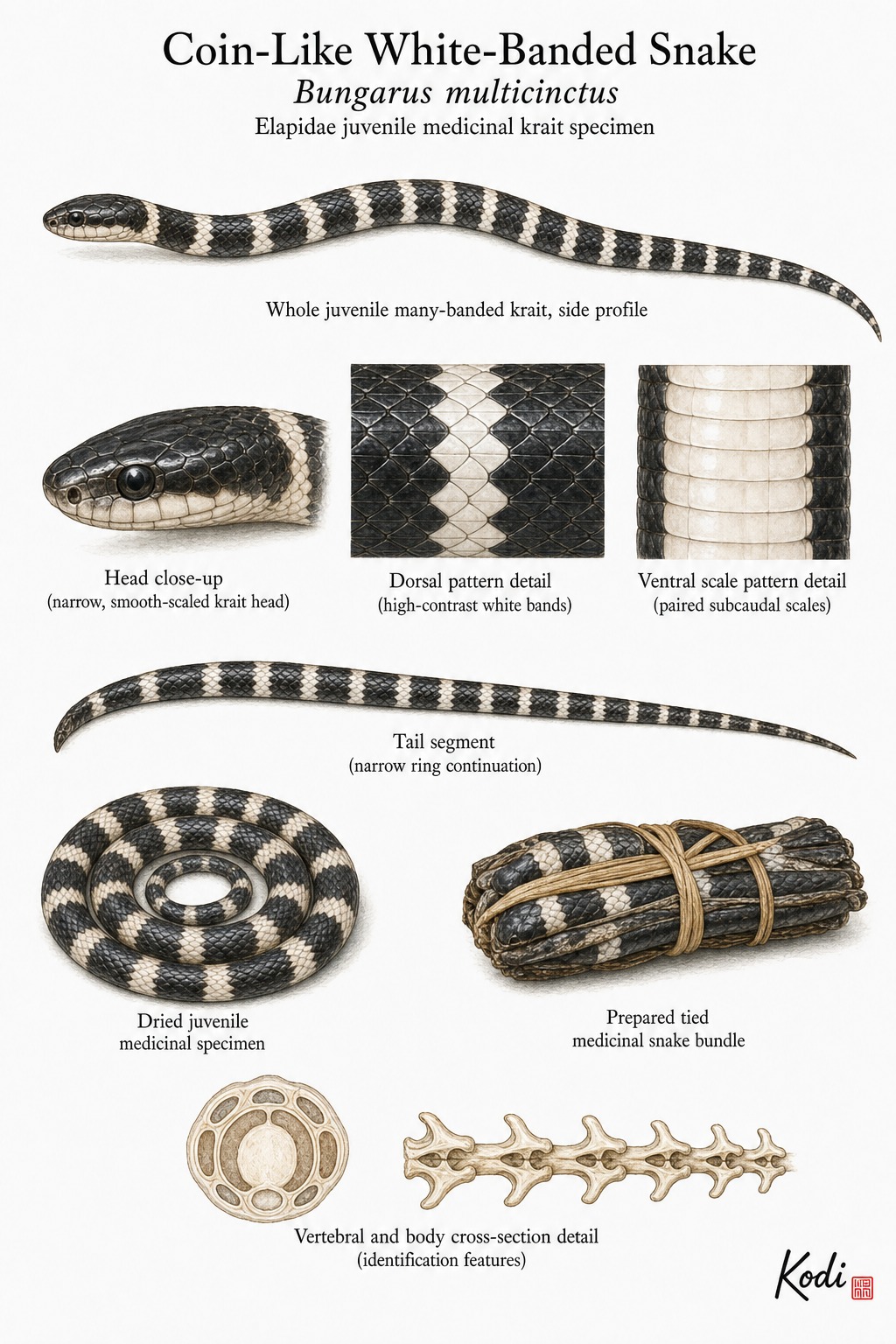
Known in TCM as Jin Qian Bai Hua She (金钱白花蛇), this sweet and salty, warm herb enters the Liver. Traditionally, it dispels wind-damp and unblocks the collaterals - Jin Qian Bai Hua She is a strong snake medicinal used for stubborn joint pain, numbness, and chronic channel obstruction when ordinary wind-damp herbs are insufficient, most often applied for joint pain, facial paralysis, and eczema. Modern research has identified Alpha-bungarotoxin among its active constituents.
Also Known As
Latin: Bungarus Parvus | Pinyin: Jin Qian Bai Hua She | Chinese: 金钱白花蛇
TCM Properties
- Taste
- sweet, salty
- Temperature
- warm
- Channels
- Liver
Traditional Use
Primary Actions
- Dispels wind-damp and unblocks the collaterals - Jin Qian Bai Hua She is a strong snake medicinal used for stubborn joint pain, numbness, and chronic channel obstruction when ordinary wind-damp herbs are insufficient.
- Extinguishes wind and stops spasms - traditional use includes convulsions, facial paralysis, tremor, and post-stroke or channel-wind sequelae.
- Searches out wind from the skin and channels - it is also used for persistent pruritic or scaly skin disorders when deeper wind-toxin or channel obstruction is involved.
Secondary Actions
- Jin Qian Bai Hua She is traditionally regarded as a prized juvenile snake form with stronger penetrating action than milder non-toxic snake medicinals.
- The record sits close to Bai Hua She in function but carries its own trade identity and extra authentication challenges.
Classic Formulas
- Da Huo Luo Dan - major wind-damp and stroke-sequelae formula logic in which strong snake medicinals help dredge deep collaterals.
- Jin Qian Bai Hua She with Quan Xie or Wu Gong - strong wind-extinguishing and spasm-relieving pairing strategy in difficult channel-wind disorders.
- Snake-medicine combinations for chronic itchy dermatoses - traditional pairing logic when skin disease is interpreted as a deep wind-toxin problem.
Classical References
- Traditional TCM teaching places Jin Qian Bai Hua She in the same broad family as Bai Hua She: warm, Liver-entering, wind-damp dispelling, spasm stopping, and itch relieving, but typically stronger and more valued.
- A California acupuncture board reference list still preserves the old exam-line identity of Jin Qian Bai Hua She as Bungarus Parvus, reflecting why older English herb lists can look taxonomically unstable.
- Modern Chinese scientific literature also links Jin Qian Bai Hua She to the many-banded krait lineage, so authentication is a real practical issue rather than a minor naming quirk.
Modern Research
Active Compounds
- Alpha-bungarotoxin and related three-finger neurotoxins - hallmark potent neuroactive venom proteins of Bungarus species
- Phospholipase A2 venom proteins - major enzymatic toxins relevant to neuromuscular and inflammatory effects
- Additional presynaptic and postsynaptic neurotoxin complexes - key drivers of krait venom toxicity
- Whole-body protein and peptide matrix of the processed juvenile snake medicinal - distinct from isolated venom but still biologically active
Studied Effects
- Modern indexed literature on Jin Qian Bai Hua She is dominated by authentication, genomics, and venom biology rather than by direct therapeutic trials, so contemporary evidence mainly clarifies identity and risk rather than proving clinical benefit.
- A PCR-based identification study specifically distinguished Jin Qian Bai Hua She from adulterants, underscoring the long-standing authentication problem in the medicinal trade (PMID 12016862).
- Genomic and transcriptomic work on Bungarus multicinctus identified it as the medicinal animal resource for Jin Qian Bai Hua She and mapped the toxin-rich biology underlying both its danger and scientific interest (PMID 37250171).
- In vitro venom research continues to confirm potent neurotoxicity in Chinese krait material, reinforcing why medicinal use requires fully processed professional products rather than any crude snake-derived improvisation (PMID 33440641).
PubMed References
- Sequencing of Cyt b gene fragments and PCR identification of Jinqian Baihuashe and its adulterants (2002)
- Genomic, transcriptomic, and epigenomic analysis of a medicinal snake, Bungarus multicinctus, to provide insights into the origin of Elapidae neurotoxins (2023)
- In Vitro Neurotoxicity of Chinese Krait (Bungarus multicinctus) Venom and Neutralization by Antivenoms (2021)
Safety & Interactions
Contraindications
- Pregnancy
- Mild patterns that can be handled by less toxic wind-damp herbs
- Improvised or non-medicinal snake material of any kind
Cautions
- This is a high-risk animal medicinal tied to venomous krait lineage and must not be equated with casual use of dried snake products.
- Authentication, parasite control, legal sourcing, and proper processing are essential because adulteration and species confusion are well documented.
- The same toxin biology that drives modern scientific interest also means unsupervised use can be dangerous, especially around neurologic symptoms or overdose.
Conditions
- Joint Pain Traditional ★★★★★ JSON
- Facial Paralysis Traditional ★★★★☆ JSON
- Eczema Traditional ★★★★☆ JSON
- Epilepsy Traditional ★★★☆☆ JSON
Frequently Asked Questions
What is Coin-Like White-Banded Snake used for?
Coin-Like White-Banded Snake is traditionally used to Dispels wind-damp and unblocks the collaterals - Jin Qian Bai Hua She is a strong snake medicinal used for stubborn joint pain, numbness, and chronic channel obstruction when ordinary wind-damp herbs are insufficient., Extinguishes wind and stops spasms - traditional use includes convulsions, facial paralysis, tremor, and post-stroke or channel-wind sequelae., Searches out wind from the skin and channels - it is also used for persistent pruritic or scaly skin disorders when deeper wind-toxin or channel obstruction is involved.. Research has investigated its effects on: Modern indexed literature on Jin Qian Bai Hua She is dominated by authentication, genomics, and venom biology rather than by direct therapeutic trials, so contemporary evidence mainly clarifies identity and risk rather than proving clinical benefit.; A PCR-based identification study specifically distinguished Jin Qian Bai Hua She from adulterants, underscoring the long-standing authentication problem in the medicinal trade (PMID 12016862)..
What are other names for Coin-Like White-Banded Snake?
Coin-Like White-Banded Snake is also known as Bungarus. In TCM: 金钱白花蛇 (Jin Qian Bai Hua She); Bungarus Parvus.
Is Coin-Like White-Banded Snake safe during pregnancy?
Coin-Like White-Banded Snake is not recommended during pregnancy.
What are the contraindications for Coin-Like White-Banded Snake?
Coin-Like White-Banded Snake should not be used in: Pregnancy; Mild patterns that can be handled by less toxic wind-damp herbs; Improvised or non-medicinal snake material of any kind. Consult a qualified healthcare provider before use.