Cockscomb Flower
- Chinese
- 鸡冠花
- Pinyin
- Ji Guan Hua
- Latin
- Flos Celosiae Cristatae
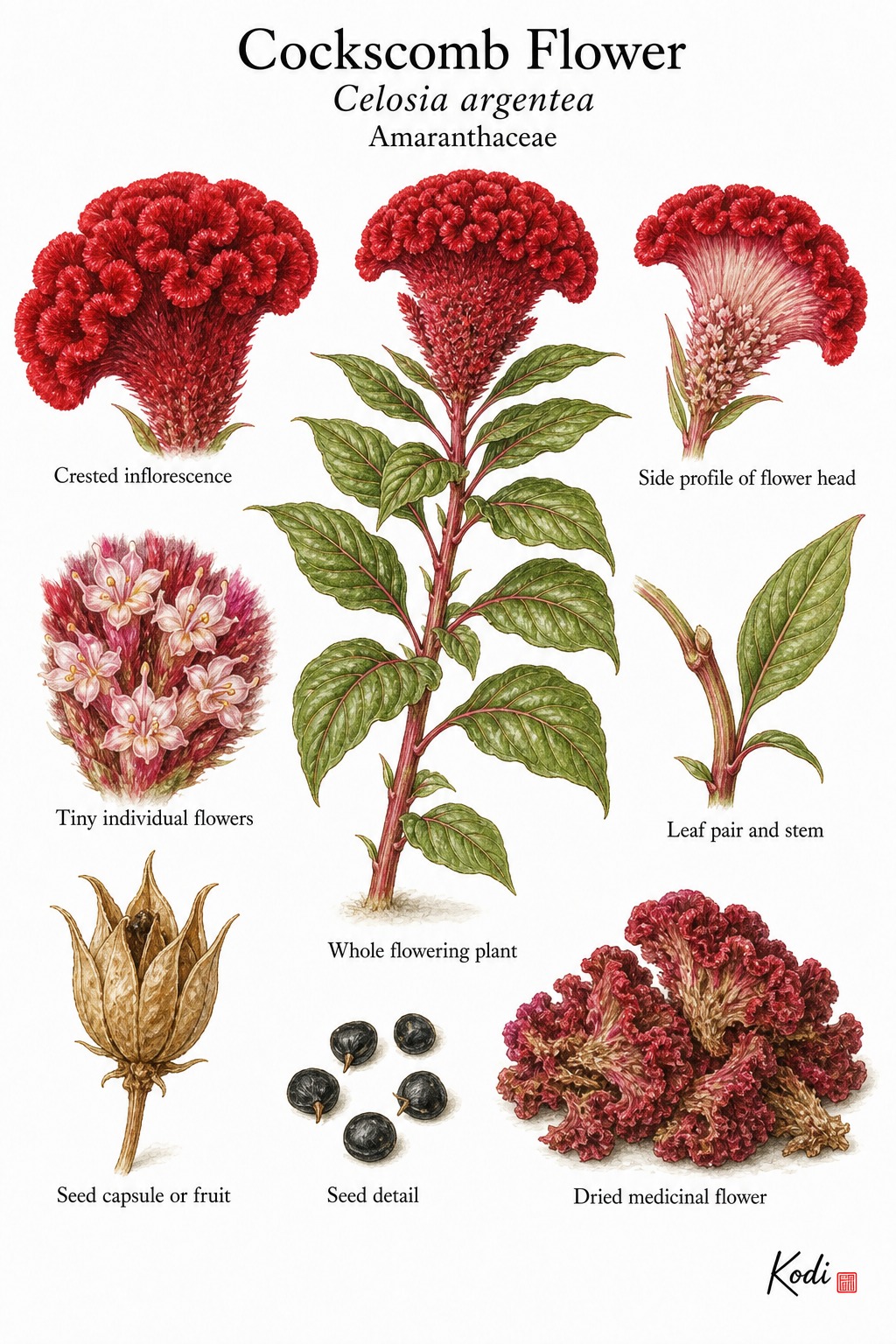
Known in TCM as Ji Guan Hua (鸡冠花), this sweet and astringent, cool herb enters the Large Intestine and Liver. Traditionally, it cools blood and stops bleeding - Ji Guan Hua is traditionally used for uterine bleeding, heavy menses, bloody stool, hematuria, and other hemorrhagic disorders in which a cool astringent flower is appropriate, most often applied for abnormal uterine bleeding, leucorrhea, and dysentery. Modern research has identified Flavonoids among its active constituents.
Part used: Flower
Also Known As
Latin: Flos Celosiae Cristatae | Pinyin: Ji Guan Hua | Chinese: 鸡冠花
TCM Properties
- Taste
- sweet, astringent
- Temperature
- cool
- Channels
- Large Intestine, Liver
Traditional Use
Primary Actions
- Cools blood and stops bleeding - Ji Guan Hua is traditionally used for uterine bleeding, heavy menses, bloody stool, hematuria, and other hemorrhagic disorders in which a cool astringent flower is appropriate.
- Stops leukorrhea - it is also classically used for excessive vaginal discharge, especially when dampness and weakness allow chronic leakage.
- Checks dysenteric discharge - the astringing quality extends to chronic dysentery or prolonged lower-bowel discharge.
Secondary Actions
- The charred form, Ji Guan Hua Tan, is classically said to astringe bleeding and discharge even more strongly than the raw flower.
- Although the flower is gentle compared with strong mineral or animal hemostatics, it occupies a useful middle ground between cooling blood and astringing leakage.
Classic Formulas
- Charred Ji Guan Hua with Ce Bai Ye Tan or Qian Cao Tan - hemostatic combination logic for persistent uterine or intestinal bleeding.
- Ji Guan Hua with Bai Ji Li and Qian Shi - leukorrhea-oriented astringing strategy when dampness and leakage coexist.
- Ji Guan Hua with dysentery-directed herbs such as Bai Tou Weng or Qin Pi - lower-burner discharge and bowel-irritation pairing logic.
Classical References
- American Dragon lists Ji Guan Hua as cooling and astringing, with actions of stopping bleeding, checking leukorrhea, and treating dysentery, and specifically notes that the charred form is better at restraining bleeding and discharge.
- TCM Wiki likewise places Ji Guan Hua among stop-bleeding herbs and highlights uterine bleeding, leukorrhea, and dysenteric disorders as the major indications.
- Its enduring clinical niche is not broad anti-inflammatory use but rather cool astringent control of lower-tract leakage.
Modern Research
Active Compounds
- Flavonoids - major bioactive constituents emphasized in recent reviews
- Triterpenoids and steroids - repeatedly described classes in Celosia cristata chemistry
- Polysaccharides - bioactive macromolecules studied for immune effects
- Phenolic and organic-acid constituents - additional contributors to antioxidant and anti-inflammatory activity
Studied Effects
- A 2024 review of Celosia cristata summarized traditional use for bleeding disorders, leukorrhea, and gastrointestinal infections while also reviewing haemostatic, anti-inflammatory, antibacterial, analgesic, and immunoregulatory research (PMID 38740106).
- Polysaccharides extracted from Celosia cristata flowers showed immunostimulatory activity in macrophage-related experimental work, expanding the modern biologic profile beyond simple astringency (PMID 33719132).
- Nutritional and antioxidant profiling of Celosia cristata flowers further supports that the inflorescence contains meaningful antioxidant constituents, although this does not replace the traditional hemostatic interpretation (PMID 33426325).
PubMed References
- Celosia cristata L.: A review of its traditional uses, phytochemistry, pharmacology, toxicology, and quality control, along with network pharmacological analysis of its components and targets (2024)
- Immunostimulatory Activity of Polysaccharides Extracted from Celosia cristata Flowers (2021)
- Celosia cristata Linn. flowers as a new source of nutraceuticals - A study on nutritional composition, chemical characterization and in-vitro antioxidant capacity (2020)
Safety & Interactions
Contraindications
- Constipation or very dry bowels when strong astringency would worsen the pattern
- Bleeding that reflects emergency obstetric, oncologic, or surgical causes rather than outpatient herbal patterns
Cautions
- Persistent uterine bleeding or leukorrhea requires evaluation for structural or infectious causes rather than self-treatment alone.
- The herb's astringing nature can be counterproductive if an acute pathogen or unresolved damp-heat needs to be drained rather than restrained.
Conditions
- Abnormal Uterine Bleeding Traditional ★★★★☆ JSON
- Leucorrhea Traditional ★★★★☆ JSON
- Dysentery Traditional ★★★☆☆ JSON
- Hematuria Traditional ★★☆☆☆ JSON
Frequently Asked Questions
What is Cockscomb Flower used for?
Cockscomb Flower is traditionally used to Cools blood and stops bleeding - Ji Guan Hua is traditionally used for uterine bleeding, heavy menses, bloody stool, hematuria, and other hemorrhagic disorders in which a cool astringent flower is appropriate., Stops leukorrhea - it is also classically used for excessive vaginal discharge, especially when dampness and weakness allow chronic leakage., Checks dysenteric discharge - the astringing quality extends to chronic dysentery or prolonged lower-bowel discharge.. Research has investigated its effects on: A 2024 review of Celosia cristata summarized traditional use for bleeding disorders, leukorrhea, and gastrointestinal infections while also reviewing haemostatic, anti-inflammatory, antibacterial, analgesic, and immunoregulatory research (PMID 38740106).; Polysaccharides extracted from Celosia cristata flowers showed immunostimulatory activity in macrophage-related experimental work, expanding the modern biologic profile beyond simple astringency (PMID 33719132)..
What are other names for Cockscomb Flower?
Cockscomb Flower is also known as Celosia. In TCM: 鸡冠花 (Ji Guan Hua); Flos Celosiae Cristatae.
Is Cockscomb Flower safe during pregnancy?
The safety of Cockscomb Flower during pregnancy has not been established. Consult a qualified healthcare provider before use.
What are the contraindications for Cockscomb Flower?
Cockscomb Flower should not be used in: Constipation or very dry bowels when strong astringency would worsen the pattern; Bleeding that reflects emergency obstetric, oncologic, or surgical causes rather than outpatient herbal patterns. Consult a qualified healthcare provider before use.