Wingless Cockroach
- Chinese
- 蟅虫
- Pinyin
- Zhe Chong
- Latin
- Eupolyphaga Seu Steleophaga
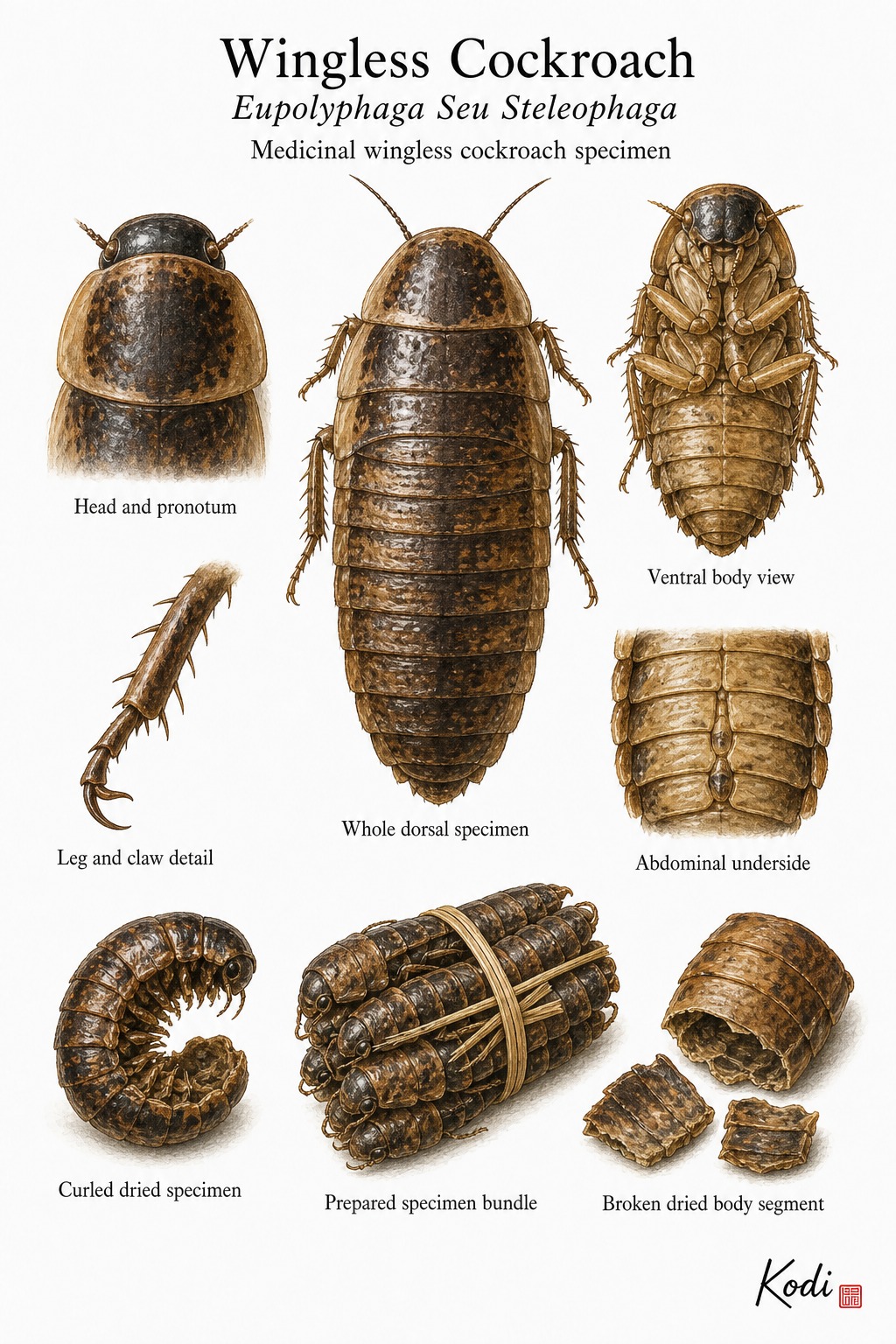
Known in TCM as Zhe Chong (蟅虫), this salty, cold herb enters the Liver. Traditionally, it breaks blood stasis and dissipates long-standing masses - Zhe Chong is the classical name most closely associated with severe, chronic, and fixed stasis disorders in the old formula literature, most often applied for amenorrhea, dysmenorrhea, and traumatic injury. Modern research has identified Fatty among its active constituents.
Also Known As
Latin: Eupolyphaga Seu Steleophaga | Pinyin: Zhe Chong | Chinese: 蟅虫
TCM Properties
- Taste
- salty
- Temperature
- cold
- Channels
- Liver
Traditional Use
Primary Actions
- Breaks blood stasis and dissipates long-standing masses - Zhe Chong is the classical name most closely associated with severe, chronic, and fixed stasis disorders in the old formula literature.
- Relieves pain from congealed blood obstruction - this includes menstrual pain, postpartum lower-abdominal pain, and chronic fullness or hardness from old stasis.
- Supports recovery after trauma and fracture - like Tu Bie Chong, the classical Zhe Chong lineage is also valued for helping restore continuity after injury.
Secondary Actions
- This file preserves the older formula-language identity of Zhe Chong rather than inventing a separate species-level medicinal from Tu Bie Chong.
- In practical modern use, Zhe Chong and Tu Bie Chong usually refer to the same medicinal insect family, but the classical name appears prominently in major canonical formulas.
Classic Formulas
- Da Huang Zhe Chong Wan - the signature classical formula carrying the Zhe Chong name and one of the strongest examples of stasis-breaking formula design.
- Bie Jia Jian Wan - chronic accumulation and mass-dispersing formula logic in which deep stasis and hardness are central concerns.
- Trauma formulas containing Zhe Chong with blood-moving and bone-repair herbs - later practical extensions of the same stasis-breaking identity.
Classical References
- TCM Wiki specifically frames Zhe Chong through chronic consumptive disease with blood stasis, amenorrhea, abdominal fullness, and Da Huang Zhe Chong Wan from the Jin Kui Yao Lue.
- The classical formula tradition therefore gives Zhe Chong a slightly more canonical, text-anchored feel than the more colloquial Tu Bie Chong name, even though they are not meaningfully separate medicinals here.
- This record should be read as a classical-name variant within the same medicinal lineage, not as a second unrelated 'cockroach' herb.
Modern Research
Active Compounds
- Fatty acid-rich insect fractions
- Peptides and small proteins linked to tissue-repair and immune research
- Polysaccharide and amino-acid matrix components
- Broad small-molecule insect metabolites mapped in Eupolyphaga review literature
Studied Effects
- Modern pharmacology for Zhe Chong is effectively the same as for Tu Bie Chong because both names usually point back to Eupolyphaga/Steleophaga medicinal insect material.
- A 2022 review summarized the chemical and pharmacological research on Tubiechong, including circulation-related, anti-inflammatory, and anticancer directions (PMID 35497279).
- A scoping review of Eupolyphaga sinensis described broad experimental effects across cancer, immunity, and oxidative-stress pathways (PMID 35700853).
- Recent oral-extract research showing enhanced bone formation and fusion support provides a plausible modern correlate for the classical fracture-repair reputation preserved under the Zhe Chong name as well (PMID 40949778).
PubMed References
- A periodic review of chemical and pharmacological profiles of Tubiechong as insect Chinese medicine (2022)
- Scoping review of the medicinal effects of Eupolyphaga sinensis Walker and the underlying mechanisms (2022)
- Oral Eupolyphaga sinensis extract promotes lumbar interbody fusion by enhancing vascularization of cartilage endplate (2025)
Safety & Interactions
Contraindications
- Pregnancy
- Heavy active bleeding without clear stasis
- Deficiency states without fixed blood obstruction
Cautions
- Because Zhe Chong is one of the stronger blood-breaking medicinals in the classical canon, dosing and indication need more precision than with gentle blood-movers.
- Authentication and contamination control matter for all medicinal insect materials in this category.
- Use caution in patients with known insect allergies or unusual immune reactivity.
Drug Interactions
- Anticoagulants or antiplatelet drugs - additive bleeding risk is plausible
Conditions
- Amenorrhea Traditional ★★★★☆ JSON
- Dysmenorrhea Traditional ★★★☆☆ JSON
- Traumatic Injury Traditional ★★★☆☆ JSON
- Abdominal Pain Traditional ★★☆☆☆ JSON
Frequently Asked Questions
What is Wingless Cockroach used for?
Wingless Cockroach is traditionally used to Breaks blood stasis and dissipates long-standing masses - Zhe Chong is the classical name most closely associated with severe, chronic, and fixed stasis disorders in the old formula literature., Relieves pain from congealed blood obstruction - this includes menstrual pain, postpartum lower-abdominal pain, and chronic fullness or hardness from old stasis., Supports recovery after trauma and fracture - like Tu Bie Chong, the classical Zhe Chong lineage is also valued for helping restore continuity after injury.. Research has investigated its effects on: Modern pharmacology for Zhe Chong is effectively the same as for Tu Bie Chong because both names usually point back to Eupolyphaga/Steleophaga medicinal insect material.; A 2022 review summarized the chemical and pharmacological research on Tubiechong, including circulation-related, anti-inflammatory, and anticancer directions (PMID 35497279)..
What are other names for Wingless Cockroach?
Wingless Cockroach is also known as Eupolyphaga. In TCM: 蟅虫 (Zhe Chong); Eupolyphaga Seu Steleophaga.
Is Wingless Cockroach safe during pregnancy?
Wingless Cockroach is not recommended during pregnancy.
What are the contraindications for Wingless Cockroach?
Wingless Cockroach should not be used in: Pregnancy; Heavy active bleeding without clear stasis; Deficiency states without fixed blood obstruction. Consult a qualified healthcare provider before use.
Does Wingless Cockroach interact with any medications?
Wingless Cockroach may interact with: Anticoagulants or antiplatelet drugs - additive bleeding risk is plausible. Always inform your healthcare provider of any herbal supplements you are taking.