Wingless Cockroach
- Chinese
- 土鳖虫
- Pinyin
- Tu Bie Chong
- Latin
- Eupolyphaga Seu Steleophaga
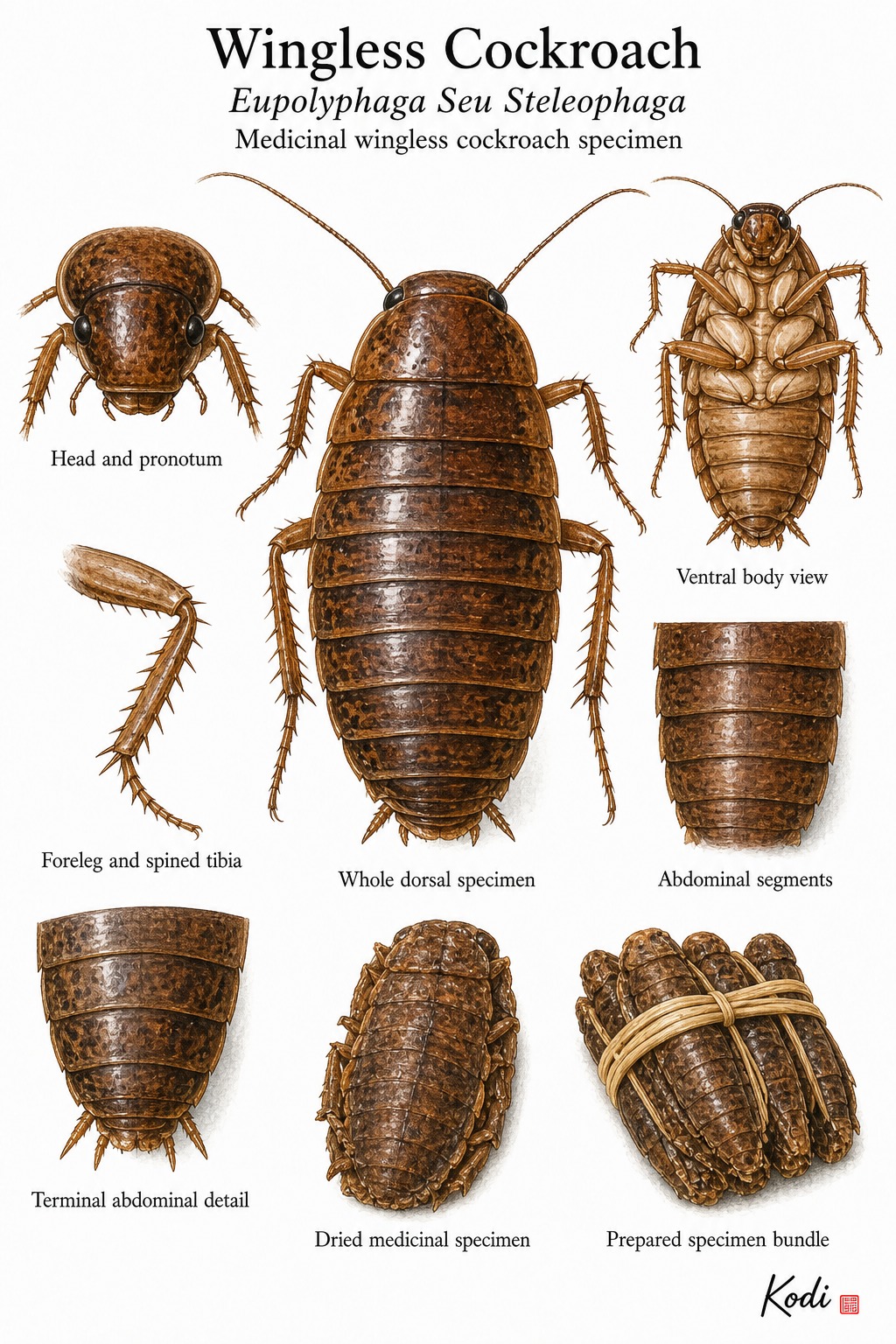
Known in TCM as Tu Bie Chong (土鳖虫), this salty, cold herb enters the Liver. Traditionally, it breaks up blood stasis and dispels accumulations - Tu Bie Chong is a strong blood-breaking medicinal used for amenorrhea, fixed abdominal masses, postpartum stasis pain, and other entrenched stasis disorders that gentler movers may not resolve, most often applied for amenorrhea, traumatic injury, and dysmenorrhea. Modern research has identified Fatty among its active constituents.
Also Known As
Latin: Eupolyphaga Seu Steleophaga | Pinyin: Tu Bie Chong | Chinese: 土鳖虫
TCM Properties
- Taste
- salty
- Temperature
- cold
- Channels
- Liver
Traditional Use
Primary Actions
- Breaks up blood stasis and dispels accumulations - Tu Bie Chong is a strong blood-breaking medicinal used for amenorrhea, fixed abdominal masses, postpartum stasis pain, and other entrenched stasis disorders that gentler movers may not resolve.
- Relieves pain caused by obstructive blood stasis - its traditional sphere includes stubborn menstrual pain and focal pain with hardness or palpable mass.
- Reconnects sinews and bones after traumatic injury - beyond gynecologic and mass-dispersing use, it is classically valued for fractures, contusions, and tissue damage where stasis prevents recovery.
Secondary Actions
- Despite the imported English label, this is not a household pest remedy but a specific medicinal wingless insect traditionally processed for blood-stasis and trauma use.
- Tu Bie Chong is much more forceful than ordinary blood-moving herbs and is therefore reserved for more substantial stasis or injury patterns.
Classic Formulas
- Da Huang Zhe Chong Wan - one of the defining classical blood-stasis formulas for chronic stasis with abdominal fullness, emaciation, or fixed masses.
- Xia Yu Xue Tang - classical postpartum or lower-abdominal blood-stasis formula logic in which strong stasis-resolving herbs are required.
- Trauma and fracture formulas using Tu Bie Chong with Gu Sui Bu or Zi Ran Tong - traditional pairing logic for sinew-bone repair after injury.
Classical References
- Modern TCM summaries place Tu Bie Chong among the strongest blood-stasis-breaking medicinals and emphasize amenorrhea, palpable masses, and traumatic injury as the core indications.
- The Jin Kui Yao Lue formula tradition is especially important for this herb, particularly Da Huang Zhe Chong Wan and related stasis formulas.
- Later materia medica also preserve the 'joins sinews and bones' reputation that keeps the insect relevant in trauma and fracture discussions.
Modern Research
Active Compounds
- Fatty acids and lipid fractions - abundant components repeatedly described in Tubiechong chemistry
- Peptides and small protein fractions - candidate contributors to bioactivity in wound, immune, and tissue-repair research
- Polysaccharide and amino-acid-rich insect matrix fractions - part of the complex whole-animal medicinal profile
- Bioactive small molecules identified across Eupolyphaga and Steleophaga species - increasingly mapped in review literature
Studied Effects
- A 2022 review of Tubiechong summarized ethnomedicinal use, chemistry, and pharmacology, with special emphasis on blood-circulation, swelling-pain, anticancer, and tissue-repair themes across Eupolyphaga and related medicinal insects (PMID 35497279).
- A scoping review of Eupolyphaga sinensis further described anti-inflammatory, antioxidant, immune, and antitumor research directions, reinforcing that modern interest extends well beyond the old 'break blood stasis' wording (PMID 35700853).
- Recent experimental work reported that oral Eupolyphaga sinensis extract promoted lumbar interbody fusion by enhancing vascularization and new bone formation, offering a modern correlate for the classical sinew-and-bone-repair reputation (PMID 40949778).
- Quality control matters in practice: one Chinese study found substantial aflatoxin contamination in some Eupolyphaga/Steleophaga samples, underscoring the need for properly sourced medicinal material (PMID 32237341).
PubMed References
- A periodic review of chemical and pharmacological profiles of Tubiechong as insect Chinese medicine (2022)
- Scoping review of the medicinal effects of Eupolyphaga sinensis Walker and the underlying mechanisms (2022)
- Oral Eupolyphaga sinensis extract promotes lumbar interbody fusion by enhancing vascularization of cartilage endplate (2025)
- Simultaneous determination of aflatoxins in Eupolyphaga Steleophaga by immunoaffinity column clean-up and HPLC-FLD with post-column photochemical derivatization (2020)
Safety & Interactions
Contraindications
- Pregnancy - strong blood-breaking activity creates miscarriage risk
- Heavy active bleeding without a clear blood-stasis pattern
- Marked Qi and Blood deficiency without fixed stasis or traumatic obstruction
Cautions
- This is a strong blood-breaking animal medicinal and should not be treated as a gentle circulatory tonic.
- Quality control is unusually important because medicinal insect products can vary in authentication, cleanliness, and mycotoxin burden.
- Patients with shellfish or insect hypersensitivity may react unpredictably to insect-derived medicinal materials.
Drug Interactions
- Anticoagulants or antiplatelet drugs - additive bleeding risk is plausible because the herb is strongly blood-moving and blood-breaking
Conditions
- Amenorrhea Traditional ★★★★☆ JSON
- Traumatic Injury Traditional ★★★★☆ JSON
- Dysmenorrhea Traditional ★★★☆☆ JSON
- Abdominal Pain Traditional ★★☆☆☆ JSON
Frequently Asked Questions
What is Wingless Cockroach used for?
Wingless Cockroach is traditionally used to Breaks up blood stasis and dispels accumulations - Tu Bie Chong is a strong blood-breaking medicinal used for amenorrhea, fixed abdominal masses, postpartum stasis pain, and other entrenched stasis disorders that gentler movers may not resolve., Relieves pain caused by obstructive blood stasis - its traditional sphere includes stubborn menstrual pain and focal pain with hardness or palpable mass., Reconnects sinews and bones after traumatic injury - beyond gynecologic and mass-dispersing use, it is classically valued for fractures, contusions, and tissue damage where stasis prevents recovery.. Research has investigated its effects on: A 2022 review of Tubiechong summarized ethnomedicinal use, chemistry, and pharmacology, with special emphasis on blood-circulation, swelling-pain, anticancer, and tissue-repair themes across Eupolyphaga and related medicinal insects (PMID 35497279).; A scoping review of Eupolyphaga sinensis further described anti-inflammatory, antioxidant, immune, and antitumor research directions, reinforcing that modern interest extends well beyond the old 'break blood stasis' wording (PMID 35700853)..
What are other names for Wingless Cockroach?
Wingless Cockroach is also known as Eupolyphaga. In TCM: 土鳖虫 (Tu Bie Chong); Eupolyphaga Seu Steleophaga.
Is Wingless Cockroach safe during pregnancy?
Wingless Cockroach is not recommended during pregnancy.
What are the contraindications for Wingless Cockroach?
Wingless Cockroach should not be used in: Pregnancy - strong blood-breaking activity creates miscarriage risk; Heavy active bleeding without a clear blood-stasis pattern; Marked Qi and Blood deficiency without fixed stasis or traumatic obstruction. Consult a qualified healthcare provider before use.
Does Wingless Cockroach interact with any medications?
Wingless Cockroach may interact with: Anticoagulants or antiplatelet drugs - additive bleeding risk is plausible because the herb is strongly blood-moving and blood-breaking. Always inform your healthcare provider of any herbal supplements you are taking.