Clove Oil
- Chinese
- 丁香油
- Pinyin
- Ding Xiang You
- Latin
- Oleum Caryophylli
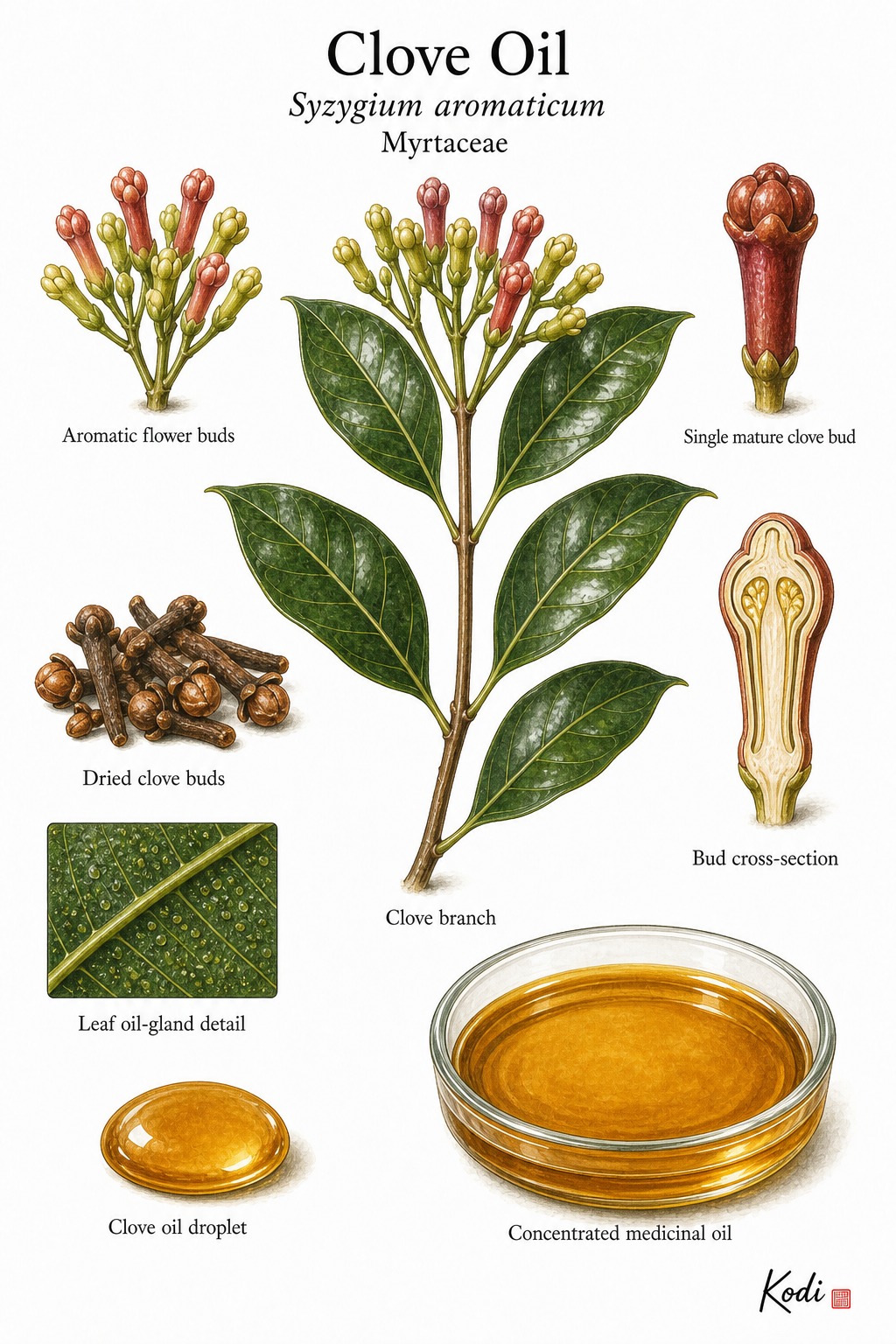
Known in TCM as Ding Xiang You (丁香油), this acrid, warm herb enters the Spleen and Stomach. Traditionally, it warms the Spleen and Stomach in concentrated aromatic form - Ding Xiang You is used when cold in the middle burner causes abdominal pain, nausea, poor appetite, or loose stool and a sharper preparation is desired, most often applied for abdominal pain, nausea, and diarrhea. Modern research has identified Eugenol among its active constituents.
Part used: Oil
Also Known As
Latin: Oleum Caryophylli | Pinyin: Ding Xiang You | Chinese: 丁香油
TCM Properties
- Taste
- acrid
- Temperature
- warm
- Channels
- Spleen, Stomach
Traditional Use
Primary Actions
- Warms the Spleen and Stomach in concentrated aromatic form - Ding Xiang You is used when cold in the middle burner causes abdominal pain, nausea, poor appetite, or loose stool and a sharper preparation is desired.
- Redirects rebellious Stomach Qi - the oil follows the same descending-warming direction as clove bud but acts more rapidly and more irritably because it is a concentrated volatile preparation.
- Provides topical aromatic pain-relieving use - outside decoction practice, clove oil has long been valued for concentrated external application in oral or localized painful conditions.
Secondary Actions
- This is a preparation-state record rather than a separate species: its identity depends on being the volatile oil of clove, not a distinct traditional crude herb.
- Because the oil is much stronger than the whole flower bud or fruit, clinical handling is closer to concentrated aromatic pharmacology than to ordinary food-spice use.
Classic Formulas
- Ding Xiang You with other warming aromatics - preparation-style use for cold middle-jiao pain and rebellious Qi.
- Topical clove-oil application - practical oral and local analgesic use rather than a famous classical decoction lineage.
Classical References
- Traditional Chinese materia-medica summaries describe Ding Xiang You as warming the Spleen and Stomach, redirecting rebellious Qi, and supporting cold-type digestive pain in a more concentrated form than the crude herb.
- The practical distinction between Ding Xiang and Ding Xiang You is one of intensity and irritation: the oil is much more penetrating but much less forgiving.
- This file therefore treats clove oil as a derivative preparation whose external and concentrated uses matter as much as its inherited TCM direction.
Modern Research
Active Compounds
- Eugenol - the dominant active constituent responsible for much of clove oil's analgesic, antimicrobial, and anti-inflammatory profile
- Eugenyl acetate - a major aromatic constituent contributing to fragrance and bioactivity
- Beta-caryophyllene - a sesquiterpene relevant to anti-inflammatory and analgesic discussion
- Minor phenylpropanoids and terpenes - supporting constituents that vary by source and extraction
Studied Effects
- A 2020 review of Syzygium aromaticum detailed the broad pharmacology of clove oil and eugenol, including antimicrobial, anti-inflammatory, antispasmodic, and analgesic effects (PMID 32019140).
- A dedicated review on clove oil's antimicrobial research summarized strong activity against bacteria and fungi and highlighted eugenol as the main driver of preservative and antiseptic interest (PMID 29802735).
- Recent review work continues to position clove essential oil as a human-health-relevant antimicrobial and anti-inflammatory preparation rather than merely a flavoring oil (PMID 38474510).
- A 2025 study comparing whole clove essential oil with isolated eugenol reinforced that eugenol accounts for much of the oil's antioxidant, antibacterial, and antifungal activity, while the complete oil still behaves as a multicomponent preparation (PMID 40104575).
PubMed References
- Syzygium aromaticum L. (Myrtaceae): Traditional Uses, Bioactive Chemical Constituents, Pharmacological and Toxicological Activities (2020)
- Progress on the Antimicrobial Activity Research of Clove Oil and Eugenol in the Food Antisepsis Field (2018)
- Antimicrobial Activity of Syzygium aromaticum Essential Oil in Human Health Treatment (2024)
- Evaluating the multifaceted bioactivity of Syzygium aromaticum essential oil: the central role of eugenol (2025)
Safety & Interactions
Contraindications
- Undiluted internal use outside professional supervision
- Hot-pattern vomiting, stomach heat, reflux with burning, or Yin-deficiency heat
- Application to damaged mucosa or broken skin without careful dilution
Cautions
- Clove oil is far more irritating than the whole herb and can cause mucosal burning, nausea, vomiting, or skin reactions if used too strongly.
- Pediatric poisoning and liver injury have been reported with excessive ingestion of eugenol-rich clove oil; this is not a casual internal-use product.
- Topical use should be diluted and oral use should remain practitioner-directed.
Drug Interactions
- Anticoagulants or antiplatelet drugs - concentrated eugenol-rich oil may increase bleeding tendency
- Hepatotoxic drugs - large internal exposures may add to liver stress
Conditions
Frequently Asked Questions
What is Clove Oil used for?
Clove Oil is traditionally used to Warms the Spleen and Stomach in concentrated aromatic form - Ding Xiang You is used when cold in the middle burner causes abdominal pain, nausea, poor appetite, or loose stool and a sharper preparation is desired., Redirects rebellious Stomach Qi - the oil follows the same descending-warming direction as clove bud but acts more rapidly and more irritably because it is a concentrated volatile preparation., Provides topical aromatic pain-relieving use - outside decoction practice, clove oil has long been valued for concentrated external application in oral or localized painful conditions.. Research has investigated its effects on: A 2020 review of Syzygium aromaticum detailed the broad pharmacology of clove oil and eugenol, including antimicrobial, anti-inflammatory, antispasmodic, and analgesic effects (PMID 32019140).; A dedicated review on clove oil's antimicrobial research summarized strong activity against bacteria and fungi and highlighted eugenol as the main driver of preservative and antiseptic interest (PMID 29802735)..
What are other names for Clove Oil?
Clove Oil is also known as Caryophylli. In TCM: 丁香油 (Ding Xiang You); Oleum Caryophylli.
Is Clove Oil safe during pregnancy?
The safety of Clove Oil during pregnancy has not been established. Consult a qualified healthcare provider before use.
What are the contraindications for Clove Oil?
Clove Oil should not be used in: Undiluted internal use outside professional supervision; Hot-pattern vomiting, stomach heat, reflux with burning, or Yin-deficiency heat; Application to damaged mucosa or broken skin without careful dilution. Consult a qualified healthcare provider before use.
Does Clove Oil interact with any medications?
Clove Oil may interact with: Anticoagulants or antiplatelet drugs - concentrated eugenol-rich oil may increase bleeding tendency; Hepatotoxic drugs - large internal exposures may add to liver stress. Always inform your healthcare provider of any herbal supplements you are taking.