Clove Fruit
- Chinese
- 母丁香
- Pinyin
- Mu Ding Xiang
- Latin
- Fructus Caryophylli
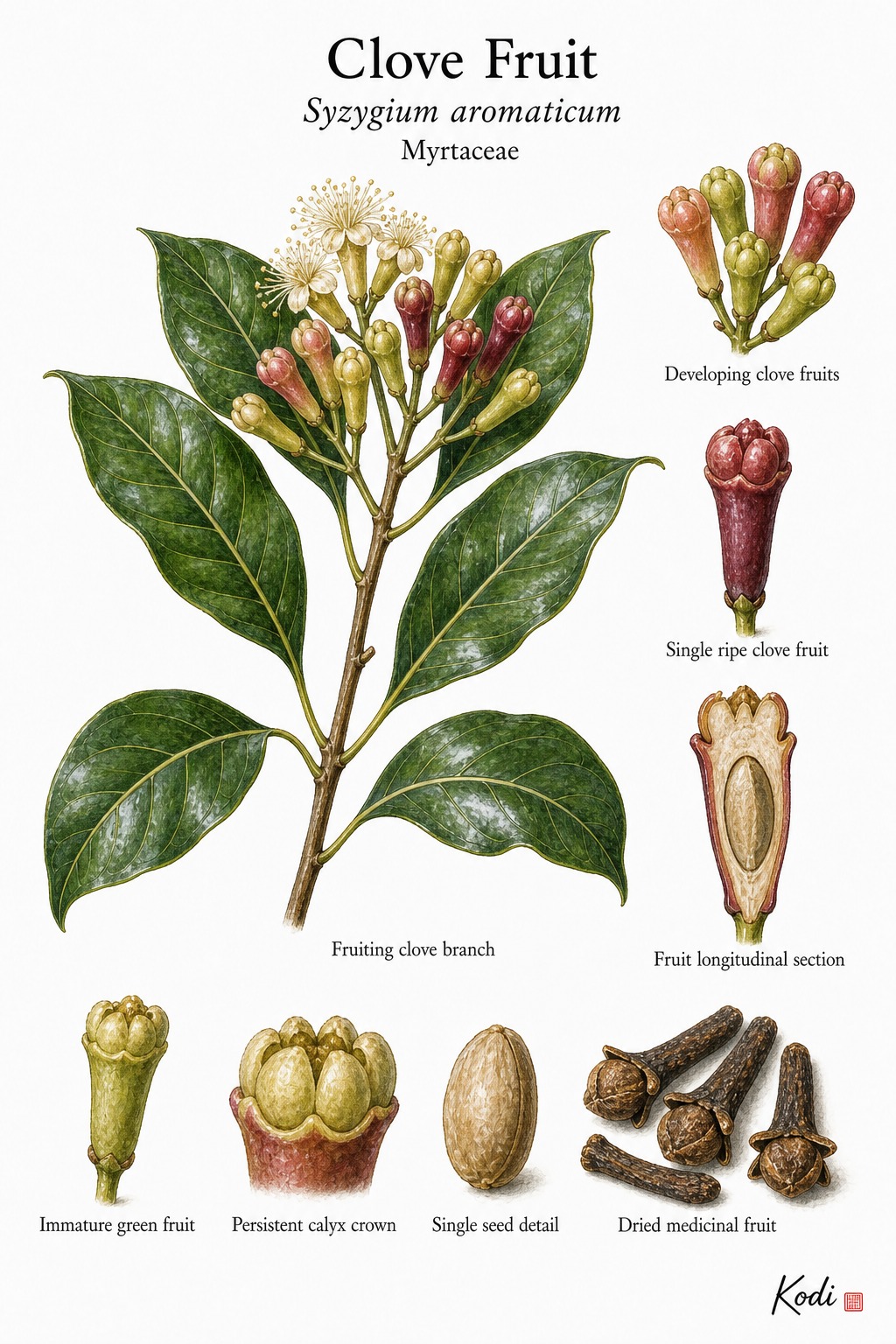
Known in TCM as Mu Ding Xiang (母丁香), this acrid, warm herb enters the Kidney, Spleen, and Stomach. Traditionally, it warms the Spleen and Stomach and disperses interior cold - Mu Ding Xiang is used for middle-burner cold with abdominal discomfort, poor appetite, loose stool, and cold-type digestive weakness, most often applied for nausea, abdominal pain, and diarrhea. Modern research has identified Eugenol among its active constituents.
Part used: Fruit
Also Known As
Latin: Fructus Caryophylli | Pinyin: Mu Ding Xiang | Chinese: 母丁香
TCM Properties
- Taste
- acrid
- Temperature
- warm
- Channels
- Kidney, Spleen, Stomach
Traditional Use
Primary Actions
- Warms the Spleen and Stomach and disperses interior cold - Mu Ding Xiang is used for middle-burner cold with abdominal discomfort, poor appetite, loose stool, and cold-type digestive weakness.
- Directs rebellious Stomach Qi downward - like the flower bud, the fruit is used for retching, hiccup, nausea, and vomiting when deficiency-cold is the driving pattern.
- Warms Kidney Yang and supports cold lower-jiao patterns - traditional use extends to impotence and cold pain below the umbilicus when warming support is needed.
Secondary Actions
- Traditional comparison notes usually describe Mu Ding Xiang as less abrupt but somewhat more sustained than the flower bud, which is why the two are sometimes paired.
- Some later materia-medica sources add blood-invigorating or labor-promoting language to Mu Ding Xiang specifically, but those claims are less central than the shared warming-middle profile.
Classic Formulas
- Mu Ding Xiang with Ding Xiang - paired bud-and-fruit logic when a fuller clove warming profile is desired for chronic cold in the middle burner.
- Mu Ding Xiang with Ban Xia and Sheng Jiang - cold-type nausea and vomiting strategy centered on warming and descending.
- Mu Ding Xiang with Sha Ren or Bai Zhu - Spleen-Stomach deficiency-cold combination logic when loose stool and poor appetite accompany rebellious Qi.
Classical References
- TCM Wiki classifies Mu Ding Xiang within the same warming-interior family as Ding Xiang, with actions of warming the Spleen and Stomach, directing rebellious Qi downward, and restoring Kidney Yang.
- American Dragon notes that Mu Ding Xiang is the fruit of the same plant and is often considered less immediately forceful than the flower bud while still sharing the same cold-dispelling and descending direction.
- Older commercial and materia-medica summaries sometimes mention blood-entering or labor-inducing aspects for Mu Ding Xiang, which is one reason pregnancy caution is stronger here than with ordinary culinary clove exposure.
Modern Research
Active Compounds
- Eugenol - still the best-known clove phytochemical, though fruit material is often less concentrated in volatile oil than the flower bud
- Eugenyl acetate - a major aromatic constituent shared across clove materials
- Beta-caryophyllene - a terpene discussed in anti-inflammatory and analgesic research
- Phenolic and tannin fractions - broader whole-clove constituents with antioxidant relevance
Studied Effects
- Modern indexed literature is much richer for whole clove and clove bud than for Fructus Caryophylli specifically, so most pharmacologic interpretation here is species-level rather than fruit-only.
- A broad 2020 review of Syzygium aromaticum described antimicrobial, anti-inflammatory, antioxidant, and antispasmodic activities relevant to the traditional warming-digestive use of clove materials (PMID 32019140).
- Eugenol-centered reviews continue to support anti-inflammatory and antioxidant activity as a plausible bridge for the clove fruit record even though direct Mu Ding Xiang clinical trials are scarce (PMID 30425782).
- Recent neuropharmacology-oriented review work also cataloged bioactive compounds across buds, fruits, branches, and leaves, reinforcing that the fruit belongs to the same broader medicinal plant system rather than to a separate species (PMID 40149988).
PubMed References
- Syzygium aromaticum L. (Myrtaceae): Traditional Uses, Bioactive Chemical Constituents, Pharmacological and Toxicological Activities (2020)
- An Overview on the Anti-inflammatory Potential and Antioxidant Profile of Eugenol (2018)
- Neuroprotective Properties of Clove (Syzygium aromaticum): State of the Art and Future Pharmaceutical Applications for Alzheimer's Disease (2025)
Safety & Interactions
Contraindications
- Yin deficiency heat patterns
- Hot-pattern vomiting or active stomach heat
Cautions
- Because some later traditional sources attribute blood-moving or labor-promoting qualities to Mu Ding Xiang, pregnancy use should be more conservative than ordinary food-spice use.
- Most modern research is indirect and species-level rather than dedicated to the fruit record itself.
- Concentrated extracts and essential oil are substantially stronger than the crude medicinal fruit.
Drug Interactions
- Anticoagulants or antiplatelet drugs - eugenol-rich concentrated preparations may increase bleeding tendency
Conditions
Frequently Asked Questions
What is Clove Fruit used for?
Clove Fruit is traditionally used to Warms the Spleen and Stomach and disperses interior cold - Mu Ding Xiang is used for middle-burner cold with abdominal discomfort, poor appetite, loose stool, and cold-type digestive weakness., Directs rebellious Stomach Qi downward - like the flower bud, the fruit is used for retching, hiccup, nausea, and vomiting when deficiency-cold is the driving pattern., Warms Kidney Yang and supports cold lower-jiao patterns - traditional use extends to impotence and cold pain below the umbilicus when warming support is needed.. Research has investigated its effects on: Modern indexed literature is much richer for whole clove and clove bud than for Fructus Caryophylli specifically, so most pharmacologic interpretation here is species-level rather than fruit-only.; A broad 2020 review of Syzygium aromaticum described antimicrobial, anti-inflammatory, antioxidant, and antispasmodic activities relevant to the traditional warming-digestive use of clove materials (PMID 32019140)..
What are other names for Clove Fruit?
Clove Fruit is also known as Caryophylli. In TCM: 母丁香 (Mu Ding Xiang); Fructus Caryophylli.
Is Clove Fruit safe during pregnancy?
Clove Fruit is not recommended during pregnancy. Because some later traditional sources attribute blood-moving or labor-promoting qualities to Mu Ding Xiang, pregnancy use should be more conservative than ordinary food-spice use.
What are the contraindications for Clove Fruit?
Clove Fruit should not be used in: Yin deficiency heat patterns; Hot-pattern vomiting or active stomach heat. Consult a qualified healthcare provider before use.
Does Clove Fruit interact with any medications?
Clove Fruit may interact with: Anticoagulants or antiplatelet drugs - eugenol-rich concentrated preparations may increase bleeding tendency. Always inform your healthcare provider of any herbal supplements you are taking.