Clinopodium Herb
- Chinese
- 断血流
- Pinyin
- Duan Xue Liu
- Latin
- Herba Clinopodii
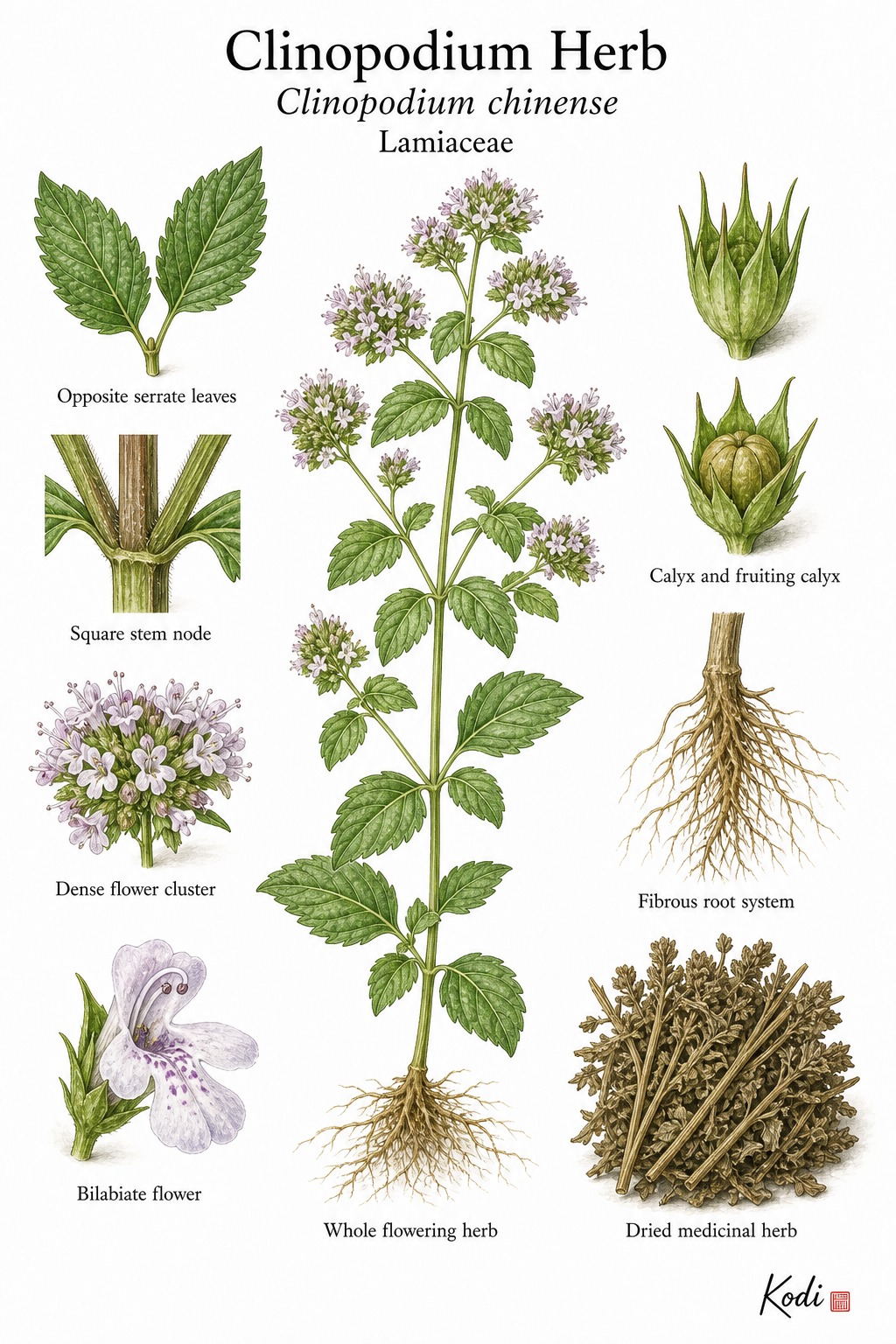
Known in TCM as Duan Xue Liu (断血流), this bitter and astringent, cool herb enters the Liver. Traditionally, it cools blood and stops bleeding - Duan Xue Liu is primarily used for uterine bleeding, heavy menstrual bleeding, hemoptysis, hematuria, bloody stool, and other hemorrhagic presentations with heat or restless-blood features, most often applied for abnormal uterine bleeding, hematuria, and hemoptysis. Modern research has identified Total among its active constituents.
Part used: Whole herb
Also Known As
Latin: Herba Clinopodii | Pinyin: Duan Xue Liu | Chinese: 断血流
TCM Properties
- Taste
- bitter, astringent
- Temperature
- cool
- Channels
- Liver
Traditional Use
Primary Actions
- Cools blood and stops bleeding - Duan Xue Liu is primarily used for uterine bleeding, heavy menstrual bleeding, hemoptysis, hematuria, bloody stool, and other hemorrhagic presentations with heat or restless-blood features.
- Restrains bleeding while supporting tissue recovery - later clinical use especially emphasizes gynecologic bleeding and repair of the damaged endometrial environment rather than only blunt astringency.
- Clears heat and helps treat damp-heat or toxic bowel disorders - traditional and ethnomedical use extends to dysentery-type diarrhea, intestinal irritation, and inflammatory lower-burner patterns.
- Can be used externally for traumatic bleeding - this preserves the herb's folk identity as a practical hemostatic rather than a purely internal gynecologic medicinal.
Secondary Actions
- Duan Xue Liu is a comparatively modern officially recognized folk hemostatic, so its literature base is stronger in Pharmacopoeia-era and regional practice sources than in very old classical formula canons.
- The herb name now covers two legitimate Pharmacopoeia sources, Clinopodium chinense and Clinopodium polycephalum, which is important for quality control and consistency.
Classic Formulas
- Duan Xue Liu Pian or capsules - modern Chinese hemostatic preparations used especially for dysfunctional uterine bleeding and other nonemergency hemorrhagic disorders.
- Duan Xue Liu with cooling-blood hemostatics such as Di Yu or Bai Mao Gen - pattern logic when bleeding is heat-driven and lower-tract irritation is prominent.
- Duan Xue Liu with San Qi or other stasis-aware hemostatics - practical pairing logic when bleeding and tissue injury coexist.
Classical References
- Modern Chinese materia-medica references describe Duan Xue Liu as slightly bitter to astringent and cool, entering the Liver, with the core function of cooling blood and stopping bleeding.
- The 2024 quality-control paper on the two official Clinopodium sources notes that both Clinopodium chinense and Clinopodium polycephalum are legitimate origins of Duan Xue Liu in the Pharmacopoeia of the People's Republic of China.
- Traditional and regional usage consistently centers on hemorrhagic disease, especially gynecologic bleeding, while also preserving a broader folk role in dysentery and traumatic bleeding.
Modern Research
Active Compounds
- Total saponins and triterpenoid glycosides - prominent fractions repeatedly discussed in the modern Clinopodium literature
- Flavonoids - implicated in anti-inflammatory and vascular-protective activity
- Diterpenoid glycosides - part of the expanding phytochemical profile of Clinopodium chinense
- Additional phenolic and polysaccharide-type constituents - supportive components in broader anti-inflammatory and quality-control studies
Studied Effects
- A 2020 rat study reported that Clinopodium chinense reduced metrorrhagia volume, improved inflammatory markers, and promoted endometrial repair in an abnormal uterine bleeding model, directly supporting one of the herb's most important current indications (PMID 32094083).
- A 2023 mouse study found that Clinopodium chinense ameliorated dextran-sulfate-sodium-induced ulcerative colitis while reducing systemic inflammation and regulating metabolism, giving a modern correlate for the herb's dysentery and inflammatory bowel use (PMID 36868438).
- A 2024 characterization study comparing the two official Duan Xue Liu source plants included biological activity assays and reinforced that both legitimate sources share clinically relevant hemostatic potential, which matters for standardization (PMID 38467319).
PubMed References
- Protective effect of Clinopodium chinense (Benth.) O. Kuntze against abnormal uterine bleeding in female rats (2020)
- Clinopodium chinense Kuntze ameliorates dextran sulfate sodium-induced ulcerative colitis in mice by reducing systematic inflammation and regulating metabolism (2023)
- A multidimensional strategy for characterization, distinction, and quality control of two Clinopodium medicinal plants (2024)
Safety & Interactions
Contraindications
- Pregnancy - avoid routine unsupervised use in pregnancy because the herb is used specifically around uterine bleeding states and should not be self-prescribed
- Massive or unexplained bleeding that requires urgent medical evaluation rather than outpatient herbal self-treatment
- Bleeding from severe deficiency collapse without a clear heat, inflammation, or active hemorrhagic indication
Cautions
- Abnormal uterine bleeding, hematuria, and hemoptysis all require diagnosis; the herb should not delay evaluation for structural, malignant, or emergency causes.
- Most modern evidence is preclinical or based on Chinese pharmaco-clinical contexts rather than large international trials.
- Source quality matters because Duan Xue Liu officially includes more than one species, and interchange without quality control can blur consistency.
Conditions
- Abnormal Uterine Bleeding Research ★★★★☆ JSON
- Hematuria Traditional ★★★☆☆ JSON
- Hemoptysis Traditional ★★★☆☆ JSON
- Dysentery Research ★★☆☆☆ JSON
Frequently Asked Questions
What is Clinopodium Herb used for?
Clinopodium Herb is traditionally used to Cools blood and stops bleeding - Duan Xue Liu is primarily used for uterine bleeding, heavy menstrual bleeding, hemoptysis, hematuria, bloody stool, and other hemorrhagic presentations with heat or restless-blood features., Restrains bleeding while supporting tissue recovery - later clinical use especially emphasizes gynecologic bleeding and repair of the damaged endometrial environment rather than only blunt astringency., Clears heat and helps treat damp-heat or toxic bowel disorders - traditional and ethnomedical use extends to dysentery-type diarrhea, intestinal irritation, and inflammatory lower-burner patterns., Can be used externally for traumatic bleeding - this preserves the herb's folk identity as a practical hemostatic rather than a purely internal gynecologic medicinal.. Research has investigated its effects on: A 2020 rat study reported that Clinopodium chinense reduced metrorrhagia volume, improved inflammatory markers, and promoted endometrial repair in an abnormal uterine bleeding model, directly supporting one of the herb's most important current indications (PMID 32094083).; A 2023 mouse study found that Clinopodium chinense ameliorated dextran-sulfate-sodium-induced ulcerative colitis while reducing systemic inflammation and regulating metabolism, giving a modern correlate for the herb's dysentery and inflammatory bowel use (PMID 36868438)..
What are other names for Clinopodium Herb?
Clinopodium Herb is also known as Clinopodium. In TCM: 断血流 (Duan Xue Liu); Herba Clinopodii.
Is Clinopodium Herb safe during pregnancy?
Clinopodium Herb is not recommended during pregnancy.
What are the contraindications for Clinopodium Herb?
Clinopodium Herb should not be used in: Pregnancy - avoid routine unsupervised use in pregnancy because the herb is used specifically around uterine bleeding states and should not be self-prescribed; Massive or unexplained bleeding that requires urgent medical evaluation rather than outpatient herbal self-treatment; Bleeding from severe deficiency collapse without a clear heat, inflammation, or active hemorrhagic indication. Consult a qualified healthcare provider before use.