Clam Shell
- Chinese
- 海蛤壳
- Pinyin
- Hai Ge Ke
- Latin
- Concha Cyclinae
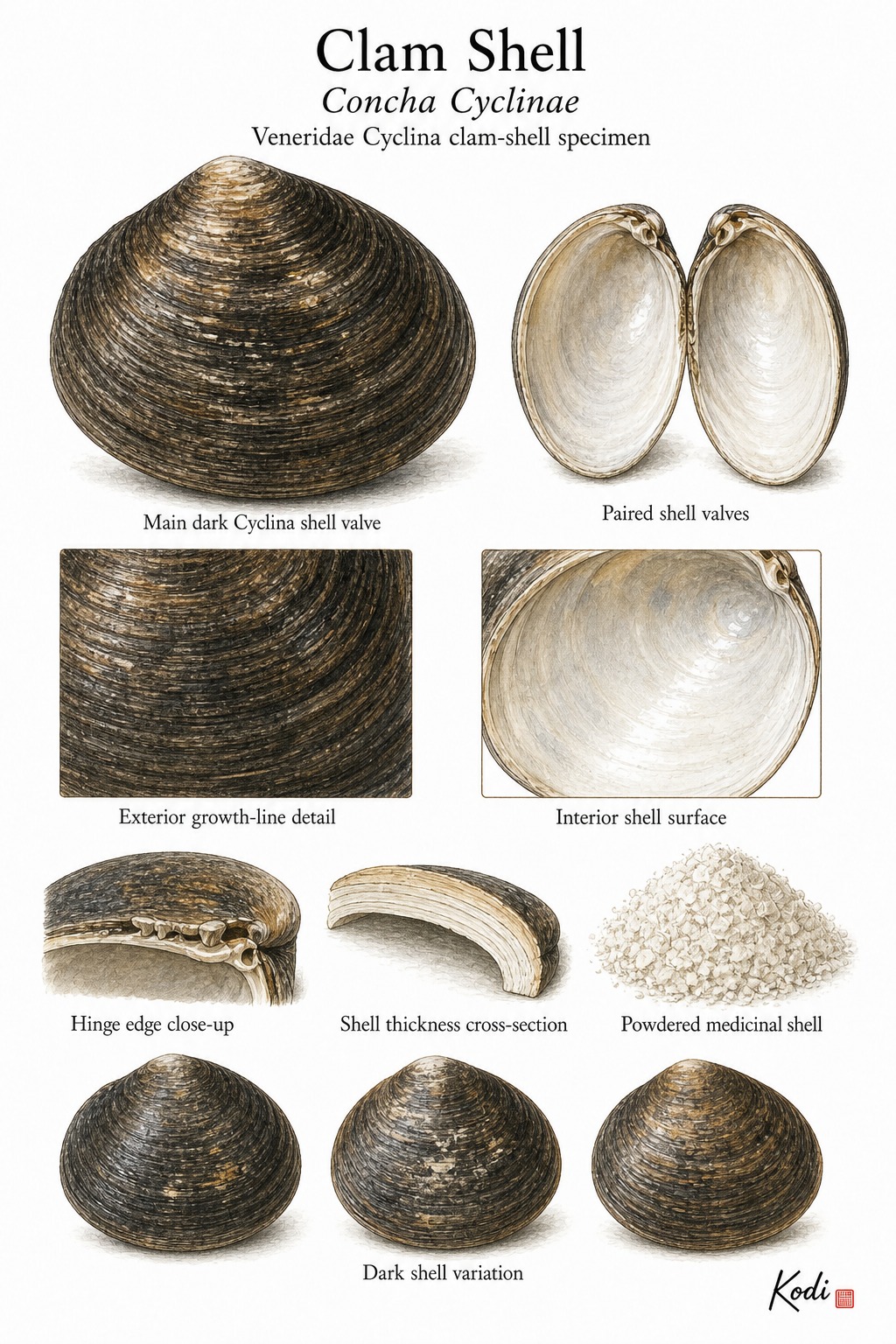
Known in TCM as Hai Ge Ke (海蛤壳), this bitter and salty, cold herb enters the Lung and Stomach. Traditionally, it clears Lung heat and resolves stubborn phlegm - Hai Ge Ke is used for cough, dyspnea, wheezing, and a blocked chest when thick phlegm-heat is difficult to expel, most often applied for productive cough, wheezing, and scrofula. Modern research has identified Calcium among its active constituents.
Part used: Shell
Also Known As
Latin: Concha Cyclinae | Pinyin: Hai Ge Ke | Chinese: 海蛤壳
TCM Properties
- Taste
- bitter, salty
- Temperature
- cold
- Channels
- Lung, Stomach
Traditional Use
Primary Actions
- Clears Lung heat and resolves stubborn phlegm - Hai Ge Ke is used for cough, dyspnea, wheezing, and a blocked chest when thick phlegm-heat is difficult to expel.
- Softens congealed hardness and helps disperse nodules - this Cyclina-derived shell belongs to the same heavy phlegm-softening family used for scrofula, goiter, and lingering phlegm-fire masses.
- Supports fluid movement and mild edema reduction - traditional shell use extends to dampness-related swelling or turbidity patterns when phlegm and water metabolism are both impaired.
- When calcined and powdered, it can also be used for acid regurgitation and epigastric pain - a practical processing shift shared with the broader Ge Qiao category.
Secondary Actions
- This entry reflects the narrower Hai Ge Ke naming within the broader clam-shell lineage, so its clinical profile closely overlaps Ge Qiao but keeps the Cyclina-specific label intact.
- Traditional processing matters: unprocessed shell is more cooling and phlegm-oriented, while calcined powder is more clearly directed toward acidity and pain.
Classic Formulas
- Hai Ge Ke with Sang Bai Pi, Xing Ren, or Pi Pa Ye - Lung-heat cough strategy when thick sputum and dyspnea dominate.
- Hai Ge Ke with Hai Zao, Kun Bu, and Wa Leng Zi - classic shell-seaweed hardness-softening logic for scrofula and goiter patterns.
- Calcined Hai Ge Ke with Hai Piao Xiao - shell-mineral pairing for acid regurgitation or sour painful reflux.
Classical References
- TCM Wiki lists Hai Ge Ke as salty and cold, entering the Lung and Stomach, and highlights cough from phlegm-heat, scrofula, and acid regurgitation as core indications.
- American Dragon treats Hai Ge Ke as the same broad medicinal family as Ge Qiao and notes the bitter-salty, cold shell profile with additional mention of a mild edema and urinary role.
- The narrower Concha Cyclinae label is best read as a source-variant within the same traditional clam-shell therapeutic family rather than as a radically different medicinal.
Modern Research
Active Compounds
- Calcium carbonate shell minerals - the main structural and functional component
- Calcination-shifted crystal forms with increased dissolution - a practical processing feature relevant to decoction behavior
- Trace elements such as calcium, sodium, and strontium - mineral profile repeatedly described in shell analysis
- Organic shell proteins - reduced after calcination and less central in the processed form
Studied Effects
- A 2024 structural analysis specifically compared Meretricis concha cyclinae concha with ark shell before and after calcination and found increased CaCO3 dissolution after processing, supporting why calcined shell products behave differently from raw shells in practice (PMID 38492563).
- Microscopic authentication work on common shell TCMs also identified the distinguishing features of Meretricis Concha and related shell powders, which matters because testacean drugs are easily confused or substituted (PMID 26579467).
- Like many shell medicinals, Hai Ge Ke has much stronger modern support for processing chemistry and quality control than for direct standalone clinical efficacy.
PubMed References
Safety & Interactions
Contraindications
- Cold-deficiency cough or wheezing with thin clear sputum
- Deficiency-cold digestion without heat, phlegm, nodules, or hyperacidity
Cautions
- Medication spacing matters because calcium-rich shell powders can interfere with absorption of some oral drugs.
- Source quality and proper cleaning are important for shell medicines, especially when powders are being used internally.
- Calcined and raw forms should not be treated as identical, because processing changes shell chemistry and traditional therapeutic emphasis.
Drug Interactions
- Fluoroquinolone antibiotics - shell calcium can reduce absorption; separate dosing
- Tetracycline antibiotics - chelation may reduce drug availability; stagger use
- Levothyroxine - calcium-containing shell products may impair absorption; separate by at least 4 hours
- Iron supplements - calcium can reduce iron absorption when taken together
Conditions
- Productive Cough Traditional ★★★★☆ JSON
- Wheezing Traditional ★★★★☆ JSON
- Scrofula Traditional ★★★☆☆ JSON
- Acid Reflux Traditional ★★☆☆☆ JSON
- Edema Traditional ★★☆☆☆ JSON
Frequently Asked Questions
What is Clam Shell used for?
Clam Shell is traditionally used to Clears Lung heat and resolves stubborn phlegm - Hai Ge Ke is used for cough, dyspnea, wheezing, and a blocked chest when thick phlegm-heat is difficult to expel., Softens congealed hardness and helps disperse nodules - this Cyclina-derived shell belongs to the same heavy phlegm-softening family used for scrofula, goiter, and lingering phlegm-fire masses., Supports fluid movement and mild edema reduction - traditional shell use extends to dampness-related swelling or turbidity patterns when phlegm and water metabolism are both impaired., When calcined and powdered, it can also be used for acid regurgitation and epigastric pain - a practical processing shift shared with the broader Ge Qiao category.. Research has investigated its effects on: A 2024 structural analysis specifically compared Meretricis concha cyclinae concha with ark shell before and after calcination and found increased CaCO3 dissolution after processing, supporting why calcined shell products behave differently from raw shells in practice (PMID 38492563).; Microscopic authentication work on common shell TCMs also identified the distinguishing features of Meretricis Concha and related shell powders, which matters because testacean drugs are easily confused or substituted (PMID 26579467)..
What are other names for Clam Shell?
Clam Shell is also known as Cyclina. In TCM: 海蛤壳 (Hai Ge Ke); Concha Cyclinae.
Is Clam Shell safe during pregnancy?
The safety of Clam Shell during pregnancy has not been established. Consult a qualified healthcare provider before use.
What are the contraindications for Clam Shell?
Clam Shell should not be used in: Cold-deficiency cough or wheezing with thin clear sputum; Deficiency-cold digestion without heat, phlegm, nodules, or hyperacidity. Consult a qualified healthcare provider before use.
Does Clam Shell interact with any medications?
Clam Shell may interact with: Fluoroquinolone antibiotics - shell calcium can reduce absorption; separate dosing; Tetracycline antibiotics - chelation may reduce drug availability; stagger use; Levothyroxine - calcium-containing shell products may impair absorption; separate by at least 4 hours; Iron supplements - calcium can reduce iron absorption when taken together. Always inform your healthcare provider of any herbal supplements you are taking.