Clam Shell
- Chinese
- 蛤壳
- Pinyin
- Ge Qiao
- Latin
- Concha Meretricis Seu Cyclinae
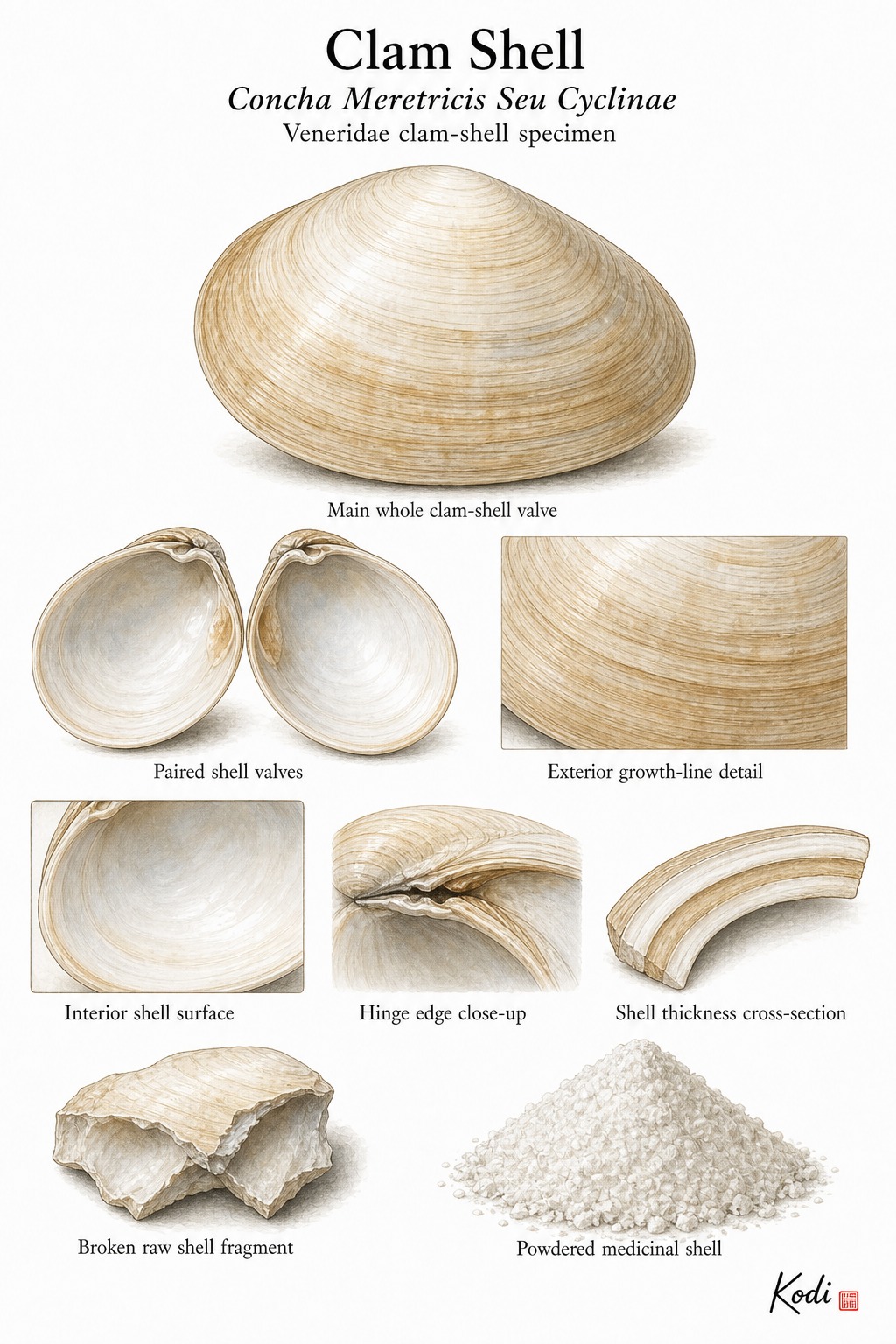
Known in TCM as Ge Qiao (蛤壳), this bitter and salty, cold herb enters the Lung and Stomach. Traditionally, it clears Lung heat, transforms phlegm, and descends Lung Qi - Ge Qiao is used for cough, wheezing, chest fullness, and thick yellow sputum when phlegm-heat or phlegm-fire binds the chest, most often applied for productive cough, wheezing, and scrofula. Modern research has identified Calcium among its active constituents.
Part used: Shell
Also Known As
Latin: Concha Meretricis Seu Cyclinae | Pinyin: Ge Qiao | Chinese: 蛤壳
TCM Properties
- Taste
- bitter, salty
- Temperature
- cold
- Channels
- Lung, Stomach
Traditional Use
Primary Actions
- Clears Lung heat, transforms phlegm, and descends Lung Qi - Ge Qiao is used for cough, wheezing, chest fullness, and thick yellow sputum when phlegm-heat or phlegm-fire binds the chest.
- Softens hardness and dissipates nodules - the salty shell lineage is classically used for scrofula, goiter-type swelling, and other phlegm-fire accumulations that require a heavy softening medicinal.
- Promotes urination and reduces superficial edema - traditional sources give it a milder water-pathway role when lingering phlegm-dampness and edema occur together.
- In calcined powder form, restrains acidity and relieves stomach pain - this is a secondary but established shell use for acid regurgitation and epigastric discomfort.
Secondary Actions
- Raw or lightly processed Ge Qiao is traditionally favored for clearing heat and transforming phlegm, while calcined material is preferred when the clinical goal shifts toward acidity control or more astringent shell use.
- Because the medicinal is a heavy shell material, it is usually wrapped for decoction or powdered after processing rather than treated like an ordinary light herb.
Classic Formulas
- Dai Ge San - Ge Qiao with Qing Dai for phlegm-heat cough, chest pain, and bloody expectoration from Lung heat damaging the collaterals.
- Han Hua Wan or related shell-seaweed combinations - Ge Qiao with Hai Zao, Kun Bu, and Wa Leng Zi for goiter and scrofula from phlegm-fire congealing.
- Ge Qiao with Hai Piao Xiao and Yan Hu Suo - shell-based antacid and pain-relieving logic for acid regurgitation and epigastric discomfort.
Classical References
- American Dragon describes Ge Qiao/Hai Ge Ke as bitter and salty, cold to neutral, entering the Lung and Stomach, with core actions of clearing Lung heat, transforming phlegm, softening hardness, and promoting urination.
- TCM Wiki likewise emphasizes salty-cold entry to the Lung and Stomach and notes that the unprocessed shell is better for clearing heat and resolving phlegm, while the calcined form is better for restraining acidity and astringing.
- Traditional shell comparison notes place Ge Qiao close to Wa Leng Zi in antacid use, but relatively more cooling and Lung-directed when phlegm-heat cough is the main issue.
Modern Research
Active Compounds
- Calcium carbonate-rich shell matrix - the dominant mineral basis of antacid and shell-buffering effects
- Aragonite in the raw shell, with conversion toward calcite after calcination - a key processing change relevant to decoction behavior
- Trace inorganic elements including calcium, sodium, strontium, and related minerals - consistent shell constituents that vary less by region than by processing
- Residual shell proteins and organic matrix components - markedly reduced after calcination
Studied Effects
- A 2024 comparative analysis of Arcae concha and Meretricis concha cyclinae concha showed that calcination increased calcium-carbonate dissolution in decoction and significantly reduced shell protein content, providing a direct modern rationale for the classic distinction between raw and calcined shell use (PMID 38492563).
- A 2015 authentication study on five testacean TCM drugs clarified the species and microscopic identification features of Meretricis Concha, reinforcing the need for correct shell identification in a category where substitution is easy (PMID 26579467).
- Modern research on Ge Qiao is still more compositional and processing-focused than clinical, so its traditional respiratory and hardness-softening uses remain much better documented in materia medica than in contemporary trials.
PubMed References
Safety & Interactions
Contraindications
- Lung deficiency-cold or clear-sputum cough without phlegm-heat
- Yang deficiency and weak digestion when there is no phlegm-heat, nodulation, or excess acidity to justify shell use
Cautions
- Like other calcium-rich shell medicinals, Ge Qiao can interfere with absorption of some medications if taken at the same time.
- Raw versus calcined form matters clinically: raw shell is more often used for phlegm-heat and nodules, while calcined shell is more aligned with antacid use.
- Only properly cleaned medicinal shell should be used because shell materials can carry contamination if poorly sourced or processed.
Drug Interactions
- Fluoroquinolone antibiotics - calcium-rich shell minerals can reduce drug absorption; separate dosing by several hours
- Tetracycline antibiotics - shell calcium can chelate the drug and lower bioavailability; stagger dosing
- Levothyroxine - calcium-containing shell products may impair thyroid hormone absorption; separate by at least 4 hours
- Iron supplements - concurrent calcium can reduce iron absorption; take at different times
Conditions
- Productive Cough Traditional ★★★★☆ JSON
- Wheezing Traditional ★★★★☆ JSON
- Scrofula Traditional ★★★☆☆ JSON
- Acid Reflux Traditional ★★☆☆☆ JSON
- Edema Traditional ★★☆☆☆ JSON
Frequently Asked Questions
What is Clam Shell used for?
Clam Shell is traditionally used to Clears Lung heat, transforms phlegm, and descends Lung Qi - Ge Qiao is used for cough, wheezing, chest fullness, and thick yellow sputum when phlegm-heat or phlegm-fire binds the chest., Softens hardness and dissipates nodules - the salty shell lineage is classically used for scrofula, goiter-type swelling, and other phlegm-fire accumulations that require a heavy softening medicinal., Promotes urination and reduces superficial edema - traditional sources give it a milder water-pathway role when lingering phlegm-dampness and edema occur together., In calcined powder form, restrains acidity and relieves stomach pain - this is a secondary but established shell use for acid regurgitation and epigastric discomfort.. Research has investigated its effects on: A 2024 comparative analysis of Arcae concha and Meretricis concha cyclinae concha showed that calcination increased calcium-carbonate dissolution in decoction and significantly reduced shell protein content, providing a direct modern rationale for the classic distinction between raw and calcined shell use (PMID 38492563).; A 2015 authentication study on five testacean TCM drugs clarified the species and microscopic identification features of Meretricis Concha, reinforcing the need for correct shell identification in a category where substitution is easy (PMID 26579467)..
What are other names for Clam Shell?
Clam Shell is also known as Meretricis. In TCM: 蛤壳 (Ge Qiao); Concha Meretricis Seu Cyclinae.
Is Clam Shell safe during pregnancy?
The safety of Clam Shell during pregnancy has not been established. Consult a qualified healthcare provider before use.
What are the contraindications for Clam Shell?
Clam Shell should not be used in: Lung deficiency-cold or clear-sputum cough without phlegm-heat; Yang deficiency and weak digestion when there is no phlegm-heat, nodulation, or excess acidity to justify shell use. Consult a qualified healthcare provider before use.
Does Clam Shell interact with any medications?
Clam Shell may interact with: Fluoroquinolone antibiotics - calcium-rich shell minerals can reduce drug absorption; separate dosing by several hours; Tetracycline antibiotics - shell calcium can chelate the drug and lower bioavailability; stagger dosing; Levothyroxine - calcium-containing shell products may impair thyroid hormone absorption; separate by at least 4 hours; Iron supplements - concurrent calcium can reduce iron absorption; take at different times. Always inform your healthcare provider of any herbal supplements you are taking.