Citron Fruit
- Chinese
- 香橼
- Pinyin
- Xiang Yuan
- Latin
- Fructus Citri
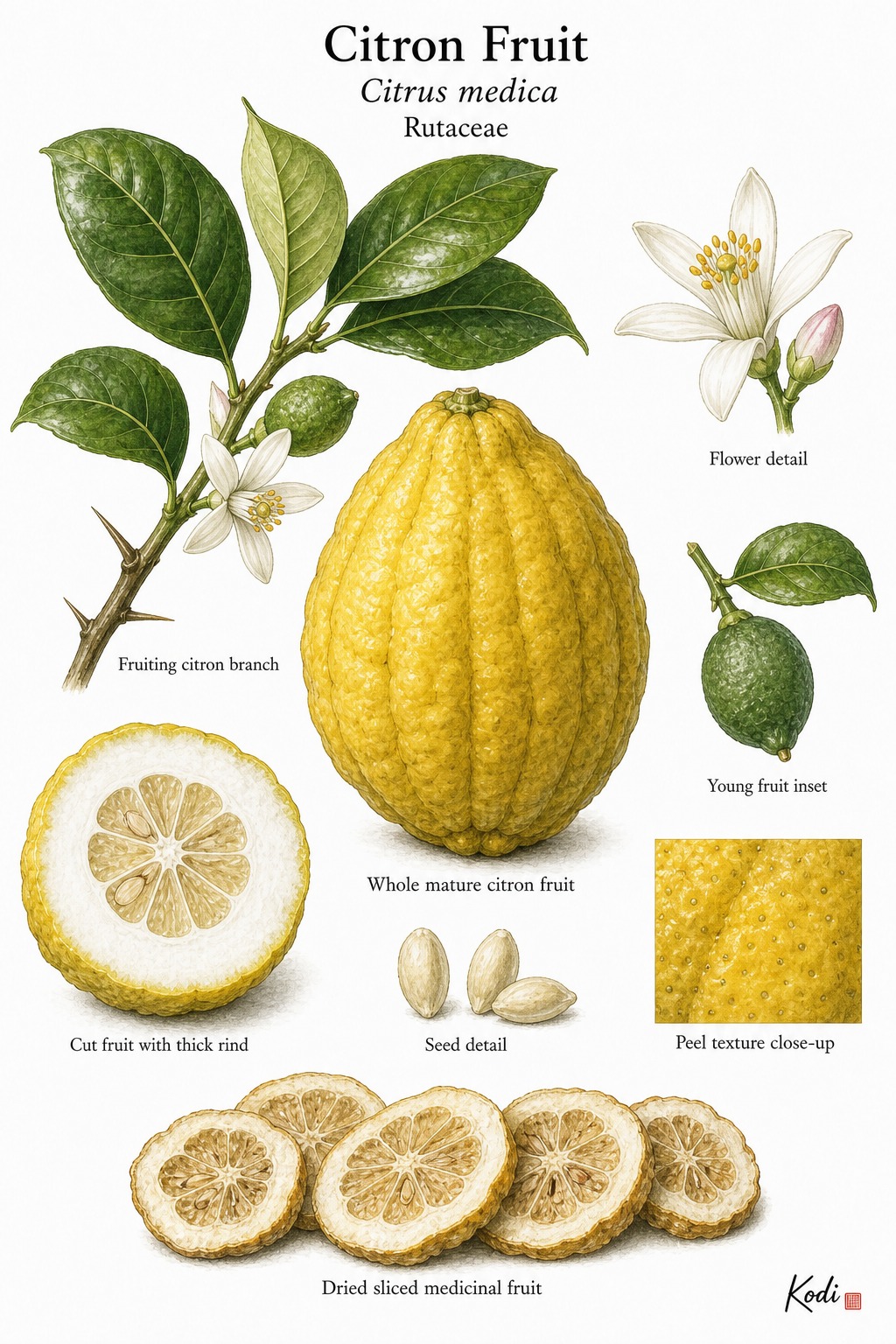
Known in TCM as Xiang Yuan (香橼), this acrid and bitter and sour, warm herb enters the Liver, Lung, and Spleen. Traditionally, it regulates Liver and middle-jiao Qi to relieve distention and pain - Xiang Yuan is used for epigastric fullness, abdominal discomfort, chest oppression, and flank tension when stagnant Qi is prominent, most often applied for abdominal pain, indigestion, and productive cough. Modern research has identified Volatile among its active constituents.
Part used: Fruit
Also Known As
Latin: Fructus Citri | Pinyin: Xiang Yuan | Chinese: 香橼
TCM Properties
- Taste
- acrid, bitter, sour
- Temperature
- warm
- Channels
- Liver, Lung, Spleen
Traditional Use
Primary Actions
- Regulates Liver and middle-jiao Qi to relieve distention and pain - Xiang Yuan is used for epigastric fullness, abdominal discomfort, chest oppression, and flank tension when stagnant Qi is prominent.
- Awakens the Spleen and harmonizes digestion - belching, poor appetite, nausea, and a sense of food or phlegm sitting in the middle burner are common traditional uses.
- Transforms phlegm and eases cough - the fruit is classically used when Qi stagnation and phlegm combine to cause cough with abundant sputum or a blocked, stifling chest sensation.
Secondary Actions
- Xiang Yuan is traditionally described as a relatively mild citrus regulator that usually works best in formulas rather than as an isolated single-herb strategy.
- It overlaps with Fo Shou but is often described as relatively more Lung-Spleen and phlegm oriented, while Xiang Yuan Pi is the more strongly moving bark or peel fraction.
Classic Formulas
- Xiang Yuan with Mu Xiang and Huo Xiang - middle-jiao stagnation pairing logic for belching, poor appetite, and abdominal fullness.
- Xiang Yuan with Chai Hu, Yu Jin, and Fo Shou - Liver-Qi-regulating strategy for flank or chest distention and pain.
- Xiang Yuan with Ban Xia, Fu Ling, Gua Lou, or Zi Su Zi - phlegm-constraining-the-chest approach for cough with copious sputum and oppression.
Classical References
- American Dragon lists Xiang Yuan as acrid, slightly bitter, sour, and warm, entering the Liver, Spleen, and Lung, with actions of transforming phlegm, moving Qi, easing the middle, and stopping pain.
- The same traditional comparison notes distinguish Xiang Yuan from Fo Shou and add that Xiang Yuan Pi has a stronger Qi-circulating function than the fruit itself.
- Traditional summaries repeatedly emphasize that the herb is relatively mild and therefore commonly paired with other Qi-regulating or phlegm-resolving medicinals.
Modern Research
Active Compounds
- Volatile terpenes such as limonene, citral, and linalool - major aroma compounds tied to digestive and anti-inflammatory interest
- Flavonoids including hesperidin, naringin, and related citrus polyphenols - widely reported in Citrus medica lineage materials
- Coumarins and limonoids such as bergapten and limonin - repeatedly identified in finger-citron and citron profiling work
- Polysaccharides and phenolic acids - nonvolatile fractions now studied for anti-inflammatory and barrier-protective activity
Studied Effects
- A 2018 review summarized broad Citrus medica phytochemistry and biological activity, supporting the modern plausibility of anti-inflammatory, antioxidant, digestive, and antimicrobial effects across citron materials (PMID 29594287).
- A finger-citron polysaccharide study demonstrated anti-inflammatory activity and gives a molecular bridge for the traditional use of citron fruit in inflamed or irritated patterns, though it is not a direct clinical Xiang Yuan trial (PMID 35757248).
- Recent animal work reported that Citri Sarcodactylis Fructus reduced inflammatory signaling and lung injury markers in an acute lung-injury model, which is not the same as proving an expectorant indication but does reinforce why citrus-fruit materia medica remains relevant to respiratory inflammation discussions (PMID 40901654).
PubMed References
- Citrus medica: nutritional, phytochemical composition and health benefits - a review (2018)
- Structural Characterization and Anti-inflammatory Activity of a Galactorhamnan Polysaccharide From Citrus medica L. var. sarcodactylis (2022)
- Citri Sarcodactylis Fructus Alleviates LPS-Induced Acute Lung Injury by Inhibiting Inflammation and Inflammasome Activation (2025)
Safety & Interactions
Contraindications
- Marked Yin deficiency or dryness with little true Qi stagnation
- Weak digestion from deficiency-cold without phlegm, fullness, or constrained movement
Cautions
- Traditional sources advise caution in pregnancy and in dry constitutions because the aromatic, moving nature can be dispersing.
- Most modern evidence is preclinical and often based on broader Citrus medica or finger-citron materials rather than exact Xiang Yuan fruit-only clinical studies.
- Citron fruit can overlap with culinary or functional-food use, but medicinal dosing and indication still depend on pattern differentiation.
Conditions
- Abdominal Pain Traditional ★★★★☆ JSON
- Indigestion Traditional ★★★☆☆ JSON
- Productive Cough Traditional ★★★☆☆ JSON
- Acid Reflux Traditional ★★☆☆☆ JSON
Frequently Asked Questions
What is Citron Fruit used for?
Citron Fruit is traditionally used to Regulates Liver and middle-jiao Qi to relieve distention and pain - Xiang Yuan is used for epigastric fullness, abdominal discomfort, chest oppression, and flank tension when stagnant Qi is prominent., Awakens the Spleen and harmonizes digestion - belching, poor appetite, nausea, and a sense of food or phlegm sitting in the middle burner are common traditional uses., Transforms phlegm and eases cough - the fruit is classically used when Qi stagnation and phlegm combine to cause cough with abundant sputum or a blocked, stifling chest sensation.. Research has investigated its effects on: A 2018 review summarized broad Citrus medica phytochemistry and biological activity, supporting the modern plausibility of anti-inflammatory, antioxidant, digestive, and antimicrobial effects across citron materials (PMID 29594287).; A finger-citron polysaccharide study demonstrated anti-inflammatory activity and gives a molecular bridge for the traditional use of citron fruit in inflamed or irritated patterns, though it is not a direct clinical Xiang Yuan trial (PMID 35757248)..
What are other names for Citron Fruit?
Citron Fruit is also known as Citri. In TCM: 香橼 (Xiang Yuan); Fructus Citri.
Is Citron Fruit safe during pregnancy?
The safety of Citron Fruit during pregnancy has not been established. Consult a qualified healthcare provider before use.
What are the contraindications for Citron Fruit?
Citron Fruit should not be used in: Marked Yin deficiency or dryness with little true Qi stagnation; Weak digestion from deficiency-cold without phlegm, fullness, or constrained movement. Consult a qualified healthcare provider before use.