Citron Bark
- Chinese
- 香橼皮
- Pinyin
- Xiang Chuan Pi
- Latin
- Cortex Citri
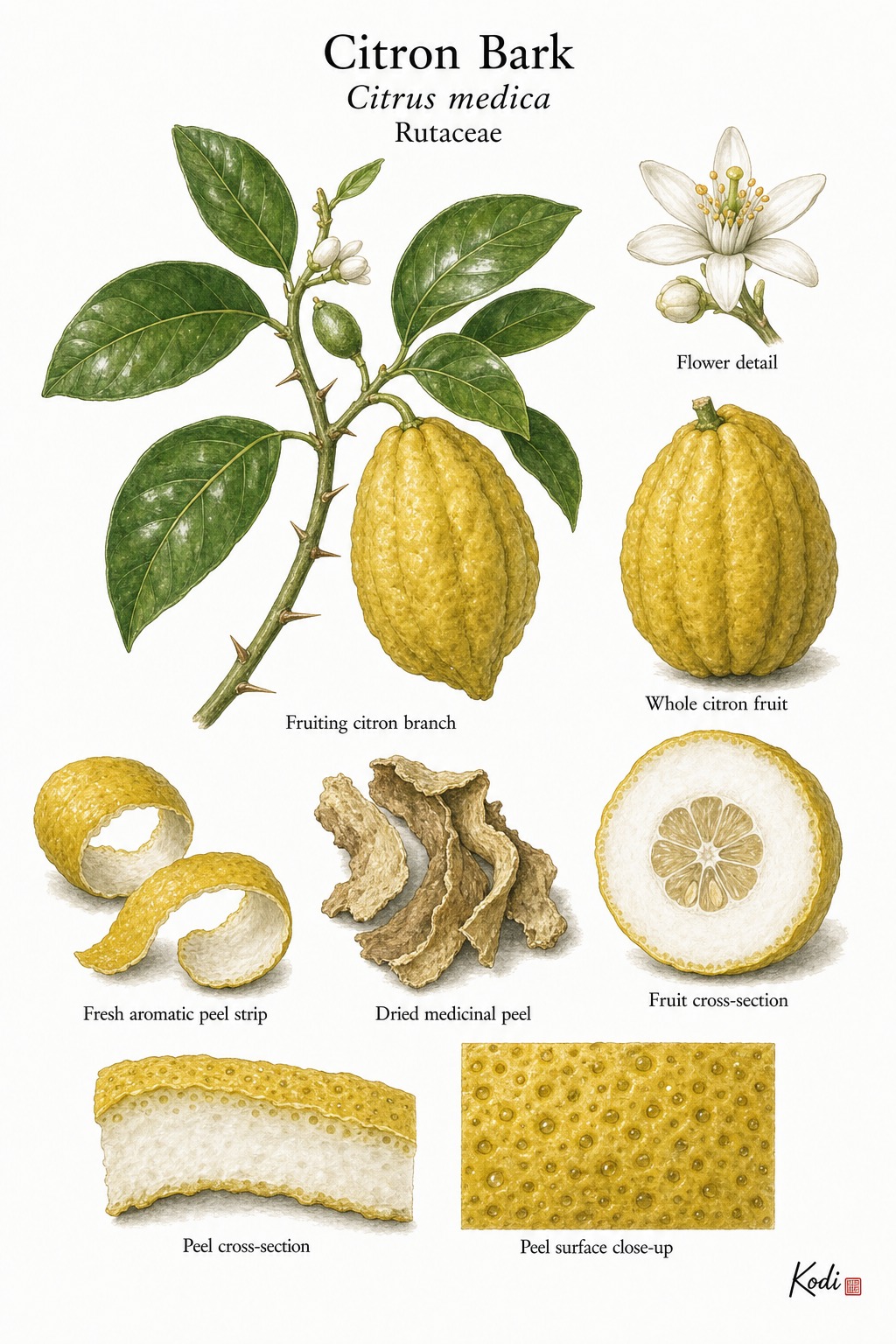
Known in TCM as Xiang Chuan Pi (香橼皮), this acrid and bitter and sour, warm herb enters the Liver, Lung, and Spleen. Traditionally, it moves constrained Qi and relieves distention pain - Xiang Chuan Pi is used for chest, flank, epigastric, and abdominal fullness when stagnant Qi is the main problem and a more moving citron-pi action is desired, most often applied for abdominal pain, indigestion, and productive cough. Modern research has identified Volatile among its active constituents.
Part used: Bark
Also Known As
Latin: Cortex Citri | Pinyin: Xiang Chuan Pi | Chinese: 香橼皮
TCM Properties
- Taste
- acrid, bitter, sour
- Temperature
- warm
- Channels
- Liver, Lung, Spleen
Traditional Use
Primary Actions
- Moves constrained Qi and relieves distention pain - Xiang Chuan Pi is used for chest, flank, epigastric, and abdominal fullness when stagnant Qi is the main problem and a more moving citron-pi action is desired.
- Harmonizes the middle and improves stagnant digestion - traditional use extends to belching, poor appetite, focal fullness, and discomfort from impaired Spleen-Stomach Qi movement.
- Helps transform phlegm and ease cough - like the broader Xiang Yuan lineage, the bark or peel is used when stagnant Qi and sticky phlegm combine to create cough, sputum retention, or a stifling chest sensation.
Secondary Actions
- Compared with whole Xiang Yuan fruit, Xiang Chuan Pi is traditionally regarded as the more strongly Qi-circulating part, with relatively less emphasis on the fuller fruit substance.
- It is a regulating citrus rather than a simple food peel, so it is usually combined with other herbs according to whether pain, digestive stagnation, or phlegm is most prominent.
Classic Formulas
- Xiang Chuan Pi with Mu Xiang and Huo Xiang - middle-jiao Qi-stagnation pairing logic for abdominal fullness, belching, and poor appetite.
- Xiang Chuan Pi with Chai Hu, Yu Jin, or Fo Shou - Liver-Qi-constriction strategy for rib-side or epigastric distention and pain.
- Xiang Chuan Pi with Ban Xia and Gua Lou Pi - citrus-phlegm combination logic when stagnant Qi and retained sputum bind the chest.
Classical References
- American Dragon's Xiang Yuan monograph notes that Xiang Yuan Pi has a stronger Qi-circulating function than the fruit itself, which is the main traditional distinction preserved in modern herb summaries.
- Traditional citron-peel usage places the medicinal in the Qi-regulating category, especially for epigastric and abdominal discomfort with chest oppression or phlegm involvement.
- Because modern indexed literature is much richer for Citrus medica fruit and finger-citron materials than for the exact bark record, this file keeps the bark profile conservative and flags where species-level inference is being used.
Modern Research
Active Compounds
- Volatile terpenes such as limonene, citral, and linalool - characteristic aromatic citrus constituents relevant to Qi-moving and anti-inflammatory discussions
- Flavonoids including hesperidin and naringin - common Citrus medica lineage compounds with antioxidant and mucosal-protective relevance
- Coumarins such as limettin and bergapten-family compounds - repeatedly reported in citron and finger-citron profiling work
- Polysaccharide and phenolic fractions - broader Citrus medica constituents studied for anti-inflammatory effects
Studied Effects
- A review of Citrus medica summarized antioxidant, anti-inflammatory, antimicrobial, and digestive-health-related findings across the species, supporting why citron-derived medicinals remain pharmacologically plausible even when bark-specific trials are scarce (PMID 29594287).
- A peel-focused study on citrus essential oils found anti-inflammatory activity across cultivar peels and helps support the traditional idea that the more aromatic outer portion can have stronger regulatory activity than the inner fruit bulk (PMID 37376044).
- Finger-citron polysaccharide work also demonstrated anti-inflammatory activity in vitro, but this should be read as species-level support rather than direct proof for Cortex Citri specifically (PMID 35757248).
PubMed References
- Citrus medica: nutritional, phytochemical composition and health benefits - a review (2018)
- Anti-Inflammatory Effects of Essential Oils from the Peels of Citrus Cultivars (2023)
- Structural Characterization and Anti-inflammatory Activity of a Galactorhamnan Polysaccharide From Citrus medica L. var. sarcodactylis (2022)
Safety & Interactions
Contraindications
- Marked Yin deficiency or dryness with little true stagnation
- Qi deficiency with weak digestion but no distention, oppression, or phlegm accumulation
Cautions
- This is a moving, aromatic citrus medicinal and can feel drying or irritating if used in patients who mainly need nourishment rather than regulation.
- Modern evidence is largely extrapolated from Citrus medica fruit, peel, or finger-citron studies rather than from dedicated Xiang Chuan Pi clinical trials.
- Concentrated citrus essential-oil products are not interchangeable with ordinary decoction use.
Conditions
- Abdominal Pain Traditional ★★★★☆ JSON
- Indigestion Traditional ★★★☆☆ JSON
- Productive Cough Traditional ★★☆☆☆ JSON
- Acid Reflux Traditional ★★☆☆☆ JSON
Frequently Asked Questions
What is Citron Bark used for?
Citron Bark is traditionally used to Moves constrained Qi and relieves distention pain - Xiang Chuan Pi is used for chest, flank, epigastric, and abdominal fullness when stagnant Qi is the main problem and a more moving citron-pi action is desired., Harmonizes the middle and improves stagnant digestion - traditional use extends to belching, poor appetite, focal fullness, and discomfort from impaired Spleen-Stomach Qi movement., Helps transform phlegm and ease cough - like the broader Xiang Yuan lineage, the bark or peel is used when stagnant Qi and sticky phlegm combine to create cough, sputum retention, or a stifling chest sensation.. Research has investigated its effects on: A review of Citrus medica summarized antioxidant, anti-inflammatory, antimicrobial, and digestive-health-related findings across the species, supporting why citron-derived medicinals remain pharmacologically plausible even when bark-specific trials are scarce (PMID 29594287).; A peel-focused study on citrus essential oils found anti-inflammatory activity across cultivar peels and helps support the traditional idea that the more aromatic outer portion can have stronger regulatory activity than the inner fruit bulk (PMID 37376044)..
What are other names for Citron Bark?
Citron Bark is also known as Citri. In TCM: 香橼皮 (Xiang Chuan Pi); Cortex Citri.
Is Citron Bark safe during pregnancy?
The safety of Citron Bark during pregnancy has not been established. Consult a qualified healthcare provider before use.
What are the contraindications for Citron Bark?
Citron Bark should not be used in: Marked Yin deficiency or dryness with little true stagnation; Qi deficiency with weak digestion but no distention, oppression, or phlegm accumulation. Consult a qualified healthcare provider before use.