Cinnamon Oil
- Chinese
- 桂皮油
- Pinyin
- Gui Pi You
- Latin
- Oleum Corticis Cinnamomi
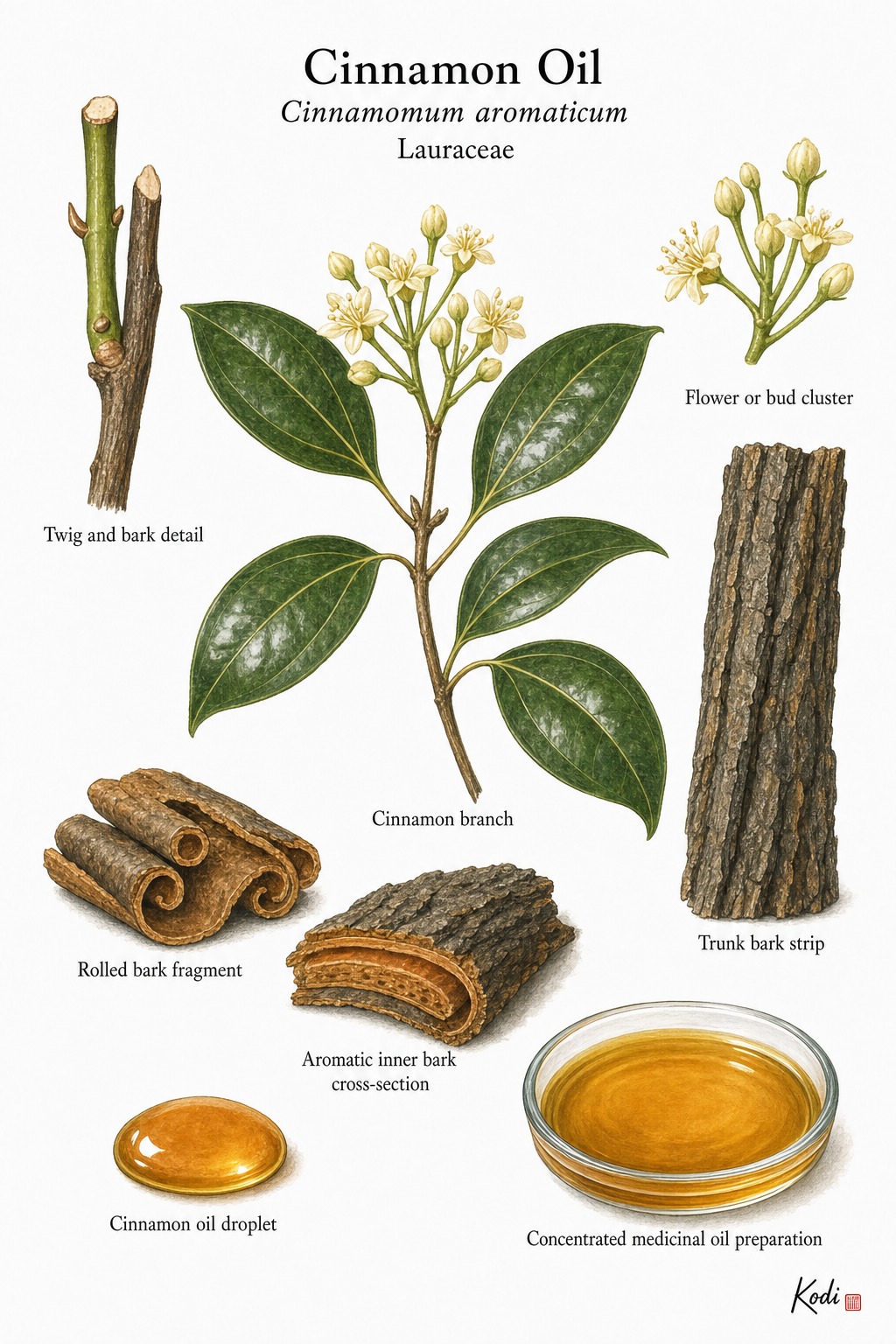
Known in TCM as Gui Pi You (桂皮油), this acrid and sweet, warm herb enters the Spleen and Stomach. Traditionally, it warms the middle burner and dispels interior cold - Gui Pi You is used when cold obstructs the Spleen and Stomach, leading to abdominal pain, poor appetite, nausea, or loose stool that improves with warmth, most often applied for abdominal pain, diarrhea, and indigestion. Modern research has identified trans-cinnamaldehyde among its active constituents.
Part used: Oil
Also Known As
Latin: Oleum Corticis Cinnamomi | Pinyin: Gui Pi You | Chinese: 桂皮油
TCM Properties
- Taste
- acrid, sweet
- Temperature
- warm
- Channels
- Spleen, Stomach
Traditional Use
Primary Actions
- Warms the middle burner and dispels interior cold - Gui Pi You is used when cold obstructs the Spleen and Stomach, leading to abdominal pain, poor appetite, nausea, or loose stool that improves with warmth.
- Strengthens Stomach and Spleen Yang in concentrated aromatic form - the oil preparation is lighter, sharper, and more immediately dispersing than the crude bark decoction.
- Expels wind and opens the surface through aromatic warmth - traditional summaries extend its use to wind-cold or cold-damp lodged superficially while the middle burner is also chilled.
- Provides a concentrated warming external preparation - topical use is directed toward cold-pattern pain, localized chill, and stiff aching areas where a penetrating cinnamon preparation is preferred.
Secondary Actions
- Gui Pi You overlaps heavily with Rou Gui You and cassia bark oil terminology in trade, so the practical task is to recognize this as a cinnamon-bark oil preparation rather than a separate species-level herb.
- Because this is a concentrated volatile oil, it is substantially more irritating to tissues than crude Rou Gui or Gui Zhi and is less suitable for prolonged unsupervised use.
Classical References
- TCM-style summaries describe cinnamon-bark oil as pungent, sweet, and warm, with actions of expelling wind, strengthening the Stomach, and warming the Spleen and Stomach.
- Traditional usage treats the oil as a preparation-state derivative of cinnamon bark rather than a distinct medicinal species, so its direction remains warming, dispersing, and middle-jiao supporting.
- IDENTITY NOTE: this record is for the concentrated oil preparation Gui Pi You, not the crude bark herb Rou Gui or the twig herb Gui Zhi; they share source material but are not interchangeable drop-for-gram.
Modern Research
Active Compounds
- trans-cinnamaldehyde
- Eugenol
- Coumarin
- Cinnamyl acetate
- Cinnamic acid and related phenylpropanoids
Studied Effects
- A 2024 review summarized cinnamon oil's chemical composition and discussed antimicrobial, anti-inflammatory, antioxidant, metabolic, and application-oriented research across multiple Cinnamomum oils, including cassia-rich preparations (PMID 39770541).
- Chinese cassia oil and cinnamaldehyde showed direct antimicrobial activity against bacterial and fungal targets, supporting longstanding external and preservative interest in cinnamon oil preparations (PMID 16710900).
- A Cinnamomum cassia essential-oil nano-emulsion demonstrated antioxidant, antibacterial, and antiproliferative activity in experimental systems, illustrating modern formulation work aimed at improving volatile-oil delivery (PMID 35472756).
- Essential oil from Cinnamomum cassia twigs alleviated pain and inflammation in mice, offering a mechanistic bridge to the warming and pain-relieving logic of cinnamon-type oil preparations (PMID 27780753).
PubMed References
- Therapeutic Potential of Cinnamon Oil: Chemical Composition, Pharmacological Actions, and Applications (2024)
- Antimicrobial activities of cinnamon oil and cinnamaldehyde from the Chinese medicinal herb Cinnamomum cassia Blume (2006)
- Preparation, characterization, and biological activity of Cinnamomum cassia essential oil nano-emulsion (2022)
- The essential oil from the twigs of Cinnamomum cassia Presl alleviates pain and inflammation in mice (2016)
Safety & Interactions
Contraindications
- Known cinnamon or cassia hypersensitivity
- Undiluted application to damaged skin or mucous membranes
- Marked internal heat or Yin-deficiency heat patterns
Cautions
- Cinnamon oil is more irritating and sensitizing than the crude bark herb and should generally be diluted before topical use.
- Some cinnamon products contain enough coumarin to raise hepatotoxicity concerns, especially with heavy or prolonged intake.
- Gastrointestinal burning, mucosal irritation, and allergic skin reactions are possible with concentrated cinnamon oils.
Drug Interactions
- CYP450 substrate drugs … Preclinical cinnamon literature suggests enzyme inhibition that could alter exposure to some CYP-metabolized drugs when concentrated preparations are used heavily. (Moderate) Source: Cinnamon pharmacology and integrative-medicine summaries
- Hepatotoxic drugs … Coumarin-bearing cinnamon products may add to liver burden in susceptible patients or with prolonged high exposure. (Moderate) Source: Cassia cinnamon toxicology literature
Conditions
- Abdominal Pain Traditional ★★★★☆ JSON
- Diarrhea Traditional ★★★☆☆ JSON
- Indigestion Traditional ★★★☆☆ JSON
- Common Cold Traditional ★★☆☆☆ JSON
- Rheumatism Traditional ★★☆☆☆ JSON
Frequently Asked Questions
What is Cinnamon Oil used for?
Cinnamon Oil is traditionally used to Warms the middle burner and dispels interior cold - Gui Pi You is used when cold obstructs the Spleen and Stomach, leading to abdominal pain, poor appetite, nausea, or loose stool that improves with warmth., Strengthens Stomach and Spleen Yang in concentrated aromatic form - the oil preparation is lighter, sharper, and more immediately dispersing than the crude bark decoction., Expels wind and opens the surface through aromatic warmth - traditional summaries extend its use to wind-cold or cold-damp lodged superficially while the middle burner is also chilled., Provides a concentrated warming external preparation - topical use is directed toward cold-pattern pain, localized chill, and stiff aching areas where a penetrating cinnamon preparation is preferred.. Research has investigated its effects on: A 2024 review summarized cinnamon oil's chemical composition and discussed antimicrobial, anti-inflammatory, antioxidant, metabolic, and application-oriented research across multiple Cinnamomum oils, including cassia-rich preparations (PMID 39770541).; Chinese cassia oil and cinnamaldehyde showed direct antimicrobial activity against bacterial and fungal targets, supporting longstanding external and preservative interest in cinnamon oil preparations (PMID 16710900)..
What are other names for Cinnamon Oil?
Cinnamon Oil is also known as Corticis. In TCM: 桂皮油 (Gui Pi You); Oleum Corticis Cinnamomi.
Is Cinnamon Oil safe during pregnancy?
The safety of Cinnamon Oil during pregnancy has not been established. Consult a qualified healthcare provider before use.
What are the contraindications for Cinnamon Oil?
Cinnamon Oil should not be used in: Known cinnamon or cassia hypersensitivity; Undiluted application to damaged skin or mucous membranes; Marked internal heat or Yin-deficiency heat patterns. Consult a qualified healthcare provider before use.
Does Cinnamon Oil interact with any medications?
Cinnamon Oil may interact with: CYP450 substrate drugs - Preclinical cinnamon literature suggests enzyme inhibition that could alter exposure to some CYP-metabolized drugs when concentrated preparations are used heavily. - (Moderate severity); Hepatotoxic drugs - Coumarin-bearing cinnamon products may add to liver burden in susceptible patients or with prolonged high exposure. - (Moderate severity). Always inform your healthcare provider of any herbal supplements you are taking.