Cinnabar
- Chinese
- 辰砂
- Pinyin
- Chen Sha
- Latin
- Cinnabaris
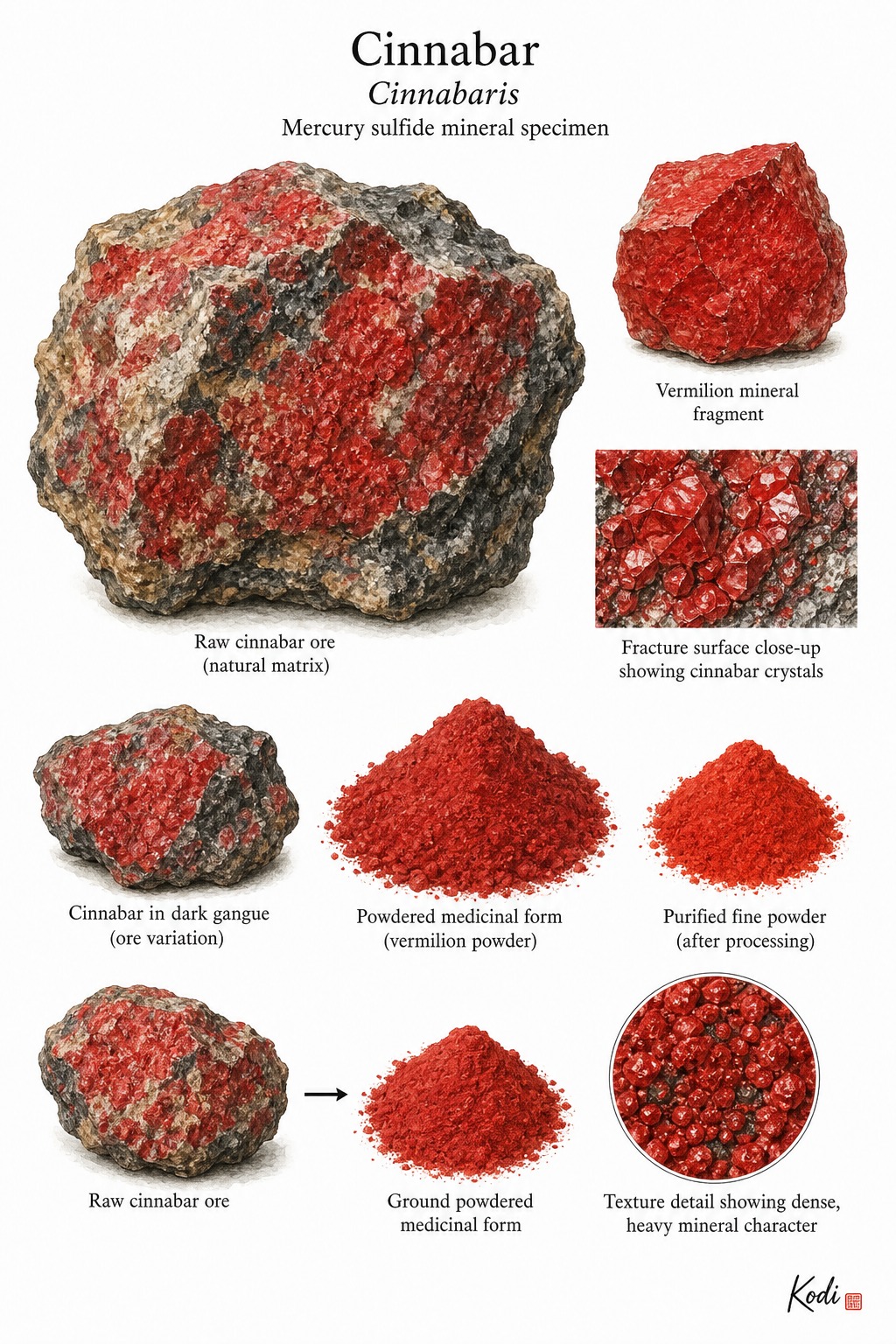
Known in TCM as Chen Sha (辰砂), this sweet, slightly cold herb enters the Heart. Traditionally, it calms the spirit and settles fright - Chen Sha is one of the classic heavy substances for severe agitation, insomnia, palpitations, and spirit disturbance, most often applied for insomnia, palpitations, and anxiety. Modern research has identified Mercury among its active constituents.
Part used: Cinnabar
TCM Properties
- Taste
- sweet
- Temperature
- slightly cold
- Channels
- Heart
Traditional Use
Primary Actions
- Calms the spirit and settles fright - Chen Sha is one of the classic heavy substances for severe agitation, insomnia, palpitations, and spirit disturbance.
- Clears Heart heat - traditional use includes vexation, irritability, and restlessness associated with blazing Heart fire.
- Addresses convulsive or seizure-type patterns in combination formulas - the mineral appears in older formula traditions for fright-wind, phlegm-heat agitation, and related severe presentations.
- Relieves toxicity when applied externally - finely prepared topical use appears in traditional management of sores, ulcerations, and inflammatory lesions.
Secondary Actions
- Modern practice is highly cautious because Chen Sha is mercury sulfide and is often restricted to tiny, controlled doses or replaced by safer alternatives.
- The mineral is not decocted and should not be heated, because heating can release toxic mercury vapor.
Classic Formulas
- Zhu Sha An Shen Wan - classic spirit-calming and Heart-fire-clearing formula.
- An Gong Niu Huang Wan - resuscitative formula tradition in which cinnabar has historically been included for severe heat and consciousness disturbance.
- Ci Zhu Wan - heavy-substance combination used traditionally for spirit disturbance, palpitations, and related sensory complaints.
Classical References
- Traditional materia medica describes cinnabar as sweet and slightly cold, entering the Heart channel to calm the spirit, clear heat, and relieve toxicity.
- Later clinical cautions repeatedly stress minute dosing, powder use rather than decoction, and careful source control because the medicinal effect is inseparable from a real mercury burden.
- This Chen Sha entry is therefore framed as a toxic mineral medicine rather than a gentle daily sleep herb.
Modern Research
Active Compounds
- Mercury sulfide (alpha-HgS)
- Trace inorganic mercury species
- Mineral sulfur matrix
- Accessory mineral impurities that vary by source and processing
Studied Effects
- A 2022 review summarized sedative, sleep-related, anxiolytic, and brain-protection research around cinnabar while emphasizing that toxicology and rational application remain central concerns (PMID 36204126).
- A classic toxicology review concluded cinnabar is less bioavailable and less acutely toxic than many other mercurials, but long-term exposure can still injure kidneys and heating releases mercury vapor (PMID 18445765).
- Risk-assessment work on cinnabar and a cinnabar-containing patent medicine found mercury accumulation especially with overdose or prolonged administration, with potential neurotoxicity despite limited short-term organ damage in rats (PMID 31866510).
- Metabolomics work in rats demonstrated neurotoxic changes in cerebrum and cerebellum after cinnabar exposure, reinforcing why any calming or hypnotic application must be weighed against real toxic risk (PMID 26110755).
PubMed References
- Pharmacology, Toxicology, and Rational Application of Cinnabar, Realgar, and Their Formulations (2022)
- Mercury in traditional medicines: is cinnabar toxicologically similar to common mercurials? (2008)
- Toxicity and risk assessment of mercury exposures from cinnabar and Baizi Yangxin Pills based on pharmacokinetic and tissue distribution studies (2020)
- (1)H NMR-Based Metabolomics and Neurotoxicity Study of Cerebrum and Cerebellum in Rats Treated with Cinnabar, a Traditional Chinese Medicine (2015)
Safety & Interactions
Contraindications
- Pregnancy
- Renal impairment, hepatic impairment, or prior heavy-metal toxicity
- Unsupervised use, prolonged use, or any plan to decoct or heat the mineral
Cautions
- Chen Sha contains mercury sulfide and should be treated as a toxic mineral even when traditional literature assigns it calming properties.
- Heating or decocting can release mercury vapor; traditional use relies on minute powder quantities instead.
- Safer non-mercurial alternatives are generally preferred outside tightly controlled traditional formula contexts.
- Modern data do not justify self-treatment of insomnia, anxiety, palpitations, or seizures with cinnabar.
Conditions
Frequently Asked Questions
What is Cinnabar used for?
Cinnabar is traditionally used to Calms the spirit and settles fright - Chen Sha is one of the classic heavy substances for severe agitation, insomnia, palpitations, and spirit disturbance., Clears Heart heat - traditional use includes vexation, irritability, and restlessness associated with blazing Heart fire., Addresses convulsive or seizure-type patterns in combination formulas - the mineral appears in older formula traditions for fright-wind, phlegm-heat agitation, and related severe presentations., Relieves toxicity when applied externally - finely prepared topical use appears in traditional management of sores, ulcerations, and inflammatory lesions.. Research has investigated its effects on: A 2022 review summarized sedative, sleep-related, anxiolytic, and brain-protection research around cinnabar while emphasizing that toxicology and rational application remain central concerns (PMID 36204126).; A classic toxicology review concluded cinnabar is less bioavailable and less acutely toxic than many other mercurials, but long-term exposure can still injure kidneys and heating releases mercury vapor (PMID 18445765)..
Is Cinnabar safe during pregnancy?
Cinnabar is not recommended during pregnancy.
What are the contraindications for Cinnabar?
Cinnabar should not be used in: Pregnancy; Renal impairment, hepatic impairment, or prior heavy-metal toxicity; Unsupervised use, prolonged use, or any plan to decoct or heat the mineral. Consult a qualified healthcare provider before use.