Cicada Slough
- Chinese
- 蝉蜕
- Pinyin
- Chan Tui
- Latin
- Periostracum Cicadae
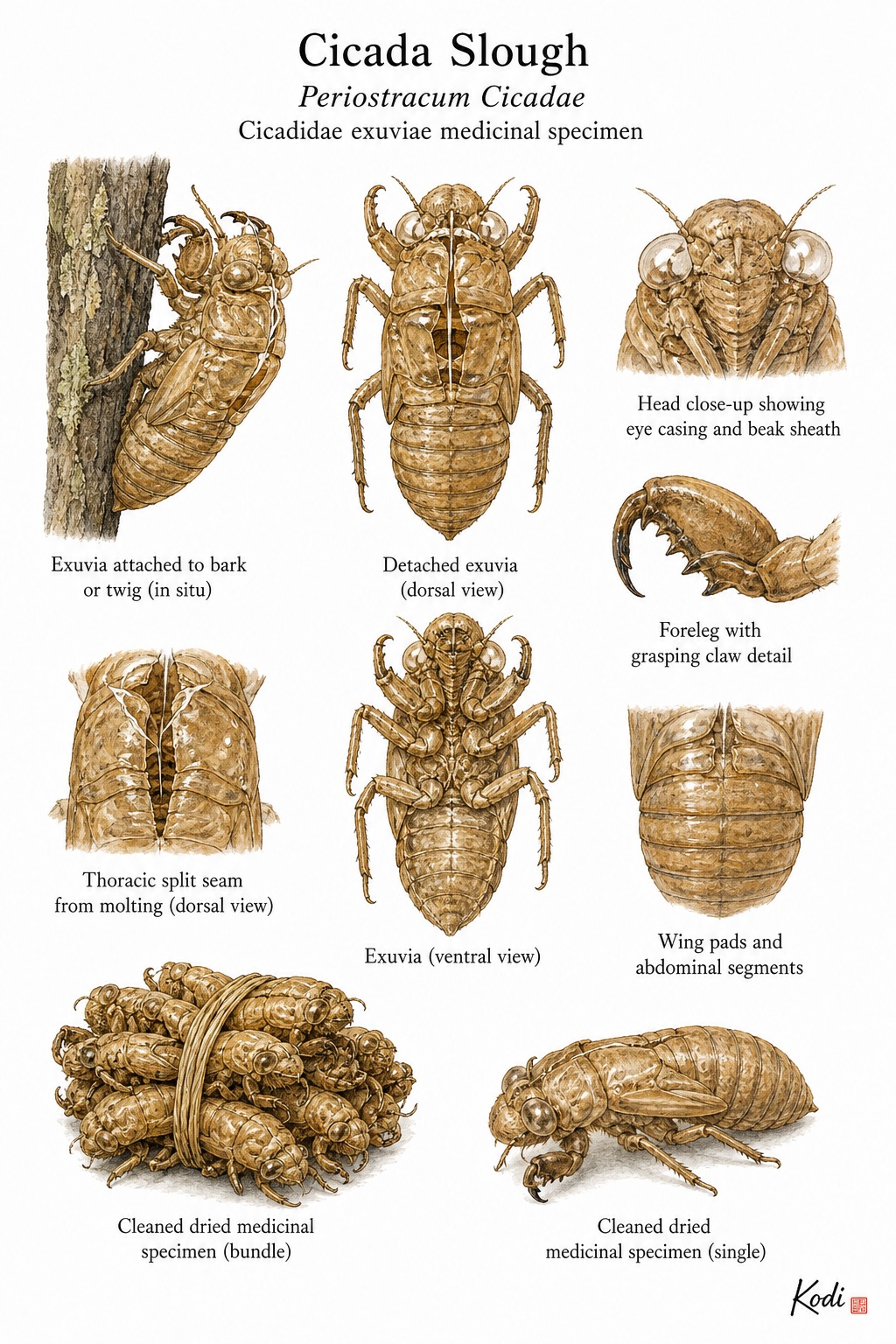
Known in TCM as Chan Tui (蝉蜕), this sweet and salty, slightly cold herb enters the Lung and Liver. Traditionally, it releases wind-heat from the exterior - Chan Tui is used for early wind-heat presentations with sore throat, mild fever, and superficial irritation, most often applied for sore throat, urticaria, and conjunctivitis. Modern research has identified N-acetyldopamine among its active constituents.
Part used: Shed skin
Also Known As
Latin: Periostracum Cicadae | Pinyin: Chan Tui | Chinese: 蝉蜕
TCM Properties
- Taste
- sweet, salty
- Temperature
- slightly cold
- Channels
- Lung, Liver
Traditional Use
Primary Actions
- Releases wind-heat from the exterior - Chan Tui is used for early wind-heat presentations with sore throat, mild fever, and superficial irritation.
- Benefits the throat and voice - it is a classic light herb for hoarseness, swollen throat, and constrained heat at the surface.
- Vents rashes and relieves itching - traditional use includes measles that do not vent well, urticaria, and pruritic wind-type eruptions.
- Extinguishes wind and stops spasms - Chan Tui is also used in combination formulas for fright-wind, childhood convulsion patterns, and tremulous movement associated with wind.
Secondary Actions
- Because it is a cast-off shell rather than a dense tonic substance, Chan Tui is valued for its light, ascending, and outward-venting quality.
- Source processing matters: cleaning and authenticity affect ash burden, heavy-metal content, and overall quality more than many ordinary botanical herbs.
Classic Formulas
- Chan Tui with Niu Bang Zi and Bo He - classic wind-heat throat and rash-venting pairing logic.
- Xiao Feng San - itching formula tradition in which Chan Tui helps vent wind from the skin and reduce pruritus.
- Chan Tui with Jiang Can and Gou Teng - spasm- and convulsion-oriented strategy when wind and agitation rise to the surface.
Classical References
- TCM herb summaries describe Chan Tui as sweet, salty, and slightly cold, entering the Lung and Liver channels, with actions of dispersing wind-heat, venting rashes, benefiting the throat, brightening the eyes, and stopping spasms.
- Traditional use often emphasizes pediatric or dermatologic patterns because the herb's light outward action helps guide constrained pathogens or rash expression to the surface.
- Its classic identity remains distinct from heavier anticonvulsant or sedative substances even though later research has explored neuroprotective effects.
Modern Research
Active Compounds
- N-acetyldopamine dimers and oligomers
- Free amino acids
- Chitinous and protein matrix fractions
- Cyclic peptide constituents
- Trace mineral and heavy-metal burden sensitive to processing quality
Studied Effects
- A 2022 quality and bioactivity study quantified N-acetyldopamine oligomers, amino acids, ash, and heavy metals and found that pre-molting-washed material retained stronger antioxidant and anti-inflammatory activity than standard washed material (PMID 36431784).
- UPLC-QTOF-MS comparison of four origins of Cicadae Periostracum mapped distinct N-acetyldopamine polymer profiles, reinforcing the importance of authenticity and source control in this animal-derived materia medica (PMID 31767224).
- Cicadae Periostracum showed antiepileptic and antiapoptotic effects in mice and PC12 cells through PI3K/Akt/Nrf2-related signaling, offering a mechanistic correlate for the herb's traditional antispasmodic use (PMID 34336105).
- Cicadidae Periostracum attenuated atopic-dermatitis-like inflammation in a mouse model by regulating NLRP3 inflammasome activation, supporting a modern research bridge to its traditional itch-relieving use (PMID 33520088).
PubMed References
- Integrating Multi-Type Component Determination and Anti-Oxidant/-Inflammatory Assay to Evaluate the Impact of Pre-Molting Washing on the Quality and Bioactivity of Cicadae Periostracum (2022)
- Quality consistency evaluation on four origins of Cicadae Periostracum by ultra-performance liquid chromatography coupled with quadrupole/time-of-flight mass spectrometry analysis (2020)
- Antiepileptic Effects of Cicadae Periostracum on Mice and Its Antiapoptotic Effects in H2O2-Stimulated PC12 Cells via Regulation of PI3K/Akt/Nrf2 Signaling Pathways (2021)
- Cicadidae Periostracum Attenuates Atopic Dermatitis Symptoms and Pathology via the Regulation of NLRP3 Inflammasome Activation (2021)
Safety & Interactions
Contraindications
- Rashes or itching that arise from marked deficiency-dryness rather than wind-heat or surface constraint
- Known allergy to insect-derived products
- Use of contaminated or poorly cleaned source material
Cautions
- Most modern evidence is preclinical and does not justify self-treatment of seizures, severe eczema, or acute throat compromise.
- Quality varies with source and processing, and heavy-metal or ash burden is a real practical issue for this insect-derived medicinal material.
- Chan Tui is a light exterior-venting substance, so it is usually less relevant once a rash has already fully expressed or when deep interior pathology predominates.
Classic formulas that use Cicada Slough
Herbs are rarely taken alone in Chinese medicine. These formula pages show what this herb does inside a classic prescription and which pattern that prescription is chosen for.
Conditions
- Sore Throat Traditional ★★★★☆ JSON
- Urticaria Traditional ★★★★☆ JSON
- Conjunctivitis Traditional ★★★☆☆ JSON
- Common Cold Traditional ★★☆☆☆ JSON
- Epilepsy Research ★★☆☆☆ JSON
Frequently Asked Questions
What is Cicada Slough used for?
Cicada Slough is traditionally used to Releases wind-heat from the exterior - Chan Tui is used for early wind-heat presentations with sore throat, mild fever, and superficial irritation., Benefits the throat and voice - it is a classic light herb for hoarseness, swollen throat, and constrained heat at the surface., Vents rashes and relieves itching - traditional use includes measles that do not vent well, urticaria, and pruritic wind-type eruptions., Extinguishes wind and stops spasms - Chan Tui is also used in combination formulas for fright-wind, childhood convulsion patterns, and tremulous movement associated with wind.. Research has investigated its effects on: A 2022 quality and bioactivity study quantified N-acetyldopamine oligomers, amino acids, ash, and heavy metals and found that pre-molting-washed material retained stronger antioxidant and anti-inflammatory activity than standard washed material (PMID 36431784).; UPLC-QTOF-MS comparison of four origins of Cicadae Periostracum mapped distinct N-acetyldopamine polymer profiles, reinforcing the importance of authenticity and source control in this animal-derived materia medica (PMID 31767224)..
What are other names for Cicada Slough?
Cicada Slough is also known as Cicada. In TCM: 蝉蜕 (Chan Tui); Periostracum Cicadae.
Is Cicada Slough safe during pregnancy?
The safety of Cicada Slough during pregnancy has not been established. Consult a qualified healthcare provider before use.
What are the contraindications for Cicada Slough?
Cicada Slough should not be used in: Rashes or itching that arise from marked deficiency-dryness rather than wind-heat or surface constraint; Known allergy to insect-derived products; Use of contaminated or poorly cleaned source material. Consult a qualified healthcare provider before use.