Cibot Rhizome
- Chinese
- 金毛狗脊
- Pinyin
- Jin Mao Gou Ji
- Latin
- Rhizoma Cibotii
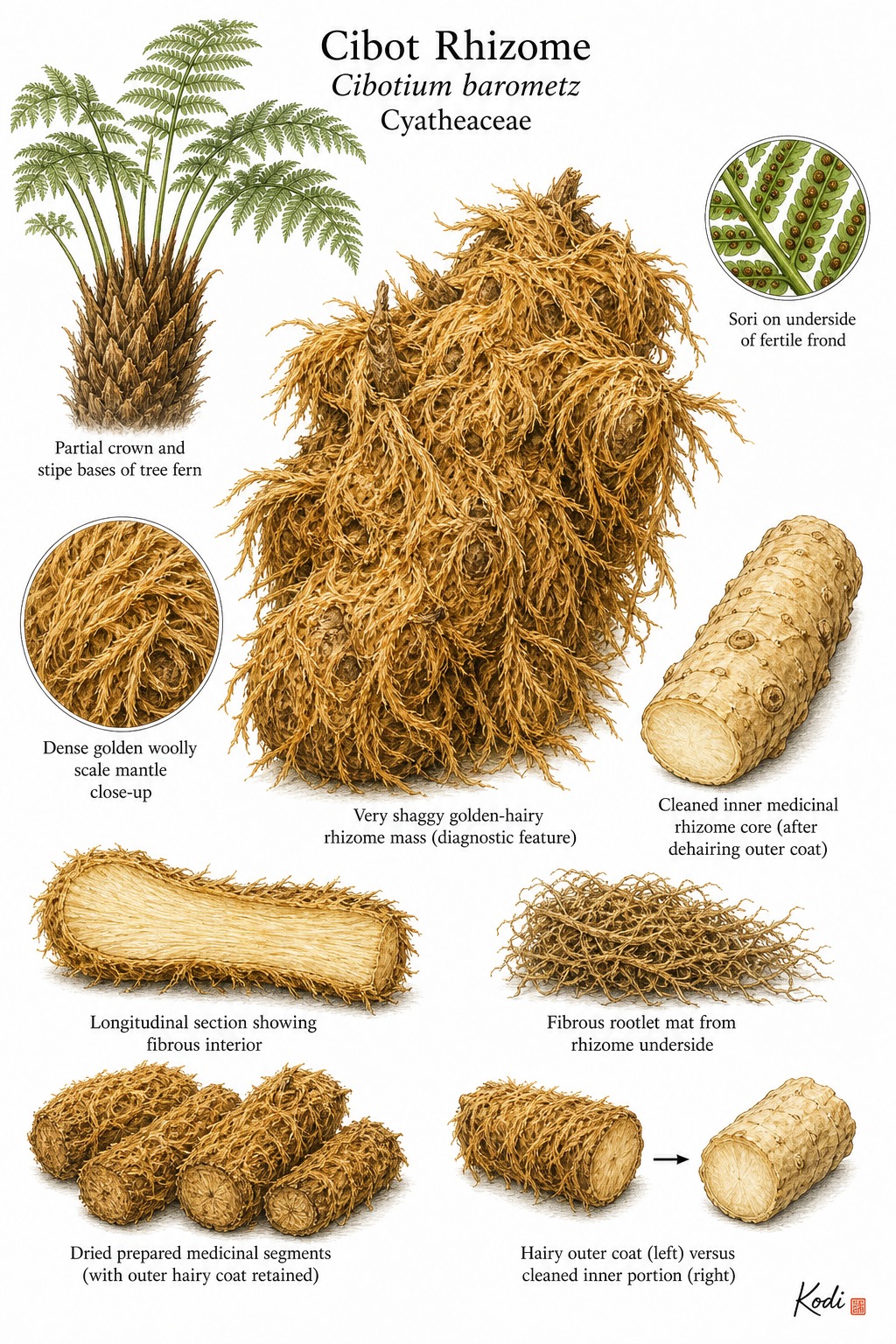
Known in TCM as Jin Mao Gou Ji (金毛狗脊), this bitter and sweet, warm herb enters the Liver and Kidney. Traditionally, it tonifies the Liver and Kidney and strengthens sinews and bones - Jin Mao Gou Ji is another catalog-level Gou Ji variant used for chronic low-back, knee, and lower-limb weakness with a deficiency root, most often applied for low back pain, joint pain, and rheumatism. Modern research has identified Cibotium among its active constituents.
Part used: Rhizome
Also Known As
Latin: Rhizoma Cibotii | Pinyin: Jin Mao Gou Ji | Chinese: 金毛狗脊
TCM Properties
- Taste
- bitter, sweet
- Temperature
- warm
- Channels
- Liver, Kidney
Traditional Use
Primary Actions
- Tonifies the Liver and Kidney and strengthens sinews and bones - Jin Mao Gou Ji is another catalog-level Gou Ji variant used for chronic low-back, knee, and lower-limb weakness with a deficiency root.
- Dispels wind-damp and alleviates painful obstruction - it is suited to long-standing soreness, heaviness, and limited movement when weakness and obstruction coexist.
- Supports lower-burner stability - traditional indications can extend to urinary frequency or dribbling associated with Kidney deficiency.
- Acts as a warm musculoskeletal support herb - the therapeutic identity remains the orthodox Gou Ji profile even when the source name emphasizes the golden-haired rhizome.
Secondary Actions
- The Jin Mao Gou Ji name usually points to the hairy source rhizome of Cibotium barometz rather than a separate classical evidence base.
- Processing remains important because the rough outer hairs are not the intended internal medicinal portion.
Classic Formulas
- Jin Mao Gou Ji with Du Zhong, Xu Duan, and Niu Xi - chronic low-back soreness and lower-limb weakness strategy.
- Jin Mao Gou Ji with Sang Ji Sheng and Qin Jiao - deficiency-rooted wind-damp painful obstruction pairing.
- Jin Mao Gou Ji with Yi Zhi Ren or Bu Gu Zhi - lower-burner securing approach when urinary frequency accompanies weakness.
Classical References
- Orthodox Gou Ji references describe a warm Liver-Kidney herb that strengthens sinews and bones while dispelling wind-damp.
- Trade names such as Jin Mao Gou Ji preserve that same therapeutic identity even when they highlight the characteristic golden hairs of the source fern.
- This entry therefore follows the standard Rhizoma Cibotii profile instead of inventing a new indication set from naming variation alone.
Modern Research
Active Compounds
- Cibotium barometz polysaccharides
- Phenylpropanoids and polyphenols
- Flavonoids
- Terpenoids
- Steroids
Studied Effects
- A 2025 review summarized the botany, traditional uses, phytochemistry, processing, and pharmacology of Cibotium barometz, highlighting bone, anti-inflammatory, antioxidant, and tissue-repair directions while noting that most evidence remains preclinical (PMID 40848860).
- Cibotium barometz extract reduced ovariectomy-induced bone loss in rats, supporting the herb's traditional association with weak bones and low-back or knee deficiency patterns (PMID 21782010).
- A network-pharmacology and animal study reported protective effects against osteoarthritis-related pathology and inflammatory signaling in rat models, aligning with its long use for painful obstruction (PMID 35873632).
- Polysaccharides isolated from Cibotium barometz attenuated chronic inflammatory pain in experimental work, offering a modern mechanistic correlate for the herb's traditional wind-damp pain indications (PMID 39818377).
PubMed References
- Botany, traditional uses, phytochemistry, pharmacology, processing, and applications of Cibotium barometz (L.) J. Sm.: A review (2025)
- Anti-osteoporosis activity of Cibotium barometz extract on ovariectomy-induced bone loss in rats (2011)
- Network Pharmacology-Based Strategy to Investigate the Mechanisms of Cibotium barometz in Treating Osteoarthritis (2022)
- Polysaccharides isolated from Cibotium barometz attenuate chronic inflammatory pain: Molecular chemical structure and role of phenylalanine (2025)
Safety & Interactions
Contraindications
- Yin deficiency with pronounced internal heat
- Hot or inflamed painful obstruction without deficiency-cold features
- Use of poorly cleaned material with irritating hairs still attached
Cautions
- This Jin Mao Gou Ji record shares the same evidence base as Gou Ji generally; current literature does not support a separate pharmacology just from the trade variant name.
- Most modern evidence remains preclinical and does not replace evaluation for fracture, nerve compression, progressive osteoporosis, or destructive joint disease.
- Warm, stabilizing herbs can be mismatched if urinary symptoms are driven by damp-heat or infection rather than deficiency.
Conditions
- Low Back Pain Traditional ★★★★☆ JSON
- Joint Pain Traditional ★★★★☆ JSON
- Rheumatism Traditional ★★★★☆ JSON
- Kidney Yang Deficiency Traditional ★★☆☆☆ JSON
- Frequent Urination Traditional ★★☆☆☆ JSON
Frequently Asked Questions
What is Cibot Rhizome used for?
Cibot Rhizome is traditionally used to Tonifies the Liver and Kidney and strengthens sinews and bones - Jin Mao Gou Ji is another catalog-level Gou Ji variant used for chronic low-back, knee, and lower-limb weakness with a deficiency root., Dispels wind-damp and alleviates painful obstruction - it is suited to long-standing soreness, heaviness, and limited movement when weakness and obstruction coexist., Supports lower-burner stability - traditional indications can extend to urinary frequency or dribbling associated with Kidney deficiency., Acts as a warm musculoskeletal support herb - the therapeutic identity remains the orthodox Gou Ji profile even when the source name emphasizes the golden-haired rhizome.. Research has investigated its effects on: A 2025 review summarized the botany, traditional uses, phytochemistry, processing, and pharmacology of Cibotium barometz, highlighting bone, anti-inflammatory, antioxidant, and tissue-repair directions while noting that most evidence remains preclinical (PMID 40848860).; Cibotium barometz extract reduced ovariectomy-induced bone loss in rats, supporting the herb's traditional association with weak bones and low-back or knee deficiency patterns (PMID 21782010)..
What are other names for Cibot Rhizome?
Cibot Rhizome is also known as Cibotium. In TCM: 金毛狗脊 (Jin Mao Gou Ji); Rhizoma Cibotii.
Is Cibot Rhizome safe during pregnancy?
The safety of Cibot Rhizome during pregnancy has not been established. Consult a qualified healthcare provider before use.
What are the contraindications for Cibot Rhizome?
Cibot Rhizome should not be used in: Yin deficiency with pronounced internal heat; Hot or inflamed painful obstruction without deficiency-cold features; Use of poorly cleaned material with irritating hairs still attached. Consult a qualified healthcare provider before use.