Chuanxiong Rhizome, Szechuan Lovage Root
- Chinese
- 西川芎
- Pinyin
- Xi Chuan Xiong
- Latin
- Rhizoma Chuanxiong
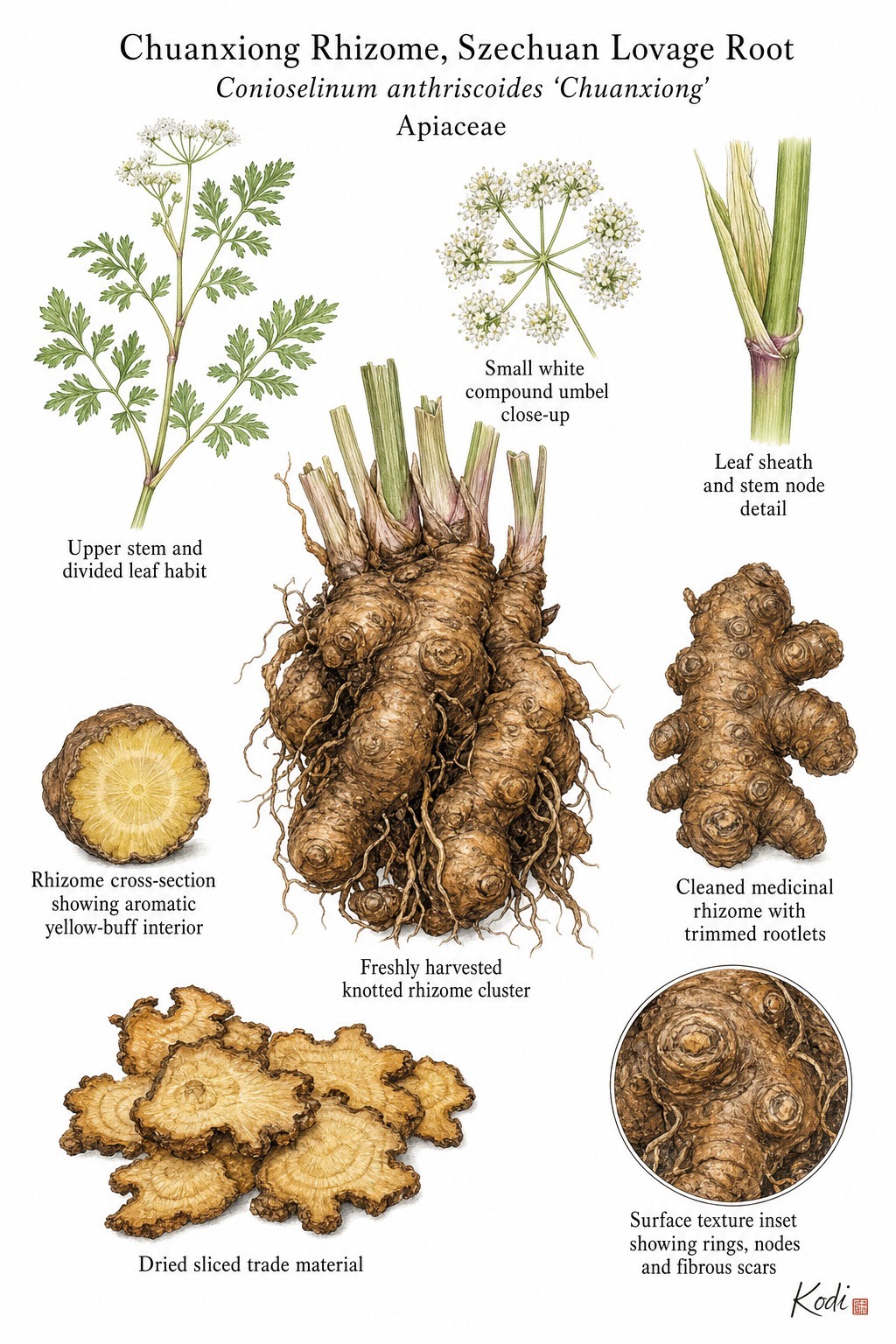
Known in TCM as Xi Chuan Xiong (西川芎), this acrid, warm herb enters the Liver, Gallbladder, and Pericardium. Traditionally, it invigorates blood and dispels stasis - Xi Chuan Xiong shares the core Chuan Xiong function of moving constrained blood in headache, menstrual pain, chest pain, and traumatic stasis patterns, most often applied for headache, dysmenorrhea, and blood stasis. Modern research has identified Z-ligustilide among its active constituents.
Part used: Rhizome
Also Known As
Latin: Rhizoma Chuanxiong | Pinyin: Xi Chuan Xiong | Chinese: 西川芎
TCM Properties
- Taste
- acrid
- Temperature
- warm
- Channels
- Liver, Gallbladder, Pericardium
Traditional Use
Primary Actions
- Invigorates blood and dispels stasis - Xi Chuan Xiong shares the core Chuan Xiong function of moving constrained blood in headache, menstrual pain, chest pain, and traumatic stasis patterns.
- Promotes qi movement and alleviates pain - it is chosen when blood stasis and qi stagnation combine into fixed, distending, or migratory pain.
- Dispels wind and relieves headache - classic use extends to wind-type headache presentations in which a blood-moving guide herb is needed in the head.
- Bridges upper-body and gynecologic pain treatment - this broad range is one reason Chuan Xiong-type records often recur in trade catalogs under closely related variant names.
Secondary Actions
- Xi Chuan Xiong is best understood here as a naming or sourcing variant of Chuan Xiong rather than a meaningfully different materia medica item.
- Older import datasets sometimes mix Radix and Rhizoma wording, but the clinically relevant identity remains the blood-moving rhizome used in standard TCM practice.
Classic Formulas
- Chuan Xiong Cha Tiao San - wind-headache formula in which Chuan Xiong guides movement in the head and alleviates pain.
- Si Wu Tang - classic blood formula where Chuan Xiong moves the blood so tonification does not become static.
- Xue Fu Zhu Yu Tang - blood-stasis formula for chest, rib-side, and headache presentations with fixed pain.
- Sheng Hua Tang - postpartum formula that uses Chuan Xiong to move retained blood and relieve pain.
Classical References
- TCM herb summaries consistently describe Chuan Xiong as acrid and warm, entering the Liver, Gallbladder, and Pericardium channels, with a premier reputation for headache and blood-stasis pain.
- The saying that headaches should not go without Chuan Xiong is frequently cited to illustrate how central the herb is across multiple wind and blood-related headache patterns.
- This Xi Chuan Xiong record preserves that same clinical identity while cleaning up catalog-level naming noise from import data.
Modern Research
Active Compounds
- Z-ligustilide
- Tetramethylpyrazine (ligustrazine)
- Ferulic acid
- Senkyunolide A
- Butylidenephthalide
Studied Effects
- A 2025 review summarized the chemistry, pharmacology, and clinical literature around Ligusticum chuanxiong, highlighting cardiovascular, neuroprotective, anti-inflammatory, and analgesic directions while noting the need for stronger clinical standardization (PMID 40235541).
- Ligustilide protected against renal ischemia-reperfusion injury by maintaining Sirt3-dependent mitochondrial homeostasis and reducing oxidative stress in experimental models (PMID 39216302).
- Z-ligustilide improved motor ability in a Caenorhabditis elegans model by alleviating oxidative stress through intestinal microvilli pathways, illustrating a newer mechanistic research angle (PMID 41482089).
- Recent review literature also continues to emphasize cardiocerebrovascular and gynecologic applications as the modern biomedical domains most often mapped onto Chuan Xiong's traditional blood-moving identity (PMID 39180449).
PubMed References
- Ligusticum chuanxiong: a chemical, pharmacological and clinical review (2025)
- Ligustilide alleviates oxidative stress during renal ischemia-reperfusion injury through maintaining Sirt3-dependent mitochondrial homeostasis (2024)
- Z-Ligustilide purified from Ligusticum chuanxiong Hort. promotes motor ability in Caenorhabditis elegans by alleviating oxidative stress via the intestinal microvilli (2026)
- Ligusticum chuanxiong Hort.: a review of its phytochemistry, pharmacology, and toxicology (2024)
Safety & Interactions
Contraindications
- Pregnancy except under specialist supervision
- Active bleeding or marked bleeding tendency unrelated to blood stasis
- Yin deficiency with heat signs
Cautions
- The herb is strongly moving and dispersing, so it is better paired carefully when deficiency is pronounced.
- High doses may cause dizziness, nausea, or agitation in sensitive patients.
- Modern pharmacology does not replace pattern-based use or standard medical care for angina, stroke risk, or severe dysmenorrhea.
Conditions
- Headache Traditional ★★★★★ JSON
- Dysmenorrhea Traditional ★★★★★ JSON
- Blood Stasis Traditional ★★★★☆ JSON
- Angina Traditional ★★★★☆ JSON
- Joint Pain Traditional ★★★☆☆ JSON
- Stroke Research ★★★☆☆ JSON
Frequently Asked Questions
What is Chuanxiong Rhizome, Szechuan Lovage Root used for?
Chuanxiong Rhizome, Szechuan Lovage Root is traditionally used to Invigorates blood and dispels stasis - Xi Chuan Xiong shares the core Chuan Xiong function of moving constrained blood in headache, menstrual pain, chest pain, and traumatic stasis patterns., Promotes qi movement and alleviates pain - it is chosen when blood stasis and qi stagnation combine into fixed, distending, or migratory pain., Dispels wind and relieves headache - classic use extends to wind-type headache presentations in which a blood-moving guide herb is needed in the head., Bridges upper-body and gynecologic pain treatment - this broad range is one reason Chuan Xiong-type records often recur in trade catalogs under closely related variant names.. Research has investigated its effects on: A 2025 review summarized the chemistry, pharmacology, and clinical literature around Ligusticum chuanxiong, highlighting cardiovascular, neuroprotective, anti-inflammatory, and analgesic directions while noting the need for stronger clinical standardization (PMID 40235541).; Ligustilide protected against renal ischemia-reperfusion injury by maintaining Sirt3-dependent mitochondrial homeostasis and reducing oxidative stress in experimental models (PMID 39216302)..
What are other names for Chuanxiong Rhizome, Szechuan Lovage Root?
Chuanxiong Rhizome, Szechuan Lovage Root is also known as Chuanxiong. In TCM: 西川芎 (Xi Chuan Xiong); Rhizoma Chuanxiong.
Is Chuanxiong Rhizome, Szechuan Lovage Root safe during pregnancy?
Chuanxiong Rhizome, Szechuan Lovage Root is not recommended during pregnancy.
What are the contraindications for Chuanxiong Rhizome, Szechuan Lovage Root?
Chuanxiong Rhizome, Szechuan Lovage Root should not be used in: Pregnancy except under specialist supervision; Active bleeding or marked bleeding tendency unrelated to blood stasis; Yin deficiency with heat signs. Consult a qualified healthcare provider before use.