Christina Loosestrife
- Chinese
- 金钱草
- Pinyin
- Jin Qian Cao
- Latin
- Herba Glechomae Longitubae
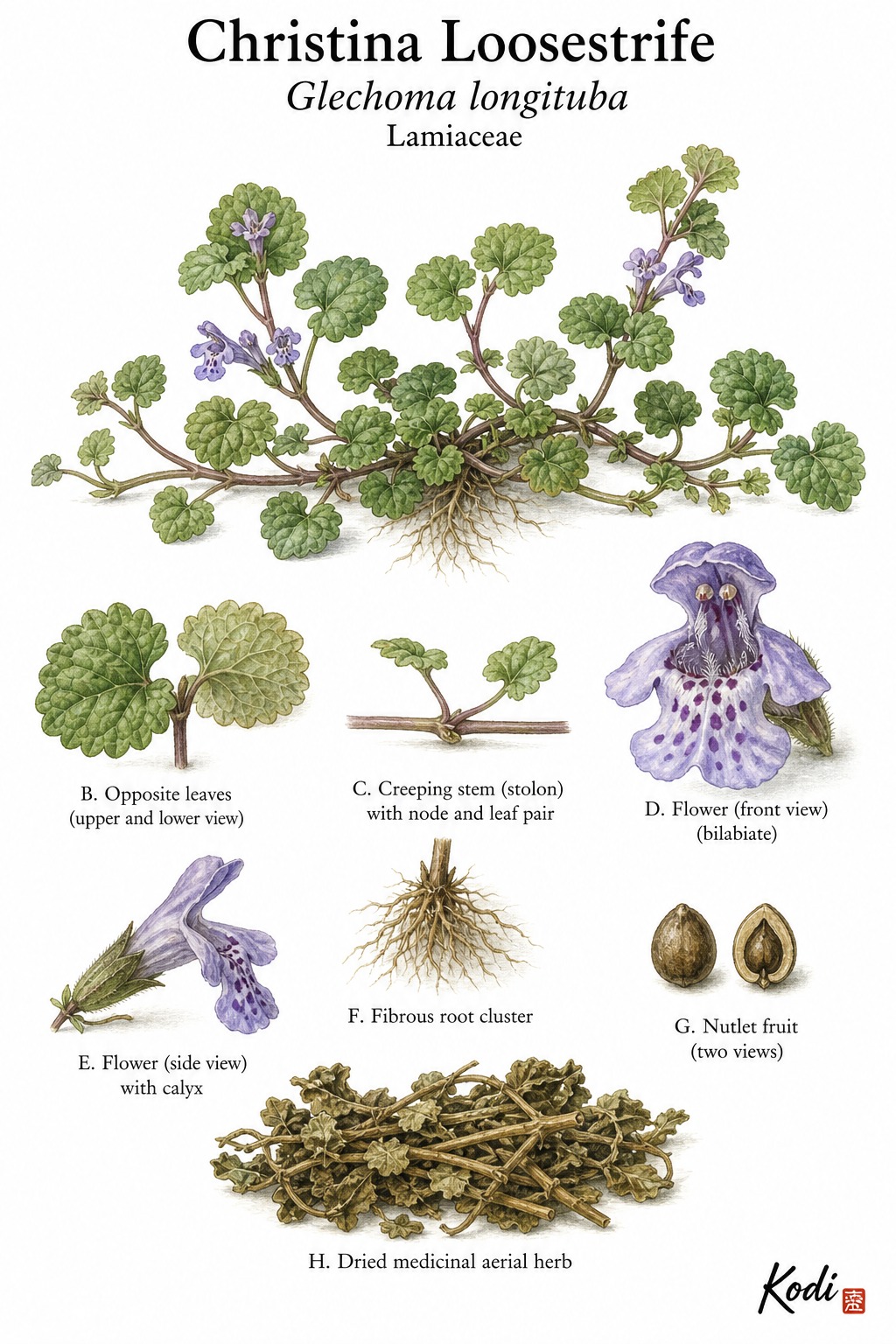
Known in TCM as Jin Qian Cao (金钱草), this acrid and bitter, slightly cold herb enters the Liver, Kidney, and Bladder. Traditionally, it promotes urination and treats strangury - this Jin Qian Cao variant is used for damp-heat urinary obstruction, heat strangury, and stone-type disorders with painful, difficult urination, most often applied for urolithiasis, urinary tract infection, and jaundice. Modern research has identified Quercetin among its active constituents.
Part used: Whole herb
Also Known As
Latin: Herba Glechomae Longitubae | Pinyin: Jin Qian Cao | Chinese: 金钱草
TCM Properties
- Taste
- acrid, bitter
- Temperature
- slightly cold
- Channels
- Liver, Kidney, Bladder
Traditional Use
Primary Actions
- Promotes urination and treats strangury - this Jin Qian Cao variant is used for damp-heat urinary obstruction, heat strangury, and stone-type disorders with painful, difficult urination.
- Clears heat and removes toxicity - traditional indications include boils, sores, damp-heat jaundice, and inflammatory lower-burner irritation.
- Eliminates stasis and resolves swelling - beyond urinary use, it is also applied to traumatic injury, bruising, and localized swelling when heat and stasis combine.
- Acts as a regional stone herb - in some herb lists and market traditions, Glechoma longituba functions as a Jin Qian Cao source herb for urolithiasis-style patterns, overlapping but not perfectly matching Lysimachia-based Gold Coin Grass.
Secondary Actions
- The naming around Jin Qian Cao is regionally variable: some pharmacopoeial and market traditions use the name for Lysimachia christinae, while others extend it to Glechoma longituba or related stone herbs.
- Because of that variability, this record is best read as a Glechoma-based Jin Qian Cao variant rather than assumed identical in all respects to Lysimachia christinae.
Classic Formulas
- Jin Qian Cao with Hai Jin Sha and Ji Nei Jin - classic stone-oriented pairing logic for urinary gravel, painful strangury, and recurrent urolithiasis.
- Jin Qian Cao with Yin Chen and Zhi Zi - damp-heat and jaundice strategy when biliary or hepatic heat accompanies yellowing and urinary discomfort.
- External Jin Qian Cao application with heat-toxin-clearing herbs - traditional use for boils, swellings, and traumatic injury with localized inflammation.
Classical References
- TCM Wiki's Lian Qian Cao entry for Herba Glechomae describes the herb as acrid, slightly bitter, and slightly cold, entering the Liver, Kidney, and Bladder channels, with actions of promoting diuresis, clearing heat and removing toxicity, and eliminating stasis and swelling.
- The same source lists indications including heat strangury, urolithiasis, jaundice due to damp-heat, traumatic injury, and sores or boils.
- Import and trade lists sometimes label Christina Loosestrife or Jin Qian Cao with the Latin Herba Glechomae Longitubae, illustrating a naming overlap that is real in catalog practice even when botanical identities differ by region.
Modern Research
Active Compounds
- Quercetin - a major flavonoid identified from Glechoma longituba
- Corosolic acid - a triterpenoid constituent reported from the plant
- Glecholone and ionol-type terpenoids - notable small molecules isolated in constituent studies
- Phenolic-acid-rich fraction - a bioactive antioxidant component characterized analytically
- Triterpenoid glycosides - newer constituents with cytotoxic and broader pharmacologic interest
Studied Effects
- Glechoma longituba extract demonstrated in-vitro and in-vivo antiurolithic activity, reducing calcium-oxalate-related injury, oxidative stress, and crystal deposition in experimental models (PMID 27840669).
- Constituent-isolation work from Glechoma longituba identified multiple flavonoids, triterpenoids, and related small molecules, helping define the plant's pharmacologically relevant chemistry (PMID 16848319).
- Analytical profiling quantified major bioactive phenolic compounds in Glechoma longituba, supporting its antioxidant and inflammation-related research potential (PMID 21366038).
- Recent phytochemical work continues to identify new terpenoid glycosides with in-vitro cytotoxicity, broadening modern interest in the herb beyond stone-related use (PMID 37963510).
PubMed References
- An Explanation of the Underlying Mechanisms for the In Vitro and In Vivo Antiurolithic Activity of Glechoma longituba (2016)
- Chemical constituents of Glechoma longituba (2006)
- Qualitative and quantitative analysis of the major bioactive phenolic compounds of Glechoma longituba by LC-coupled with PAD and ESI-MS detection (2011)
- Diverse terpenoid glycosides with in vitro cytotoxicity from Glechoma longituba (2024)
Safety & Interactions
Contraindications
- Marked deficiency-cold without damp-heat or stone patterns
- Excessive urination or fluid depletion
- Use without botanical verification when regional Jin Qian Cao identities are unclear
Cautions
- Regional naming variation is the main practical caution because different plants may all circulate under Jin Qian Cao-related names
- Stone-expelling use should not substitute for urgent care when there is fever, obstruction, uncontrollable pain, or declining kidney function
- Most modern evidence is preclinical and focused on antiurolithic mechanisms rather than large human trials
- MSK page not found - drug interaction data not available from Memorial Sloan Kettering integrative medicine database
Classic formulas that use Christina Loosestrife
Herbs are rarely taken alone in Chinese medicine. These formula pages show what this herb does inside a classic prescription and which pattern that prescription is chosen for.
Conditions
- Urolithiasis Research ★★★★☆ JSON
- Urinary Tract Infection Traditional ★★★☆☆ JSON
- Jaundice Traditional ★★☆☆☆ JSON
- Traumatic Injury Traditional ★★☆☆☆ JSON
Frequently Asked Questions
What is Christina Loosestrife used for?
Christina Loosestrife is traditionally used to Promotes urination and treats strangury - this Jin Qian Cao variant is used for damp-heat urinary obstruction, heat strangury, and stone-type disorders with painful, difficult urination., Clears heat and removes toxicity - traditional indications include boils, sores, damp-heat jaundice, and inflammatory lower-burner irritation., Eliminates stasis and resolves swelling - beyond urinary use, it is also applied to traumatic injury, bruising, and localized swelling when heat and stasis combine., Acts as a regional stone herb - in some herb lists and market traditions, Glechoma longituba functions as a Jin Qian Cao source herb for urolithiasis-style patterns, overlapping but not perfectly matching Lysimachia-based Gold Coin Grass.. Research has investigated its effects on: Glechoma longituba extract demonstrated in-vitro and in-vivo antiurolithic activity, reducing calcium-oxalate-related injury, oxidative stress, and crystal deposition in experimental models (PMID 27840669).; Constituent-isolation work from Glechoma longituba identified multiple flavonoids, triterpenoids, and related small molecules, helping define the plant's pharmacologically relevant chemistry (PMID 16848319)..
What are other names for Christina Loosestrife?
Christina Loosestrife is also known as Glechoma. In TCM: 金钱草 (Jin Qian Cao); Herba Glechomae Longitubae.
Is Christina Loosestrife safe during pregnancy?
The safety of Christina Loosestrife during pregnancy has not been established. Consult a qualified healthcare provider before use.
What are the contraindications for Christina Loosestrife?
Christina Loosestrife should not be used in: Marked deficiency-cold without damp-heat or stone patterns; Excessive urination or fluid depletion; Use without botanical verification when regional Jin Qian Cao identities are unclear. Consult a qualified healthcare provider before use.