Chlorogenic Acid
- Chinese
- 绿原酸
- Pinyin
- Lv Yuan Suan
- Latin
- Acidum Chlorogenicum
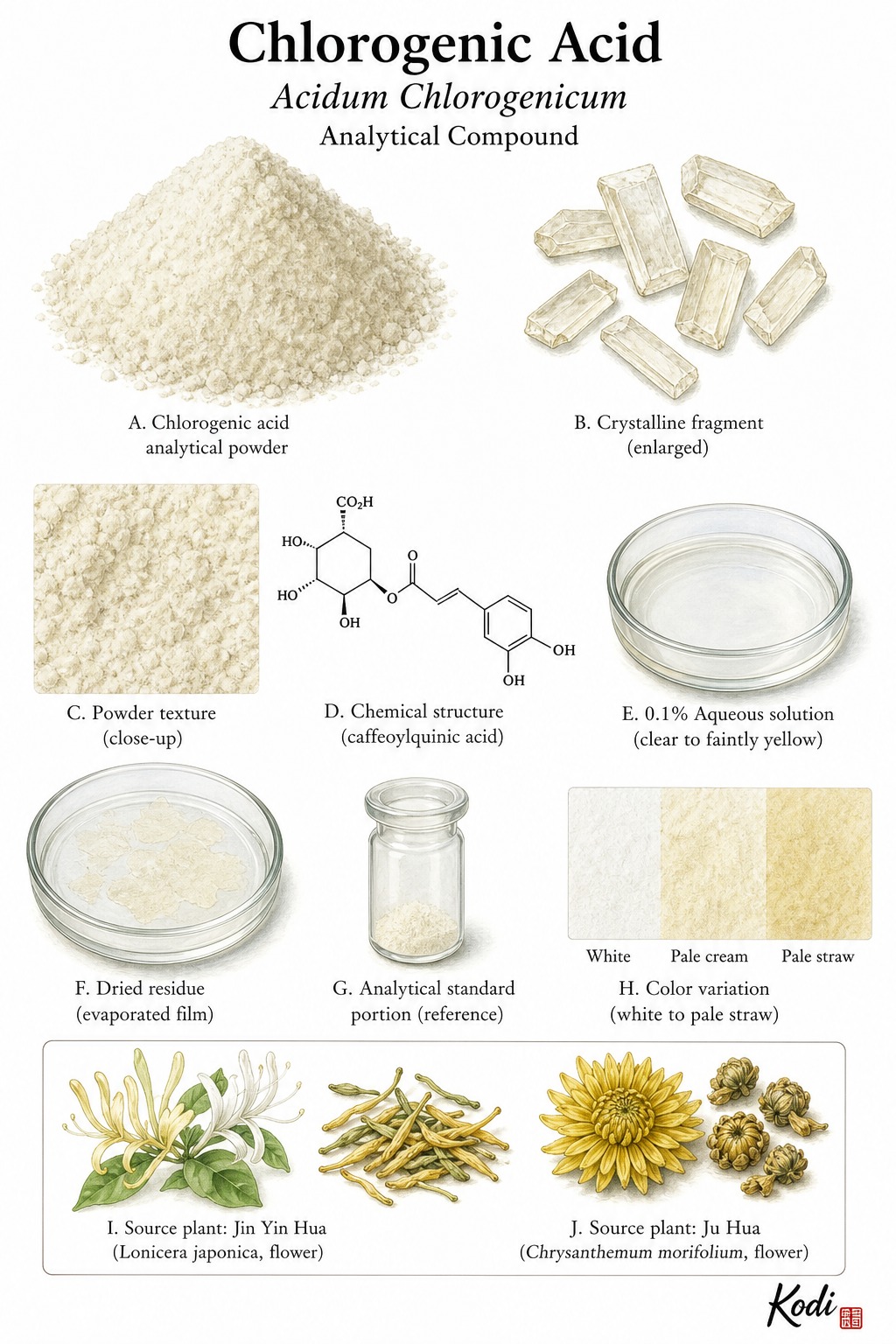
Known in TCM as Lv Yuan Suan (绿原酸). Traditionally, it import-variant compound record rather than a classical standalone herb - chlorogenic acid is a phenolic constituent found in many medicinal plants and foods, not an independent decoction herb in traditional materia medica, most often applied for hypertension, type 2 diabetes, and nafld. Modern research has identified Chlorogenic among its active constituents.
Part used: Acid
Also Known As
Latin: Acidum Chlorogenicum | Pinyin: Lv Yuan Suan | Chinese: 绿原酸
Traditional Use
Primary Actions
- Import-variant compound record rather than a classical standalone herb - chlorogenic acid is a phenolic constituent found in many medicinal plants and foods, not an independent decoction herb in traditional materia medica.
- Contextualizes heat-clearing and anti-inflammatory parent herbs - in TCM-related pharmacology, chlorogenic acid is often discussed as one molecular contributor to the effects of herbs such as Jin Yin Hua, Ju Hua, and other phenolic-rich medicinals.
- Bridges classical herb theory and modern mechanism research - its main practical role in this library is to explain antioxidant, anti-inflammatory, metabolic, and tissue-protective mechanisms within broader herb traditions.
- Functions as a modern analytical marker - chlorogenic acid is frequently used in quality control, phytochemical profiling, and mechanistic research rather than as a separately prescribed raw medicinal.
Secondary Actions
- Because chlorogenic acid occurs in many plants, its pharmacology should not be mistaken for the whole clinical identity of any one parent herb.
- Readers should interpret this file as a modern compound profile retained for catalog completeness, not as a direct replacement for classical herb-based pattern treatment.
Classic Formulas
- No standalone classical formulas - chlorogenic acid is discussed as a constituent inside herbs and formulas rather than as an independent traditional prescription ingredient.
Classical References
- IMPORT NOTE: The source XLSX imported this record as the isolated compound chlorogenic acid with the Latin Acidum Chlorogenicum and pinyin Lv Yuan Suan. This is not a canonical standalone Chinese materia-medica item.
- Modern Chinese herb research repeatedly identifies chlorogenic acid as a key constituent in multiple heat-clearing, detoxifying, and anti-inflammatory botanicals, which explains why it appears in compound-level import datasets.
- This file is therefore best read as a pharmacologic constituent note that complements, rather than replaces, the parent-herb records elsewhere in the library.
Modern Research
Active Compounds
- Chlorogenic acid (5-caffeoylquinic acid, 5-CQA) - the principal caffeoylquinic-acid isomer usually meant by the common name chlorogenic acid
- Neochlorogenic acid (3-CQA) - a closely related positional isomer often discussed alongside chlorogenic acid in phytochemical studies
- Cryptochlorogenic acid (4-CQA) - another common caffeoylquinic-acid isomer in plant extracts
- Caffeic acid - a major downstream hydrolysis and metabolism product relevant to biologic activity
- Quinic acid - the cyclitol backbone component of chlorogenic acid and its related esters
Studied Effects
- A 2023 review summarized chlorogenic acid's anti-inflammatory actions across NF-kappaB, MAPK, Nrf2, and related signaling systems, positioning it as a major mechanistic antioxidant and inflammation-modulating natural product (PMID 37781708).
- A broad pharmacology review described chlorogenic acid as hepatoprotective, cardioprotective, antihypertensive, antimicrobial, neuroprotective, and metabolically active, while also highlighting the need for more translational research (PMID 29080460).
- A focused review on chronic pain and inflammation detailed antinociceptive, antihyperalgesic, and anti-inflammatory effects relevant to both inflammatory and neuropathic pain models (PMID 31631820).
- Chlorogenic acid protected against indomethacin-related gut inflammation and mucosal damage in experimental work, reinforcing its gastrointestinal anti-inflammatory profile (PMID 32582202).
PubMed References
- Chlorogenic acid: a review on its mechanisms of anti-inflammation, disease treatment, and related delivery systems (2023)
- Chlorogenic acid (CGA): A pharmacological review and call for further research (2018)
- Pharmacologic Overview of Chlorogenic Acid and its Metabolites in Chronic Pain and Inflammation (2019)
- Chlorogenic Acid Protects Against Indomethacin-Induced Inflammation and Mucosa Damage by Decreasing Bacteroides-Derived LPS (2020)
Safety & Interactions
Cautions
- Most human exposure to chlorogenic acid comes from foods, beverages, or parent-herb extracts rather than from isolated purified dosing, so concentrated-supplement effects may differ from everyday intake
- Its blood-pressure-lowering and glucose-modulating effects are promising but also mean that concentrated use may not be neutral in patients already taking intensive cardiometabolic medications
- Low oral bioavailability is a persistent translational challenge, so strong in-vitro or animal findings do not automatically predict equivalent clinical benefit
- MSK page not found - drug interaction data not available from Memorial Sloan Kettering integrative medicine database
Drug Interactions
- Antihypertensive drugs … Chlorogenic acid shows blood-pressure-lowering activity in pharmacology literature and may theoretically add to antihypertensive effects at concentrated doses (Moderate) Source: Chlorogenic-acid pharmacology reviews
- Antidiabetic drugs … Glucose-modulating and AMPK-related effects may theoretically augment glycemic-lowering regimens when high-dose extracts are used (Moderate) Source: Chlorogenic-acid pharmacology reviews
Conditions
- Hypertension Research ★★☆☆☆ JSON
- Type 2 Diabetes Research ★★☆☆☆ JSON
- Nafld Preclinical ★★☆☆☆ JSON
- Cardiovascular Disease Preclinical ★★☆☆☆ JSON
Frequently Asked Questions
What is Chlorogenic Acid used for?
Chlorogenic Acid is traditionally used to Import-variant compound record rather than a classical standalone herb - chlorogenic acid is a phenolic constituent found in many medicinal plants and foods, not an independent decoction herb in traditional materia medica., Contextualizes heat-clearing and anti-inflammatory parent herbs - in TCM-related pharmacology, chlorogenic acid is often discussed as one molecular contributor to the effects of herbs such as Jin Yin Hua, Ju Hua, and other phenolic-rich medicinals., Bridges classical herb theory and modern mechanism research - its main practical role in this library is to explain antioxidant, anti-inflammatory, metabolic, and tissue-protective mechanisms within broader herb traditions., Functions as a modern analytical marker - chlorogenic acid is frequently used in quality control, phytochemical profiling, and mechanistic research rather than as a separately prescribed raw medicinal.. Research has investigated its effects on: A 2023 review summarized chlorogenic acid's anti-inflammatory actions across NF-kappaB, MAPK, Nrf2, and related signaling systems, positioning it as a major mechanistic antioxidant and inflammation-modulating natural product (PMID 37781708).; A broad pharmacology review described chlorogenic acid as hepatoprotective, cardioprotective, antihypertensive, antimicrobial, neuroprotective, and metabolically active, while also highlighting the need for more translational research (PMID 29080460)..
What are other names for Chlorogenic Acid?
Chlorogenic Acid is also known as Chlorogenicum. In TCM: 绿原酸 (Lv Yuan Suan); Acidum Chlorogenicum.
Is Chlorogenic Acid safe during pregnancy?
The safety of Chlorogenic Acid during pregnancy has not been established. Consult a qualified healthcare provider before use.
Does Chlorogenic Acid interact with any medications?
Chlorogenic Acid may interact with: Antihypertensive drugs - Chlorogenic acid shows blood-pressure-lowering activity in pharmacology literature and may theoretically add to antihypertensive effects at concentrated doses - (Moderate severity); Antidiabetic drugs - Glucose-modulating and AMPK-related effects may theoretically augment glycemic-lowering regimens when high-dose extracts are used - (Moderate severity). Always inform your healthcare provider of any herbal supplements you are taking.