Chlorite Schist
- Chinese
- 青礞石
- Pinyin
- Qing Meng Shi
- Latin
- Lapis Chloriti
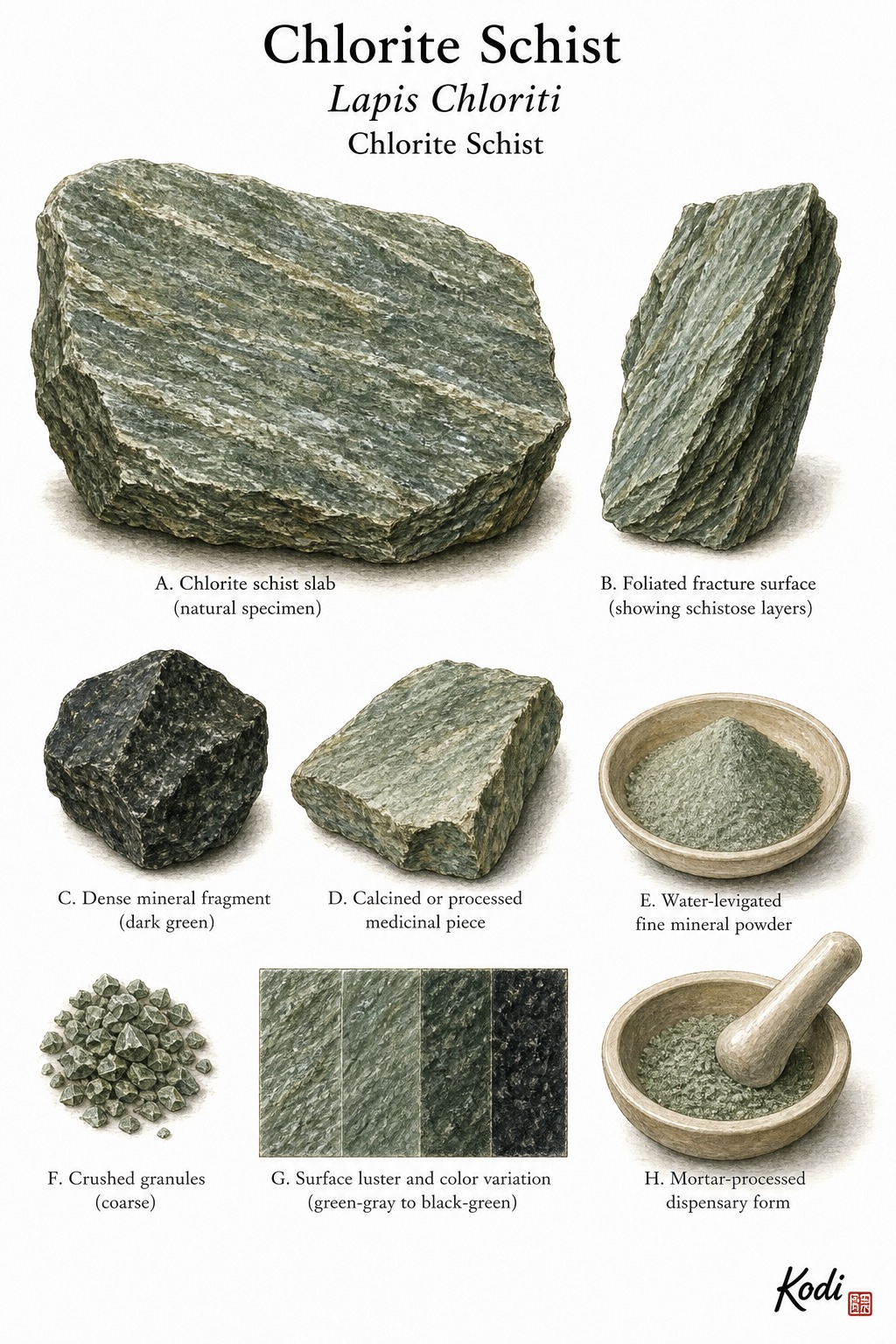
Known in TCM as Qing Meng Shi (青礞石), this sweet and salty, neutral herb enters the Lung, Liver, and Stomach. Traditionally, it heavily descends Qi and transforms stubborn phlegm - Qing Meng Shi is reserved for thick, old, clumped phlegm that ordinary phlegm-transforming herbs cannot easily clear, especially when coughing, wheezing, or chest oppression are severe, most often applied for phlegm accumulation, productive cough, and wheezing. Modern research has identified Chlorite-rich among its active constituents.
Part used: Mineral stone
Also Known As
Latin: Lapis Chloriti | Pinyin: Qing Meng Shi | Chinese: 青礞石
TCM Properties
- Taste
- sweet, salty
- Temperature
- neutral
- Channels
- Lung, Liver, Stomach
Traditional Use
Primary Actions
- Heavily descends Qi and transforms stubborn phlegm - Qing Meng Shi is reserved for thick, old, clumped phlegm that ordinary phlegm-transforming herbs cannot easily clear, especially when coughing, wheezing, or chest oppression are severe.
- Calms the Liver and stops convulsions - traditional indications include phlegm-heat with seizures, epilepsy, mania, or severe agitation when the orifices are obstructed and internal wind is stirred.
- Resolves food stagnation and masses - classical texts also connect the mineral with severe food accumulation, abdominal masses, and constipation when phlegm and stagnation obstruct the middle burner.
- Acts as a strong downward-driving mineral - its therapeutic identity depends on heaviness and sinking action, which is why it is usually processed and used for excess patterns only.
Secondary Actions
- Modern clinical practice distinguishes Qing Meng Shi from Jin Meng Shi, though both appear under the broader name Meng Shi in many references; Qing Meng Shi is the chlorite-schist form and the older classical standard.
- Because the raw mineral is harsh, internal use usually relies on processed or calcined material, often in pill or powder form rather than as a simple decoction.
Classic Formulas
- Gun Tan Wan (滚痰丸) - the archetypal phlegm-fire formula using Meng Shi to drive down severe old phlegm with constipation, mania, seizures, and chest obstruction.
- Ding Xian Wan (定痫丸) - seizure-oriented formula logic in which Qing Meng Shi helps drag obstructing phlegm downward while companion herbs settle wind and clear heat.
- Dao Tan Tang modifications - later practice adds Qing Meng Shi when ordinary phlegm-transforming herbs are insufficient for stubborn, deep-seated phlegm.
Classical References
- Me and Qi describes Qing Meng Shi as a mineral medicine used primarily for difficult, stubborn phlegm that ordinary remedies cannot clear, especially when thick phlegm causes hard-to-expectorate cough or contributes to convulsions and mental agitation.
- American Dragon lists Qing Meng Shi as sweet, salty, and neutral, entering the Liver, Lung, and Stomach channels, with actions of descending Qi, reducing phlegm, calming the Liver, and controlling convulsions.
- Classical and modern commentary alike stress that only the calcined or appropriately processed material should be used internally, and then only for acute excess conditions rather than deficiency states.
Modern Research
Active Compounds
- Chlorite-rich silicate mineral matrix - the defining mineral basis of Qing Meng Shi
- Magnesium-, iron-, and aluminum-bearing phyllosilicates - the major inorganic structural components of chlorite schist
- Associated mica and trace mineral fractions - secondary geological constituents that vary by source region
- Calcined mineral surface produced with xiao shi processing - the clinically relevant form used to modify harshness and enhance utility
- Water-levigated fine mineral powder - the standard final preparation form for internal dispensary use
Studied Effects
- Direct PubMed-indexed standalone pharmacology for Qing Meng Shi remains sparse; most modern literature focuses on botanical-style reviews of traditional indications, mineral identity, and processed dispensary practice rather than modern human efficacy trials.
- Current evidence for Qing Meng Shi therefore remains anchored more in long TCM formula history and mineral-processing practice than in conventional biomedical trial design.
- Its continued place in seizure and phlegm-fire formulas reflects strong traditional pattern logic, but modern mineral-medicine standardization is still far thinner than for common botanical herbs.
Safety & Interactions
Contraindications
- Pregnancy
- Qi or Blood deficiency
- Weak Spleen and Stomach digestion
- Dry phlegm or Yin-deficiency patterns
- Phlegm mixed with blood or significant hoarseness
Cautions
- Qing Meng Shi is a harsh, strongly descending mineral intended only for acute excess patterns with stubborn phlegm, not for chronic weak constitutions
- Internal use should rely on properly processed material because raw mineral is rougher, harder to digest, and less appropriate clinically
- Because it is heavy and draining, prolonged self-use can damage digestion and worsen fatigue or frailty
- MSK page not found - drug interaction data not available from Memorial Sloan Kettering integrative medicine database
Conditions
- Phlegm Accumulation Traditional ★★★★★ JSON
- Productive Cough Traditional ★★★★☆ JSON
- Wheezing Traditional ★★★☆☆ JSON
- Epilepsy Traditional ★★★☆☆ JSON
- Constipation Traditional ★★☆☆☆ JSON
Frequently Asked Questions
What is Chlorite Schist used for?
Chlorite Schist is traditionally used to Heavily descends Qi and transforms stubborn phlegm - Qing Meng Shi is reserved for thick, old, clumped phlegm that ordinary phlegm-transforming herbs cannot easily clear, especially when coughing, wheezing, or chest oppression are severe., Calms the Liver and stops convulsions - traditional indications include phlegm-heat with seizures, epilepsy, mania, or severe agitation when the orifices are obstructed and internal wind is stirred., Resolves food stagnation and masses - classical texts also connect the mineral with severe food accumulation, abdominal masses, and constipation when phlegm and stagnation obstruct the middle burner., Acts as a strong downward-driving mineral - its therapeutic identity depends on heaviness and sinking action, which is why it is usually processed and used for excess patterns only.. Research has investigated its effects on: Direct PubMed-indexed standalone pharmacology for Qing Meng Shi remains sparse; most modern literature focuses on botanical-style reviews of traditional indications, mineral identity, and processed dispensary practice rather than modern human efficacy trials.; Current evidence for Qing Meng Shi therefore remains anchored more in long TCM formula history and mineral-processing practice than in conventional biomedical trial design..
What are other names for Chlorite Schist?
Chlorite Schist is also known as Chloriti. In TCM: 青礞石 (Qing Meng Shi); Lapis Chloriti.
Is Chlorite Schist safe during pregnancy?
Chlorite Schist is not recommended during pregnancy.
What are the contraindications for Chlorite Schist?
Chlorite Schist should not be used in: Pregnancy; Qi or Blood deficiency; Weak Spleen and Stomach digestion; Dry phlegm or Yin-deficiency patterns; Phlegm mixed with blood or significant hoarseness. Consult a qualified healthcare provider before use.