Chinese Taxillus Herb
- Chinese
- 桑寄生
- Pinyin
- Sang Ji Sheng
- Latin
- Herba Taxilli
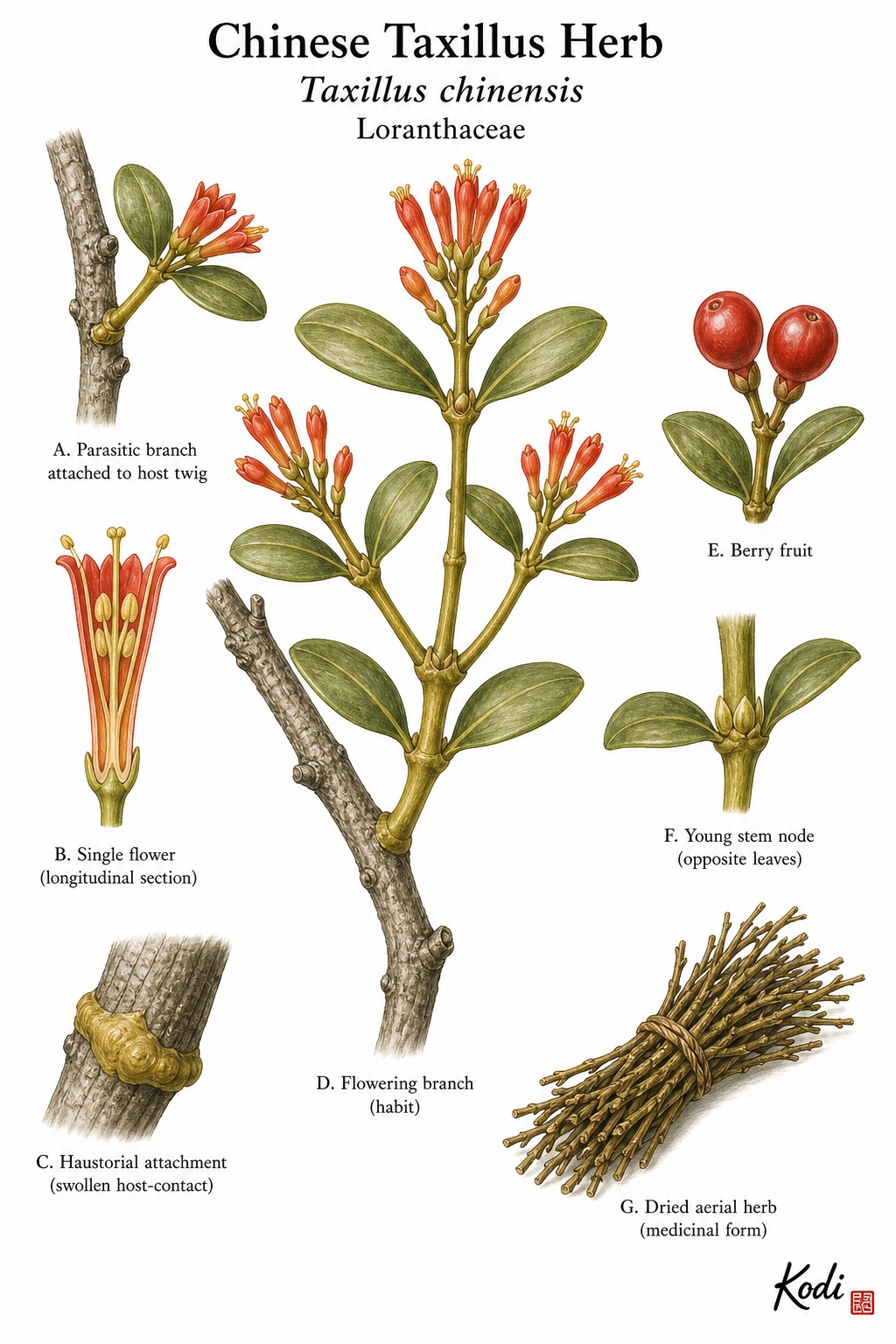
Known in TCM as Sang Ji Sheng (桑寄生), this bitter and sweet, neutral herb enters the Liver and Kidney. Traditionally, it dispels wind-damp and alleviates painful obstruction - Sang Ji Sheng is a classic herb for chronic bi syndrome affecting the joints, tendons, low back, and knees, especially when pain is paired with weakness rather than robust excess, most often applied for joint pain, low back pain, and threatened miscarriage. Modern research has identified Flavonoids among its active constituents.
Part used: Whole herb
Also Known As
Latin: Herba Taxilli | Pinyin: Sang Ji Sheng | Chinese: 桑寄生
TCM Properties
- Taste
- bitter, sweet
- Temperature
- neutral
- Channels
- Liver, Kidney
Traditional Use
Primary Actions
- Dispels wind-damp and alleviates painful obstruction - Sang Ji Sheng is a classic herb for chronic bi syndrome affecting the joints, tendons, low back, and knees, especially when pain is paired with weakness rather than robust excess.
- Tonifies the Liver and Kidneys - unlike many dispersing wind-damp herbs, it nourishes the deeper deficiency that underlies chronic weakness of sinews and bones, making it especially useful for older or debilitated patients.
- Strengthens sinews and bones - it is used for weak knees, low-back soreness, difficulty walking, and recovery states in which tendon-bone support is compromised.
- Calms the fetus and stops restless pregnancy - classical and modern TCM use includes threatened miscarriage, fetal restlessness, and pregnancy low-back pain when deficiency rather than acute heat-toxin is the main pattern.
Secondary Actions
- Sang Ji Sheng is prized because it can both dispel and nourish at the same time, so it often sits in formulas where deficiency and obstruction must be treated together rather than sequentially.
- The host tree matters in traditional quality discussions because parasitic growth on different trees may slightly shift the herb's chemistry and perceived medicinal strength.
Classic Formulas
- Du Huo Ji Sheng Tang (独活寄生汤) - the defining formula for chronic wind-cold-damp bi with Liver-Kidney deficiency, where Sang Ji Sheng helps nourish while obstruction is dispelled.
- Shou Tai Wan (寿胎丸) - traditional fetus-calming formula logic in which Sang Ji Sheng is paired with Tu Si Zi, Xu Duan, and E Jiao for threatened miscarriage and restless fetus due to deficiency.
- Tian Ma Gou Teng Yin (天麻钩藤饮) - later formula usage extends Sang Ji Sheng into hypertension-style patterns where Liver and Kidney deficiency coexists with rising Yang and internal wind.
Classical References
- TCM Wiki describes Sang Ji Sheng as bitter, sweet, and neutral, entering the Liver and Kidney channels, with actions of dispelling wind-damp, tonifying the Liver and Kidneys, strengthening sinews and bones, and calming the fetus.
- American Dragon emphasizes that it is one of the gentlest and most deficiency-supportive wind-damp herbs, especially appropriate for chronic low-back and knee weakness, arthritis, and pregnancy support.
- Traditional formula literature strongly anchors Sang Ji Sheng in chronic bi syndrome and fetus-calming use, which is why it appears in both Du Huo Ji Sheng Tang and Shou Tai Wan traditions.
Modern Research
Active Compounds
- Flavonoids including avicularin, quercetin derivatives, and catechin-type compounds - widely discussed bioactives in Taxillus chinensis research
- Phenolic acids such as chlorogenic and caffeic-acid-related constituents - antioxidant and anti-inflammatory components
- Tannins and proanthocyanidin-rich fractions - likely contributors to vascular and connective-tissue activity
- Polysaccharides - high-molecular-weight constituents with immunomodulatory potential
- Host-dependent metabolite profile - a meaningful variable in Sang Ji Sheng chemistry highlighted by modern reviews
Studied Effects
- A 2022 review summarized anti-inflammatory, antioxidant, antihypertensive, anti-osteoporotic, antiviral, and hepatoprotective findings for Taxillus chinensis while also stressing host-related variation in composition (PMID 36482376).
- Avicularin isolated from Taxillus chinensis inhibited fatty-acid synthase and suppressed human breast-cancer cell growth in preclinical work, illustrating one modern molecular direction for the herb's broader research profile (PMID 16570511).
- Compounds from Taxillus chinensis showed inhibitory activity against SARS-associated coronavirus in vitro, adding antiviral interest to the herb's modern pharmacology portfolio (PMID 24716104).
- Bone-related pharmacology studies continue to explore Sang Ji Sheng extracts for osteoblast support and anti-osteoporotic effects, which align well with the herb's long traditional association with sinews and bones.
PubMed References
- Taxillus chinensis: A review of traditional uses, botany, phytochemistry, pharmacology, and toxicology (2022)
- Avicularin, a plant flavonoid, inhibits fatty acid synthase and suppresses breast cancer cell growth (2006)
- Chemical constituents of Taxillus chinensis and their inhibitory activities against SARS-associated coronavirus (2014)
Safety & Interactions
Contraindications
- Acute exterior excess without underlying deficiency
- Damp-heat painful obstruction with marked heat signs unless combined appropriately
- Unsourced material of uncertain host origin
Cautions
- Sang Ji Sheng is generally gentler than many wind-damp herbs, but most modern pharmacology still comes from preclinical rather than human clinical studies
- Because composition can vary by host tree and processing, quality consistency may differ more than with nonparasitic herbs
- Its blood-pressure-lowering and diuretic tendencies are usually mild, but patients already on intensive cardiovascular regimens should still introduce it thoughtfully
- MSK page not found - drug interaction data not available from Memorial Sloan Kettering integrative medicine database
Classic formulas that use Chinese Taxillus Herb
Herbs are rarely taken alone in Chinese medicine. These formula pages show what this herb does inside a classic prescription and which pattern that prescription is chosen for.
Conditions
- Joint Pain Traditional ★★★★☆ JSON
- Low Back Pain Traditional ★★★★☆ JSON
- Threatened Miscarriage Traditional ★★★☆☆ JSON
- Rheumatism Traditional ★★★☆☆ JSON
- Hypertension Traditional ★★☆☆☆ JSON
Frequently Asked Questions
What is Chinese Taxillus Herb used for?
Chinese Taxillus Herb is traditionally used to Dispels wind-damp and alleviates painful obstruction - Sang Ji Sheng is a classic herb for chronic bi syndrome affecting the joints, tendons, low back, and knees, especially when pain is paired with weakness rather than robust excess., Tonifies the Liver and Kidneys - unlike many dispersing wind-damp herbs, it nourishes the deeper deficiency that underlies chronic weakness of sinews and bones, making it especially useful for older or debilitated patients., Strengthens sinews and bones - it is used for weak knees, low-back soreness, difficulty walking, and recovery states in which tendon-bone support is compromised., Calms the fetus and stops restless pregnancy - classical and modern TCM use includes threatened miscarriage, fetal restlessness, and pregnancy low-back pain when deficiency rather than acute heat-toxin is the main pattern.. Research has investigated its effects on: A 2022 review summarized anti-inflammatory, antioxidant, antihypertensive, anti-osteoporotic, antiviral, and hepatoprotective findings for Taxillus chinensis while also stressing host-related variation in composition (PMID 36482376).; Avicularin isolated from Taxillus chinensis inhibited fatty-acid synthase and suppressed human breast-cancer cell growth in preclinical work, illustrating one modern molecular direction for the herb's broader research profile (PMID 16570511)..
What are other names for Chinese Taxillus Herb?
Chinese Taxillus Herb is also known as Taxilli. In TCM: 桑寄生 (Sang Ji Sheng); Herba Taxilli.
Is Chinese Taxillus Herb safe during pregnancy?
The safety of Chinese Taxillus Herb during pregnancy has not been established. Consult a qualified healthcare provider before use.
What are the contraindications for Chinese Taxillus Herb?
Chinese Taxillus Herb should not be used in: Acute exterior excess without underlying deficiency; Damp-heat painful obstruction with marked heat signs unless combined appropriately; Unsourced material of uncertain host origin. Consult a qualified healthcare provider before use.