Chinese Star Anise
- Chinese
- 八角茴香
- Pinyin
- Ba Jiao Hui Xiang
- Latin
- Fructus Anisi Stellati
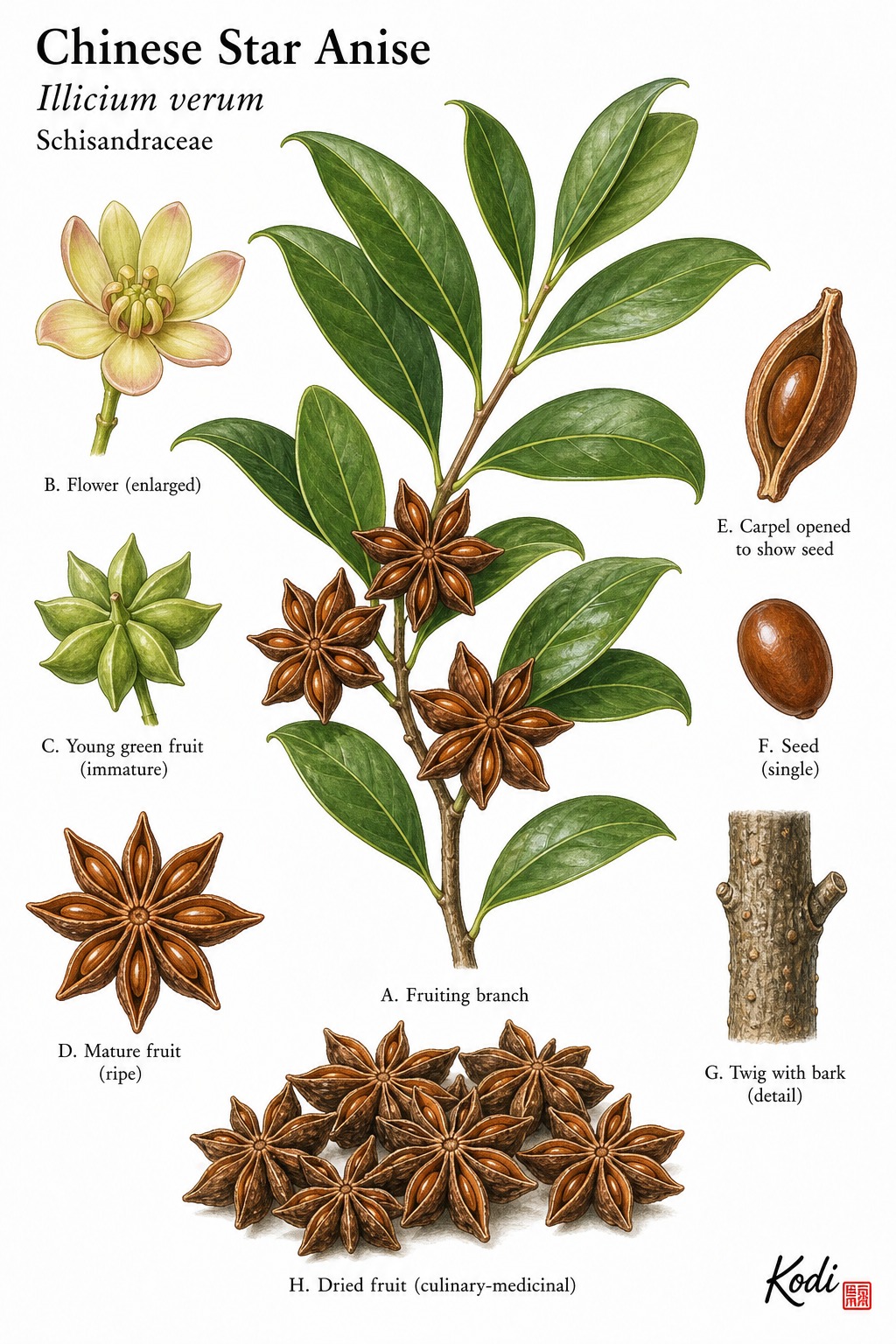
Known in TCM as Ba Jiao Hui Xiang (八角茴香), this acrid, warm herb enters the Liver, Kidney, Spleen, and Stomach. Traditionally, it warms the middle and disperses cold - Ba Jiao Hui Xiang is used for cold-type abdominal pain, epigastric fullness, poor appetite, and cramping when cold stagnation binds the middle burner, most often applied for abdominal pain, nausea, and low back pain. Modern research has identified Trans-anethole among its active constituents.
Part used: Fruit
Also Known As
Latin: Fructus Anisi Stellati | Pinyin: Ba Jiao Hui Xiang | Chinese: 八角茴香
TCM Properties
- Taste
- acrid
- Temperature
- warm
- Channels
- Liver, Kidney, Spleen, Stomach
Traditional Use
Primary Actions
- Warms the middle and disperses cold - Ba Jiao Hui Xiang is used for cold-type abdominal pain, epigastric fullness, poor appetite, and cramping when cold stagnation binds the middle burner.
- Moves Qi and alleviates pain - the aromatic, penetrating fruit helps disperse cold-constrained Qi in the chest, epigastrium, and lower abdomen, especially in hernia-like or colicky pain patterns.
- Warms the Kidneys and lower burner - traditional use extends to low-back pain, cold weakness of the waist, and cold accumulation affecting the lower abdomen or reproductive region.
- Redirects rebellious Stomach Qi - it is also used when vomiting or nausea arise from interior cold rather than heat, food stagnation, or damp-heat.
Secondary Actions
- Ba Jiao Hui Xiang is stronger, hotter, and more penetrating than Xiao Hui Xiang, so it is usually chosen when the cold nature of the pain is more pronounced.
- Because it is also a common culinary spice, the line between kitchen and clinic is closer here than with many TCM medicinals, but medicinal dosing still depends on pattern differentiation.
Classic Formulas
- Ba Jiao Hui Xiang with Wu Zhu Yu and Gan Jiang - warming-middle pairing logic for vomiting, epigastric cold pain, and nausea due to interior cold.
- Ba Jiao Hui Xiang with Chuan Lian Zi or Xiao Hui Xiang - lower-abdominal cold-stagnation strategy for hernia pain, cramping, and cold-type abdominal constriction.
- San Ceng Hui Xiang Wan - classical layered-fennel formula logic in which star-anise-type aromatic warmth helps address lower-abdominal cold, pain, and constrained Qi movement.
Classical References
- TCM Wiki lists Ba Jiao Hui Xiang as acrid and warm, entering the Liver, Kidney, Spleen, and Stomach channels, with actions of dispelling cold, regulating Qi, and relieving pain.
- American Dragon emphasizes use for cold-type abdominal pain, vomiting, and low-back or lower-abdominal pain associated with interior cold and constrained movement.
- Traditional comparison notes consistently place Ba Jiao Hui Xiang as the stronger, hotter relative of fennel-type medicinals, especially when more forceful cold-dispelling is needed.
Modern Research
Active Compounds
- Trans-anethole - the dominant aromatic constituent of Illicium verum essential oil and the main driver of many antimicrobial and spasmolytic discussions
- Shikimic acid - a widely recognized metabolite associated with the fruit's pharmaceutical relevance and quality identity
- Estragole and anisaldehyde - supporting volatile constituents contributing to fragrance and bioactivity
- Flavonoids including quercetin, kaempferol, and luteolin derivatives - nonvolatile phenolics described in modern phytochemical profiling
- Essential-oil terpene mixture - a clinically important composite fraction rather than a single isolated molecule
Studied Effects
- A comprehensive review summarized antimicrobial, antifungal, antioxidant, anti-inflammatory, and spasmolytic effects of Illicium verum while identifying trans-anethole as the major active constituent (PMID 31997473).
- Star anise essential oil showed strong inhibitory activity against a broad panel of bacteria and fungi, supporting traditional aromatic anti-infective interpretations even though this does not substitute for clinical evidence (PMID 20828316).
- A quality and safety review highlighted the need to distinguish genuine Chinese star anise from toxic Japanese star anise, which contains anisatin-type neurotoxins and is a major real-world adulteration concern (PMID 22484123).
- Recent metabolomic and pharmacognostic work continues to confirm that volatile-oil composition and phenolic profile vary by origin and processing, which matters for both culinary quality and medicinal consistency.
PubMed References
- A review on chemical constituents and pharmacological activities of Illicium verum Hook.fruits (2020)
- Chemical composition and antifungal, anti-inflammatory, anticholinesterase, and antioxidant activities of star anise oil from Illicium verum (2010)
- Quality evaluation and safety assessment of Illicium verum and related Illicium species (2012)
Safety & Interactions
Contraindications
- Yin deficiency with heat signs
- Interior heat, fire, or true hot vomiting
- Marked dryness without cold stagnation
Cautions
- The most important safety concern is adulteration or substitution with Japanese star anise and other Illicium species, which can be neurotoxic
- Concentrated essential-oil products are much stronger than culinary use and are not appropriate for infants or unsupervised high-dose use
- Its warm, acrid nature can aggravate reflux, dryness, or heat symptoms if used in the wrong pattern
- MSK page not found - drug interaction data not available from Memorial Sloan Kettering integrative medicine database
Conditions
- Abdominal Pain Traditional ★★★★☆ JSON
- Nausea Traditional ★★☆☆☆ JSON
- Low Back Pain Traditional ★★☆☆☆ JSON
- Kidney Yang Deficiency Traditional ★★☆☆☆ JSON
Frequently Asked Questions
What is Chinese Star Anise used for?
Chinese Star Anise is traditionally used to Warms the middle and disperses cold - Ba Jiao Hui Xiang is used for cold-type abdominal pain, epigastric fullness, poor appetite, and cramping when cold stagnation binds the middle burner., Moves Qi and alleviates pain - the aromatic, penetrating fruit helps disperse cold-constrained Qi in the chest, epigastrium, and lower abdomen, especially in hernia-like or colicky pain patterns., Warms the Kidneys and lower burner - traditional use extends to low-back pain, cold weakness of the waist, and cold accumulation affecting the lower abdomen or reproductive region., Redirects rebellious Stomach Qi - it is also used when vomiting or nausea arise from interior cold rather than heat, food stagnation, or damp-heat.. Research has investigated its effects on: A comprehensive review summarized antimicrobial, antifungal, antioxidant, anti-inflammatory, and spasmolytic effects of Illicium verum while identifying trans-anethole as the major active constituent (PMID 31997473).; Star anise essential oil showed strong inhibitory activity against a broad panel of bacteria and fungi, supporting traditional aromatic anti-infective interpretations even though this does not substitute for clinical evidence (PMID 20828316)..
What are other names for Chinese Star Anise?
Chinese Star Anise is also known as Anisi. In TCM: 八角茴香 (Ba Jiao Hui Xiang); Fructus Anisi Stellati.
Is Chinese Star Anise safe during pregnancy?
The safety of Chinese Star Anise during pregnancy has not been established. Consult a qualified healthcare provider before use.
What are the contraindications for Chinese Star Anise?
Chinese Star Anise should not be used in: Yin deficiency with heat signs; Interior heat, fire, or true hot vomiting; Marked dryness without cold stagnation. Consult a qualified healthcare provider before use.