Chinese Silkvine Root-Bark
- Chinese
- 香加皮
- Pinyin
- Xiang Jia Pi
- Latin
- Cortex Periplocae
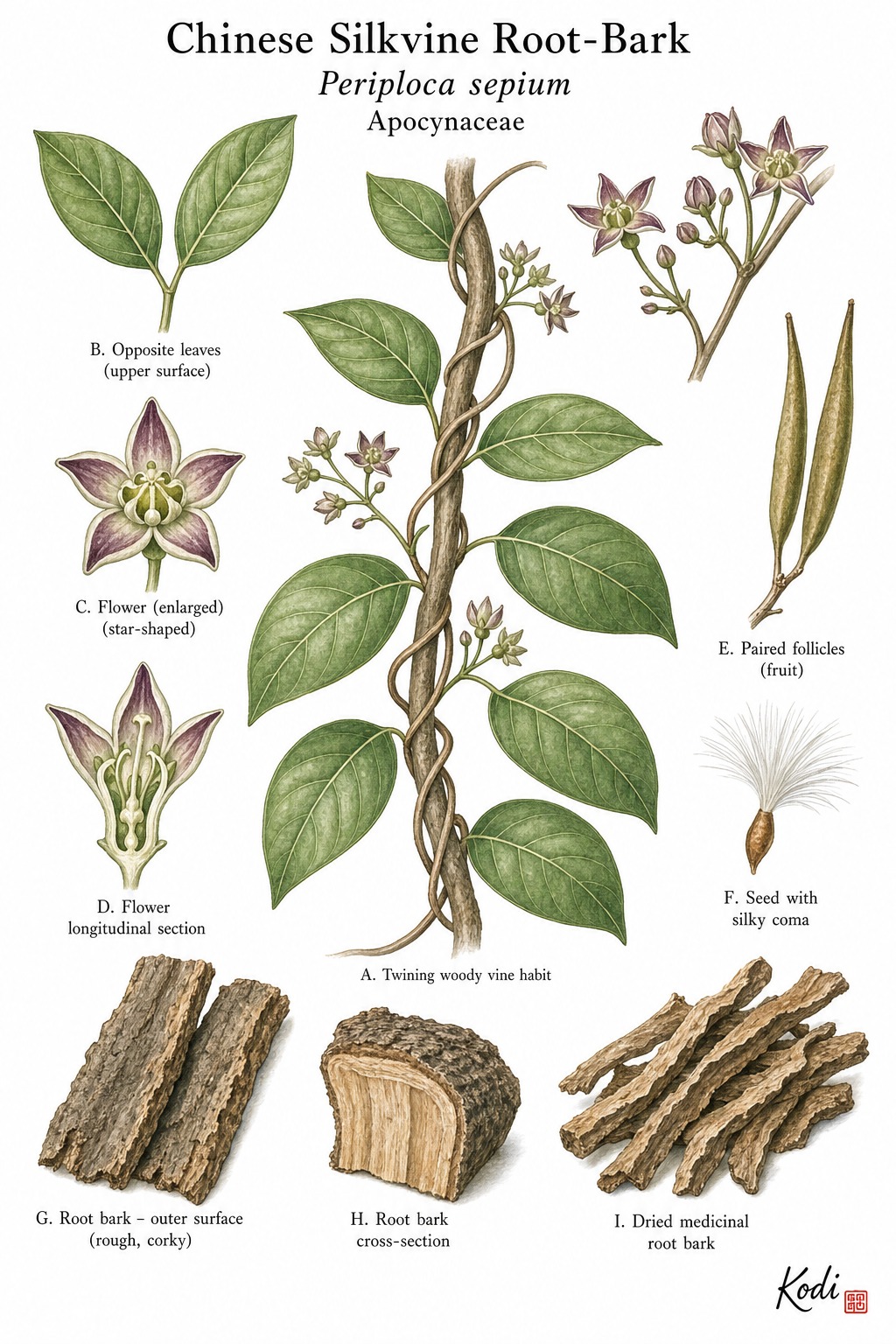
Known in TCM as Xiang Jia Pi (香加皮), this acrid and bitter, warm herb enters the Liver, Kidney, and Heart. Traditionally, it dispels wind-damp and unblocks painful obstruction - Xiang Jia Pi is used for chronic bi syndrome with cold, damp, weakness, and fixed pain affecting the low back, knees, ankles, and lower limbs, most often applied for rheumatism, joint pain, and edema. Modern research has identified Periplocin among its active constituents.
Part used: Bark
Also Known As
Latin: Cortex Periplocae | Pinyin: Xiang Jia Pi | Chinese: 香加皮
TCM Properties
- Taste
- acrid, bitter
- Temperature
- warm
- Channels
- Liver, Kidney, Heart
Traditional Use
Primary Actions
- Dispels wind-damp and unblocks painful obstruction - Xiang Jia Pi is used for chronic bi syndrome with cold, damp, weakness, and fixed pain affecting the low back, knees, ankles, and lower limbs.
- Strengthens sinews and bones - in small, carefully controlled doses it is directed to weakness of the tendons and bones, difficulty walking, and chronic lower-body debility with cold-damp obstruction.
- Promotes urination and reduces edema - traditional use extends to superficial swelling, lower-body edema, and fullness where damp accumulation coexists with cold and weakness.
- Warms the channels but requires caution - unlike the gentler Acanthopanax form of Wu Jia Pi, Xiang Jia Pi is a much stronger and more toxic substitute, so its traditional role is narrower and more specialist.
Secondary Actions
- Modern dispensing practice treats exact botanical identification as essential because Xiang Jia Pi from Periploca is not interchangeable with the safer Cortex Acanthopanacis that is sometimes marketed under similar Wu Jia Pi names.
- Traditional use is therefore usually dose-conscious and pattern-specific, favoring short, supervised courses for cold-damp painful obstruction rather than casual tonic use.
Classic Formulas
- Xiang Jia Pi with Du Zhong, Niu Xi, and Ba Ji Tian - warming, sinew-strengthening pairing logic for chronic low-back and knee pain with weakness and cold-damp obstruction.
- Xiang Jia Pi with Fu Ling Pi, Da Fu Pi, and Sheng Jiang Pi - edema-focused pairing strategy when swelling and dampness accumulate in the lower body.
- Xiang Jia Pi medicinal wine use - traditional external or internal wine preparations employ the bark in very small amounts for cold-damp bi and weakness of the legs.
Classical References
- TCM Wiki describes Xiang Jia Pi as acrid, bitter, and warm, entering the Liver, Kidney, and Heart channels, with actions of dispelling wind-damp, strengthening sinews and bones, and inducing diuresis for edema.
- American Dragon likewise emphasizes its use for painful obstruction, weakness of the tendons and bones, and edema, but notes that its toxicity makes it less commonly used than safer wind-damp herbs.
- Later clinical and trade notes repeatedly warn against confusing Xiang Jia Pi from Periploca with the gentler Acanthopanax form of Wu Jia Pi, because the therapeutic tone and safety profile are not the same.
Modern Research
Active Compounds
- Periplocin (cardenolide glycoside) - the signature cardiotonic but potentially cardiotoxic constituent most responsible for Xiang Jia Pi's modern safety concern
- Periplogenin (cardenolide aglycone) - a related steroidal constituent contributing to bioactivity and toxicity interpretation
- Periplocymarin and related cardiac glycosides - transporter-interacting cardenolides important to pharmacokinetic and safety discussions
- Periplocosides and pregnane glycosides - additional glycosidic constituents investigated for anti-inflammatory and immunomodulatory effects
- Caffeoylquinic-acid-type phenolics - noncardenolide constituents that broaden the plant's phytochemical profile
Studied Effects
- Periploca sepium glycosides inhibited inflammatory cytokine production and downregulated matrix metalloproteinases in rheumatoid-arthritis fibroblast-like synoviocytes, supporting the herb's long traditional use in painful obstruction patterns (PMID 15467222).
- Periplocin enhanced TRAIL-mediated apoptosis in human hepatocellular-carcinoma cells, illustrating an anticancer research direction that remains preclinical and far removed from routine TCM use (PMID 23365613).
- A transport study showed that Periplocae Cortex extracts and major cardenolides interact with OATP and P-glycoprotein systems, giving a mechanistic basis for clinically relevant drug-interaction concerns (PMID 24872678).
- A recent review of Periploca for rheumatoid arthritis summarized anti-inflammatory, immunoregulatory, and macrophage-polarization effects while underscoring that toxicity remains a major translational barrier (PMID 39727971).
PubMed References
- Effects of Periploca sepium Bunge on IL-6, MMP-1 and MMP-3 production in fibroblast-like synoviocytes from patients with rheumatoid arthritis (2004)
- Periplocin sensitizes TRAIL-induced apoptosis via activation of ERK1/2 in human hepatocellular carcinoma cells (2013)
- Impact of transporter interactions on the intestinal absorption of periplocin, the major cardiac glycoside from Periplocae Cortex (2014)
- Periploca for rheumatoid arthritis: progress and future directions (2024)
Safety & Interactions
Contraindications
- Pregnancy
- Known heart disease or unexplained palpitations
- Yin deficiency or heat signs without cold-damp obstruction
- Unverified source material
Cautions
- Xiang Jia Pi contains potent cardiac glycosides and is substantially more toxic than the safer Acanthopanax form of Wu Jia Pi, so substitute confusion is a major safety risk
- Overdose or cumulative exposure can produce nausea, vomiting, dizziness, arrhythmia, and other digitalis-like toxicity
- Because of transporter-mediated pharmacokinetic effects and cardiotonic constituents, concurrent use with narrow-therapeutic-index cardiovascular drugs deserves particular caution
- MSK page not found - drug interaction data not available from Memorial Sloan Kettering integrative medicine database
Drug Interactions
- Digoxin and other cardiac glycosides … Additive cardiotonic and arrhythmogenic effects are plausible because Xiang Jia Pi itself contains active cardenolides (Major) Source: Periplocae Cortex pharmacology and toxicity literature
- P-glycoprotein and OATP substrate drugs … Periplocin and related constituents interact with intestinal and hepatic transporters and may alter drug exposure (Moderate) Source: PMID 24872678
Conditions
- Rheumatism Traditional ★★★★☆ JSON
- Joint Pain Traditional ★★★★☆ JSON
- Edema Traditional ★★★☆☆ JSON
- Low Back Pain Traditional ★★☆☆☆ JSON
Frequently Asked Questions
What is Chinese Silkvine Root-Bark used for?
Chinese Silkvine Root-Bark is traditionally used to Dispels wind-damp and unblocks painful obstruction - Xiang Jia Pi is used for chronic bi syndrome with cold, damp, weakness, and fixed pain affecting the low back, knees, ankles, and lower limbs., Strengthens sinews and bones - in small, carefully controlled doses it is directed to weakness of the tendons and bones, difficulty walking, and chronic lower-body debility with cold-damp obstruction., Promotes urination and reduces edema - traditional use extends to superficial swelling, lower-body edema, and fullness where damp accumulation coexists with cold and weakness., Warms the channels but requires caution - unlike the gentler Acanthopanax form of Wu Jia Pi, Xiang Jia Pi is a much stronger and more toxic substitute, so its traditional role is narrower and more specialist.. Research has investigated its effects on: Periploca sepium glycosides inhibited inflammatory cytokine production and downregulated matrix metalloproteinases in rheumatoid-arthritis fibroblast-like synoviocytes, supporting the herb's long traditional use in painful obstruction patterns (PMID 15467222).; Periplocin enhanced TRAIL-mediated apoptosis in human hepatocellular-carcinoma cells, illustrating an anticancer research direction that remains preclinical and far removed from routine TCM use (PMID 23365613)..
What are other names for Chinese Silkvine Root-Bark?
Chinese Silkvine Root-Bark is also known as Periploca. In TCM: 香加皮 (Xiang Jia Pi); Cortex Periplocae.
Is Chinese Silkvine Root-Bark safe during pregnancy?
Chinese Silkvine Root-Bark is not recommended during pregnancy.
What are the contraindications for Chinese Silkvine Root-Bark?
Chinese Silkvine Root-Bark should not be used in: Pregnancy; Known heart disease or unexplained palpitations; Yin deficiency or heat signs without cold-damp obstruction; Unverified source material. Consult a qualified healthcare provider before use.
Does Chinese Silkvine Root-Bark interact with any medications?
Chinese Silkvine Root-Bark may interact with: Digoxin and other cardiac glycosides - Additive cardiotonic and arrhythmogenic effects are plausible because Xiang Jia Pi itself contains active cardenolides - (Major severity); P-glycoprotein and OATP substrate drugs - Periplocin and related constituents interact with intestinal and hepatic transporters and may alter drug exposure - (Moderate severity). Always inform your healthcare provider of any herbal supplements you are taking.