Chinese Silkvine Root-Bark
- Chinese
- 北五加皮
- Pinyin
- Bei Wu Jia Pi
- Latin
- Cortex Acanthopanacis Radicis
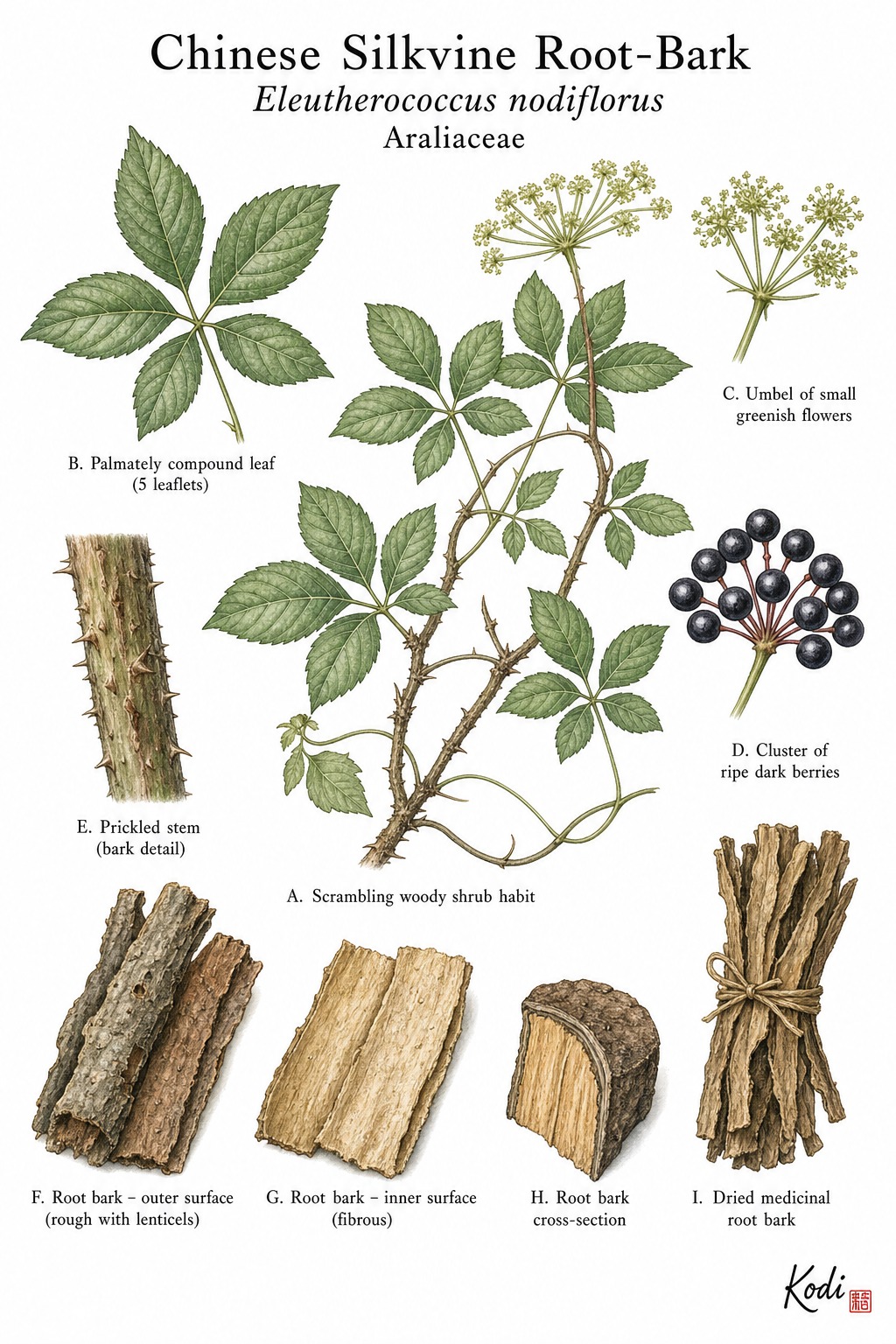
Known in TCM as Bei Wu Jia Pi (北五加皮), this bitter and acrid and sweet, warm herb enters the Liver and Kidney. Traditionally, it dispels wind-damp and alleviates painful obstruction - Bei Wu Jia Pi is used for chronic wind-cold-damp bi, painful joints, stiffness, weakness of the lower limbs, and impaired flexion or extension, especially when older or constitutionally weak patients are involved, most often applied for rheumatism, joint pain, and low back pain. Modern research has identified Kaurenoic among its active constituents.
Part used: Bark
Also Known As
Latin: Cortex Acanthopanacis Radicis | Pinyin: Bei Wu Jia Pi | Chinese: 北五加皮
TCM Properties
- Taste
- bitter, acrid, sweet
- Temperature
- warm
- Channels
- Liver, Kidney
Traditional Use
Primary Actions
- Dispels wind-damp and alleviates painful obstruction - Bei Wu Jia Pi is used for chronic wind-cold-damp bi, painful joints, stiffness, weakness of the lower limbs, and impaired flexion or extension, especially when older or constitutionally weak patients are involved.
- Tonifies the Liver and Kidneys and strengthens sinews and bones - the bark is classically chosen when chronic bi disease coexists with low back soreness, weak knees, delayed walking, or soft tendons and bones rather than an isolated acute excess pattern.
- Promotes urination and reduces edema - beyond musculoskeletal use, it appears in lower-body edema or damp leg-qi patterns in which warming, movement, and gentle drainage are all appropriate.
- Supports recovery after long-standing weakness or trauma - traditional notes also describe use in medicinal wines and combined formulas for fractures, chronic weakness, and poor lower-body mobility.
Secondary Actions
- Wu Jia Pi is considered especially suitable when deficiency and obstruction coexist, which is why it is repeatedly described as a good herb for old, weak, or chronically ill patients rather than only for robust excess cases.
- The naming around Bei Wu Jia Pi is clinically important: some regional and regulatory traditions apply the name to genuine Acanthopanacis Cortex, while many contemporary herb markets reserve Bei Wu Jia Pi or Xiang Jia Pi for the toxic Periplocae Cortex, so authentication is essential.
Classic Formulas
- Wu Jia Pi wine - classic medicinal-wine strategy recorded for chronic wind-damp pain, difficulty walking, low back weakness, and convalescent strengthening of sinews and bones.
- Wu Jia Pi San - classical pairing with Du Zhong, Niu Xi, and related tonics for Liver-Kidney deficiency with weakness of the feet, waist pain, and poor tendon-bone support.
- Wu Pi San - edema-focused formula logic in which Wu Jia Pi joins other peels and damp-draining medicinals to promote urination and reduce swelling.
Classical References
- TCM Wiki describes Cortex Acanthopanacis as pungent, bitter, and sweet, warm in nature, entering the Liver and Kidney channels, and acting to dispel wind-damp, tonify Liver and Kidney, strengthen tendons and bones, and induce diuresis.
- American Dragon emphasizes its value for chronic wind-cold-damp bi with underlying Liver-Kidney deficiency, low back and leg weakness, restricted joint movement, and mild superficial edema.
- Later trade and pharmacopeial notes warn that naming around Bei Wu Jia Pi can be inconsistent across regions, so the clinical task is to confirm genuine Acanthopanax gracilistylus root bark and not confuse it with toxic Xiang Jia Pi from Periploca.
Modern Research
Active Compounds
- Kaurenoic acid and related kaurenoic acid isomers - major diterpenoid markers identified as important active substances in the root bark
- Ent-kaurane and pimarane diterpenoids - anti-inflammatory diterpenoid classes isolated directly from Acanthopanax gracilistylus root bark
- Gracilistones A and B - sesquiterpenoid constituents associated with nitric-oxide-suppressing activity in inflammatory models
- Root-bark monoterpenoids - a newer constituent class shown to inhibit neutrophil elastase, 5-lipoxygenase, and cyclooxygenase-2 in vitro
- Acanthopanax gracilistylus saponins - preclinical constituents associated with antiplatelet and antithrombotic effects
Studied Effects
- A 2014 natural-products study isolated anti-inflammatory diterpenoids from the root bark of Acanthopanax gracilistylus and showed inhibition of key inflammatory cytokine release, supporting the bark's traditional use in painful obstruction and chronic inflammatory patterns (PMID 25338180).
- A 2023 study isolated 24 monoterpenoids from the root bark and found inhibitory effects on neutrophil elastase, 5-lipoxygenase, and cyclooxygenase-2 in vitro, offering a modern biochemical correlate for its wind-damp pain applications (PMID 37683990).
- Acanthopanax gracilistylus saponins inhibited human platelet aggregation, platelet-factor-4 liberation, and in-vitro thrombosis formation, suggesting circulation-related activity that may partly intersect with some traditional movement and obstruction indications (PMID 9863147).
- A 2024 transcriptome study identified kaurenoic acid as a main effective substance of Acanthopanax gracilistylus root bark and mapped key biosynthetic genes, reinforcing the herb's diterpenoid-centered pharmacology (PMID 38633273).
PubMed References
- Anti-inflammatory diterpenoids from the root bark of Acanthopanax gracilistylus (2014)
- Monoterpenoids from the root bark of Acanthopanax gracilistylus and their inhibitory effects on neutrophil elastase, 5-lipoxygenase, and cyclooxygenase-2 in vitro (2023)
- Inhibitory effects of Acanthopanax gracilistylus saponins on human platelet aggregation and platelet factor 4 liberation in vitro (1996)
- Full-length transcriptome profiling of Acanthopanax gracilistylus provides new insight into the kaurenoic acid biosynthesis pathway (2024)
Safety & Interactions
Contraindications
- Pregnancy
- Yin deficiency with heat or deficiency-fire signs
- Cases without wind-cold-damp or lower-body deficiency in which warming and drying would be mismatched
- Unverified source material
Cautions
- The most important safety issue is botanical confusion: many markets use Bei Wu Jia Pi or Xiang Jia Pi for Periplocae Cortex, which contains cardiotoxic glycosides and is not interchangeable with genuine Acanthopanacis Cortex
- Preclinical antiplatelet activity suggests extra caution before surgery or with anticoagulant and antiplatelet drugs, even though well-defined human interaction data for genuine Acanthopanacis Cortex are limited
- Its warm and drying nature can aggravate heat signs, dryness, or depletion if used chronically in patients without a true cold-damp and deficiency pattern
- MSK page not found - drug interaction data not available from Memorial Sloan Kettering integrative medicine database
Conditions
- Rheumatism Traditional ★★★★☆ JSON
- Joint Pain Traditional ★★★★☆ JSON
- Low Back Pain Traditional ★★★☆☆ JSON
- Edema Traditional ★★★☆☆ JSON
- Kidney Yang Deficiency Traditional ★★☆☆☆ JSON
Frequently Asked Questions
What is Chinese Silkvine Root-Bark used for?
Chinese Silkvine Root-Bark is traditionally used to Dispels wind-damp and alleviates painful obstruction - Bei Wu Jia Pi is used for chronic wind-cold-damp bi, painful joints, stiffness, weakness of the lower limbs, and impaired flexion or extension, especially when older or constitutionally weak patients are involved., Tonifies the Liver and Kidneys and strengthens sinews and bones - the bark is classically chosen when chronic bi disease coexists with low back soreness, weak knees, delayed walking, or soft tendons and bones rather than an isolated acute excess pattern., Promotes urination and reduces edema - beyond musculoskeletal use, it appears in lower-body edema or damp leg-qi patterns in which warming, movement, and gentle drainage are all appropriate., Supports recovery after long-standing weakness or trauma - traditional notes also describe use in medicinal wines and combined formulas for fractures, chronic weakness, and poor lower-body mobility.. Research has investigated its effects on: A 2014 natural-products study isolated anti-inflammatory diterpenoids from the root bark of Acanthopanax gracilistylus and showed inhibition of key inflammatory cytokine release, supporting the bark's traditional use in painful obstruction and chronic inflammatory patterns (PMID 25338180).; A 2023 study isolated 24 monoterpenoids from the root bark and found inhibitory effects on neutrophil elastase, 5-lipoxygenase, and cyclooxygenase-2 in vitro, offering a modern biochemical correlate for its wind-damp pain applications (PMID 37683990)..
What are other names for Chinese Silkvine Root-Bark?
Chinese Silkvine Root-Bark is also known as Acanthopanacis. In TCM: 北五加皮 (Bei Wu Jia Pi); Cortex Acanthopanacis Radicis.
Is Chinese Silkvine Root-Bark safe during pregnancy?
Chinese Silkvine Root-Bark is not recommended during pregnancy.
What are the contraindications for Chinese Silkvine Root-Bark?
Chinese Silkvine Root-Bark should not be used in: Pregnancy; Yin deficiency with heat or deficiency-fire signs; Cases without wind-cold-damp or lower-body deficiency in which warming and drying would be mismatched; Unverified source material. Consult a qualified healthcare provider before use.