Chinese Sage Herb
- Chinese
- 石见穿
- Pinyin
- Shi Jian Chuan
- Latin
- Herba Salviae Chinensis
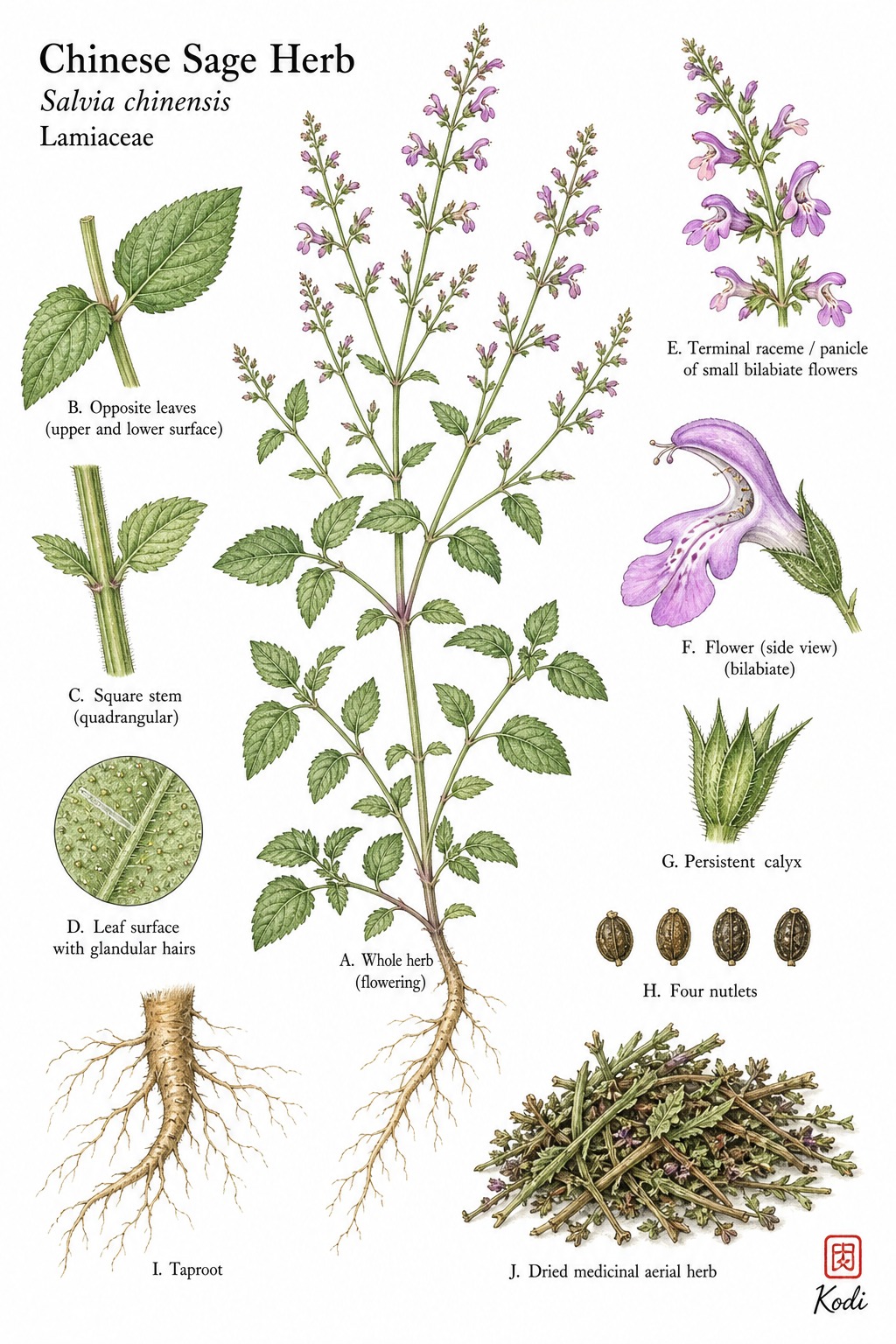
Known in TCM as Shi Jian Chuan (石见穿), this bitter and acrid and bland, slightly cold herb enters the Liver and Spleen. Traditionally, it invigorates blood and resolves stasis - Shi Jian Chuan is used for amenorrhea, postmenstrual or postpartum abdominal pain, fixed painful obstruction, and masses where stagnant blood and constrained heat bind together, most often applied for scrofula, carbuncle, and hepatitis. Modern research has identified Rosmarinic among its active constituents.
Part used: Whole herb
Also Known As
Latin: Herba Salviae Chinensis | Pinyin: Shi Jian Chuan | Chinese: 石见穿
TCM Properties
- Taste
- bitter, acrid, bland
- Temperature
- slightly cold
- Channels
- Liver, Spleen
Traditional Use
Primary Actions
- Invigorates blood and resolves stasis - Shi Jian Chuan is used for amenorrhea, postmenstrual or postpartum abdominal pain, fixed painful obstruction, and masses where stagnant blood and constrained heat bind together.
- Clears heat and resolves toxicity - the herb is traditionally chosen for carbuncles, scrofula, swollen nodules, sore inflammatory lesions, and toxic accumulations that have not yet softened or discharged cleanly.
- Dissipates nodules and reduces swelling - beyond simple detoxification, it has a specific reputation for firm masses, breast-area lumps, neck swellings, and stubborn obstructive lesions associated with phlegm, stasis, and heat.
- Clears damp-heat and promotes elimination - classical indications extend to hepatitis, reddish leukorrhea, and phlegm-related asthma or dysphagia when heat and obstruction are more prominent than deficiency.
Secondary Actions
- Shi Jian Chuan sits at an interesting crossroads between blood-moving herbs and heat-toxin-resolving herbs, which is why it appears in both gynecologic stasis patterns and toxic nodule patterns.
- Later clinical practice often pairs it with anticancer and nodule-softening herbs such as Bai Hua She She Cao, Ban Zhi Lian, Xia Ku Cao, or Zhe Bei Mu, but those uses should not be confused with proof of standalone clinical efficacy.
Classic Formulas
- Shi Jian Chuan with Bai Hua She She Cao and Ban Zhi Lian - later clinical pairing logic for hard masses, toxic swellings, and blood-stasis heat patterns in which dispersal and detoxification are both required.
- Shi Jian Chuan with Xia Ku Cao, Hai Zao, and Zhe Bei Mu - nodule-dissipating pairing logic for scrofula, neck swellings, and phlegm-fire masses with local tenderness or firmness.
- Shi Jian Chuan with Yin Chen, Ban Zhi Lian, and damp-heat-clearing herbs - internal-use strategy for hepatitis-type presentations where toxic heat, constrained blood, and dampness overlap.
Classical References
- TCM Wiki lists Shi Jian Chuan as bitter, pungent, and slightly cold, entering the Liver and Spleen channels, with actions of activating blood, clearing heat, promoting urination, and dissipating nodules for scrofula, carbuncle, hepatitis, dysphagia, asthma due to phlegm, and reddish leukorrhea.
- American Dragon presents a broader traditional picture, adding amenorrhea, postmenstrual pain, postpartum abdominal pain, arthralgia, and various cancer-related folk indications to the herb's blood-moving and detoxifying functions.
- Me and Qi classifies Shi Jian Chuan among blood-invigorating herbs while also emphasizing its ability to clear toxic heat, which helps explain why it bridges gynecologic stasis indications and swollen-mass indications.
Modern Research
Active Compounds
- Rosmarinic acid and related rosmarinate esters - caffeic-acid-derived phenolics isolated from Salvia chinensis and relevant to antioxidant and anti-inflammatory interpretation
- Salvianolic acid A - major salvianolic phenolic acid identified from the herb and plausibly linked to its blood-moving and antioxidant profile
- Salvianolic acid C and related salvianolate derivatives - additional polyphenolic constituents isolated from ethyl-acetate fractions of Salvia chinensis
- Salviachinensines A-F - antiproliferative phenolic derivatives isolated specifically from Salvia chinensis in modern natural-products research
- Quercetin, beta-sitosterol, and the SC4 acidic polysaccharide fraction - representative small-molecule and macromolecular constituents highlighted in modern mechanistic studies
Studied Effects
- Salvia chinensis aqueous extract inhibited triple-negative breast cancer progression in cell and animal models by inducing DNA-damage responses, and the study highlighted quercetin and beta-sitosterol as key constituents (PMID 36033499).
- Natural-products research isolated salviachinensines A-F from Salvia chinensis and identified them as antiproliferative phenolic derivatives, supporting the herb's longstanding association with hard masses and oncology-adjunct use in TCM settings (PMID 30370766).
- An acidic polysaccharide fraction named SC4 increased B-lymphocyte proliferation and protected PC12 cells against hydrogen-peroxide injury, suggesting immunomodulatory and cytoprotective potential beyond the herb's anticancer focus (PMID 11866878).
- Phytochemical work on the ethyl-acetate extract isolated rosmarinic acid, salvianolic acid A, salvianolic acid C, and related derivatives, broadening the modern rationale for anti-inflammatory and circulation-related effects (PMID 23947137).
PubMed References
- Salvia chinensis Benth Inhibits Triple-Negative Breast Cancer Progression by Inducing the DNA Damage Pathway (2022)
- Salviachinensines A-F, Antiproliferative Phenolic Derivatives from the Chinese Medicinal Plant Salvia chinensis (2018)
- Structural characterization and biological activities of SC4, an acidic polysaccharide from Salvia chinensis (2002)
- Chemical constituents of Salvia chinensis (2013)
Safety & Interactions
Contraindications
- Pregnancy
- Active heavy bleeding without a clear blood-stasis component
- Spleen deficiency-cold with chronic loose stools
Cautions
- Because Shi Jian Chuan moves blood and disperses stasis, it should be used cautiously in patients with unexplained bleeding, perioperative situations, or concurrent anticoagulant use even though formal human interaction data remain limited
- Most modern oncology data for Shi Jian Chuan remain preclinical and should not be interpreted as evidence that the herb can replace cancer-directed medical treatment
- Traditional sources vary somewhat on channel assignment and exact thermal nature, so formula context matters more than any single simplified herb summary
- MSK page not found - drug interaction data not available from Memorial Sloan Kettering integrative medicine database
Conditions
Frequently Asked Questions
What is Chinese Sage Herb used for?
Chinese Sage Herb is traditionally used to Invigorates blood and resolves stasis - Shi Jian Chuan is used for amenorrhea, postmenstrual or postpartum abdominal pain, fixed painful obstruction, and masses where stagnant blood and constrained heat bind together., Clears heat and resolves toxicity - the herb is traditionally chosen for carbuncles, scrofula, swollen nodules, sore inflammatory lesions, and toxic accumulations that have not yet softened or discharged cleanly., Dissipates nodules and reduces swelling - beyond simple detoxification, it has a specific reputation for firm masses, breast-area lumps, neck swellings, and stubborn obstructive lesions associated with phlegm, stasis, and heat., Clears damp-heat and promotes elimination - classical indications extend to hepatitis, reddish leukorrhea, and phlegm-related asthma or dysphagia when heat and obstruction are more prominent than deficiency.. Research has investigated its effects on: Salvia chinensis aqueous extract inhibited triple-negative breast cancer progression in cell and animal models by inducing DNA-damage responses, and the study highlighted quercetin and beta-sitosterol as key constituents (PMID 36033499).; Natural-products research isolated salviachinensines A-F from Salvia chinensis and identified them as antiproliferative phenolic derivatives, supporting the herb's longstanding association with hard masses and oncology-adjunct use in TCM settings (PMID 30370766)..
What are other names for Chinese Sage Herb?
Chinese Sage Herb is also known as Salvia. In TCM: 石见穿 (Shi Jian Chuan); Herba Salviae Chinensis.
Is Chinese Sage Herb safe during pregnancy?
Chinese Sage Herb is not recommended during pregnancy.
What are the contraindications for Chinese Sage Herb?
Chinese Sage Herb should not be used in: Pregnancy; Active heavy bleeding without a clear blood-stasis component; Spleen deficiency-cold with chronic loose stools. Consult a qualified healthcare provider before use.